
Yes, influencer marketing works under fintech compliance rules, but only when the compliance review happens before a creator posts, not after. The FTC's Endorsement Guides, updated in 2023, plus SEC and FINRA rules for regulated financial communications, don't ban creator content on TikTok or Instagram — they dictate what a creator can say, how disclosures appear, and who signs off before it goes live. Skip that layer and the app, not the creator, absorbs the regulatory risk.
- Influencer marketing works under fintech compliance rules when scripts get legal review before publishing, not after.
- FTC Endorsement Guides (updated 2023) require clear, unavoidable disclosure of paid or gifted relationships on every post.
- Broker-dealers and registered investment advisers face added review under FINRA Rule 2210 and the SEC Marketing Rule (compliance date 2022).
- Organic UGC without whitelisting or paid boosting carries less compliance overhead than paid influencer spend on a fintech app.
- The Viral App builds fintech creator campaigns around a compliance-first script and approval workflow, not a lift-and-ship model.
Why this matters
A fintech app that treats influencer content like a fitness or education app's UGC gets a script that says "guaranteed returns" or "no fees ever" from a creator who has no idea what a material claim is. That single clip can trigger FTC scrutiny, a platform takedown, or a compliance letter from a bank partner. The Viral App works with fintech clients specifically because the creator side and the compliance side rarely talk to each other without a third party managing both.
The rules aren't new. What's changed by 2026 is enforcement pressure: state regulators and the FTC have both signaled more attention to financial influencer content, and app store review teams increasingly flag fintech apps with unsubstantiated claims in linked creator videos. Compliance isn't optional friction anymore — it's the difference between a campaign that survives an audit and one that gets an app pulled.
Can influencer marketing work under fintech compliance rules?
It works when the campaign is structured around three checkpoints: script approval, disclosure placement, and record retention. Here's how the risk breaks down by content type.
| Content type | Compliance exposure | Best for |
|---|---|---|
| Organic unpaid UGC (no brand payment, no boosting) | Lowest — still needs FTC material-connection disclosure if a free product/app access was given | Early-stage fintech apps testing creator fit |
| Paid sponsored post (creator paid flat fee) | Moderate — requires disclosure + script pre-approval for regulated claims | Growth-stage apps with a compliance or legal contact |
| Whitelisted/Spark Ads (brand runs paid media through creator handle) | Highest — brand is the advertiser of record, full ad-review liability applies | Apps with in-house or agency compliance sign-off already in place |
| Regulated-entity content (broker-dealer, bank, RIA-affiliated app) | Highest, plus FINRA Rule 2210 or SEC Marketing Rule review | Apps operating under a licensed financial entity |
Verdict: influencer marketing is viable for fintech apps in 2026, but the campaign structure has to match the entity type — a licensed broker-dealer app cannot run the same loose creator brief as a budgeting or expense-tracking app with no license requirement.
Why compliance risk varies by fintech app type
Not every fintech app carries the same regulatory weight, and the creator brief should reflect that difference:
- Licensing status — a registered broker-dealer or investment adviser falls under FINRA Rule 2210 and the SEC Marketing Rule (compliance date 2022), which govern how performance and testimonials can be shown publicly.
- Claim type — APR figures, guaranteed returns, FDIC insurance language, and "no risk" framing are the highest-scrutiny phrases and need legal sign-off before a creator records anything.
- Payment structure — paid or gifted relationships trigger FTC material-connection disclosure under the 2023 Endorsement Guides regardless of platform.
- Record retention obligations — regulated entities must keep records of public communications, which means creator content needs an internal archive, not just a public post.
- State-level licensing — money transmitter and lending apps can face additional state disclosure rules layered on top of federal ones.
- Platform enforcement — TikTok and Instagram both apply their own branded-content disclosure tools on top of legal requirements, and skipping the platform tag is a separate violation from skipping the legal one.
“If a creator's script mentions APR, guaranteed returns, or FDIC insurance, compliance has to see it before it posts, not after it goes viral.”
The compliance-safe UGC workflow for fintech apps
The structure that keeps fintech influencer campaigns clean in 2026 looks like this: brief with pre-approved claim language, creator drafts a script, compliance reviews before filming, legal signs off on regulated claims, then the post goes live with disclosure tags active from the first frame.
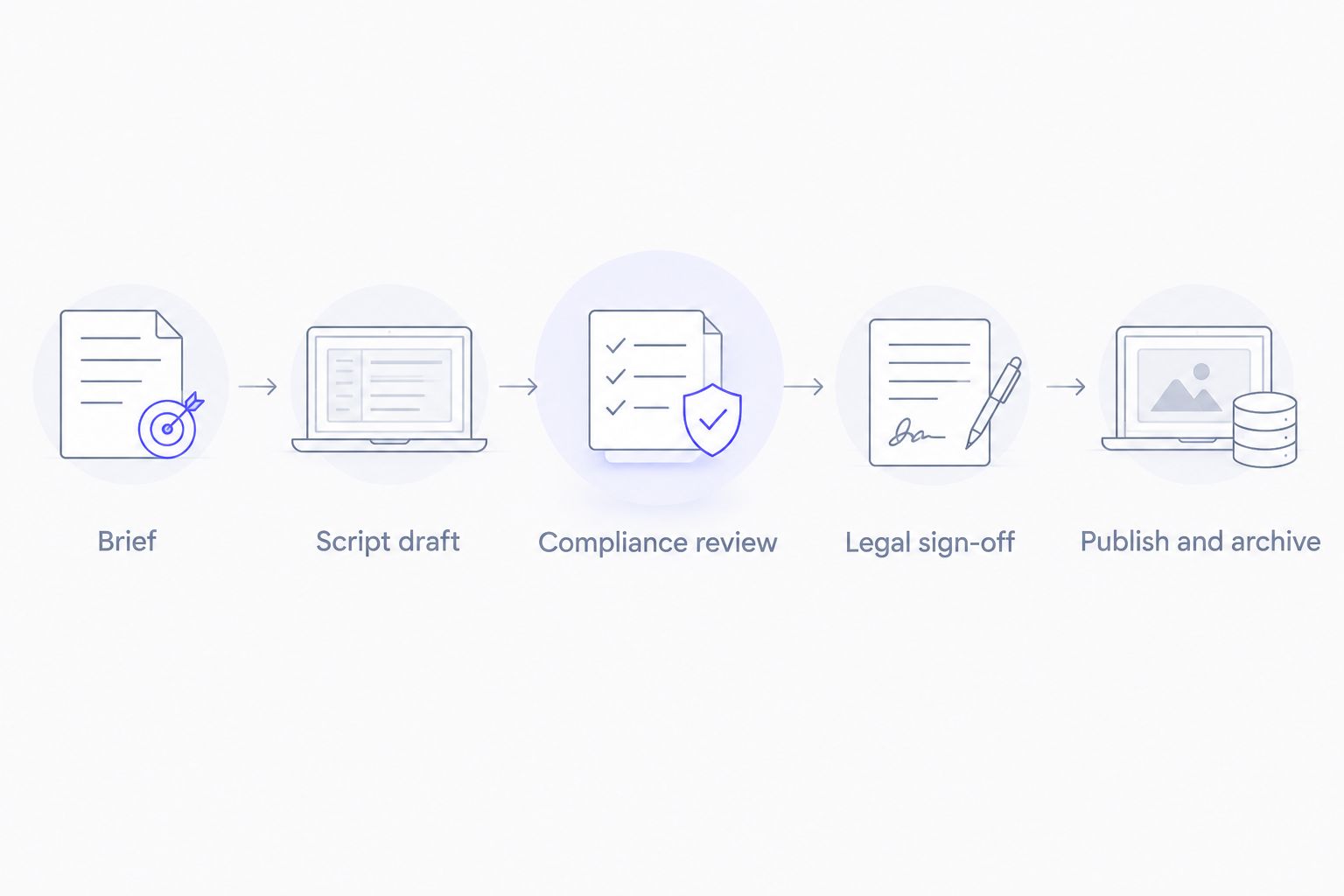
Skipping the compliance-review step is the single most common reason fintech creator campaigns get pulled after launch. Adding it doesn't kill creative freedom — it just moves the review earlier, so the creator never films a claim that legal would reject anyway.
Is organic TikTok content safer than paid whitelisting for fintech apps?
Organic, unboosted UGC carries lower compliance exposure than whitelisted or Spark Ads content, because the brand isn't the advertiser of record on an organic post. Once a fintech app pays to boost a creator's video or runs it through Ads Manager under the creator's handle, the brand inherits full ad-review liability, including any regulated claim in the original script.
Do TikTok creators need FINRA approval to promote a fintech app?
The creator doesn't need FINRA registration, but the content does need internal review when the app is affiliated with a broker-dealer or registered investment adviser under FINRA Rule 2210. A creator working with a budgeting or neobank app without broker-dealer status typically faces FTC disclosure rules only, not FINRA review.
Who is liable if a creator makes a false claim about a fintech app?
The brand is liable first under FTC enforcement, even when the creator wrote the script themselves. That's why every fintech UGC campaign needs a claim-approval step before filming — the app, not the creator, answers for an unsubstantiated APR or return claim.
Apps that manage this well tend to build a claims library upfront — a short, pre-approved list of what a creator can and can't say — and hand it to every creator before the brief goes out. That single document removes most of the back-and-forth that slows fintech UGC production down compared to a fitness or education app running the same playbook.
Build a compliant fintech creator campaign
Scripts, disclosures, and creator management built around fintech review requirements.
Agencies that specialize in fintech-compliant influencer marketing build the claims library and the approval chain into the campaign timeline from day one, rather than treating legal review as an afterthought bolted onto a standard UGC brief. That's the practical difference between a fintech app that runs TikTok influencer marketing successfully in 2026 and one that gets a takedown notice three weeks into a campaign.
Related questions
Can crypto or web3 apps use influencer marketing under SEC rules?
Crypto and web3 apps face the tightest compliance bar of any fintech category, since token-related claims can trigger securities law questions the SEC actively enforces. Creator content for these apps needs legal review on every script mentioning returns, staking yield, or token value, not just a disclosure tag.
How much does compliance review add to a fintech UGC campaign timeline?
Compliance review is the layer that extends a fintech campaign timeline, not the content production itself — script approval and legal sign-off happen before filming, which is why fintech briefs need to go out earlier than a standard consumer app brief. Budgeting that extra review time into the schedule is what keeps launch dates from slipping.
Does the FTC treat gifted app access the same as paid sponsorship?
Yes — the FTC's 2023 Endorsement Guides treat free app access, credits, or any material benefit the same as a cash payment for disclosure purposes. A creator who got free premium access to a fintech app still has to disclose that relationship clearly on the post.
FAQ
Can influencer marketing work under fintech compliance rules in 2026?
Yes, influencer marketing works under fintech compliance rules in 2026 when scripts get legal review before filming and disclosures follow FTC and, where applicable, FINRA or SEC requirements. Skipping pre-approval is what turns a routine campaign into a compliance problem.
What disclosure language does the FTC require for fintech UGC?
The FTC requires clear, unavoidable disclosure of any paid, gifted, or material relationship between the creator and the app, stated in the post itself rather than buried in a bio link. The 2023 Endorsement Guides update reinforced that platform disclosure tools alone don't satisfy the legal requirement.
Is organic influencer content safer than paid ads for fintech apps?
Organic, unboosted UGC carries lower compliance exposure than paid or whitelisted content because the brand isn't the advertiser of record. Once a fintech app pays to boost the post, full ad-review liability applies to any claim in the script.
Do broker-dealer apps face extra rules for creator content?
Yes, apps affiliated with a broker-dealer or registered investment adviser fall under FINRA Rule 2210 and the SEC Marketing Rule, which govern performance claims and require records of public communications. A neobank or budgeting app without that licensing typically only faces FTC rules.
Can a UGC agency work with a regulated fintech or bank app?
Yes, but the agency needs a compliance-review step built into the workflow — brief, script, legal sign-off, then publish. Agencies without that process tend to produce content that gets flagged after it's already live.
Who is liable for a false claim a creator makes about a fintech app?
The brand is liable first under FTC enforcement, even if the creator wrote the claim themselves. That's why claim approval has to happen before filming, not after a video goes live.
Can crypto apps run influencer marketing under SEC rules?
Crypto and web3 apps can run influencer marketing, but every script mentioning returns or token value needs legal review given SEC scrutiny of securities-related claims. This is the highest-risk fintech subcategory for creator content in 2026.
Does whitelisting increase compliance risk for fintech apps?
Yes, whitelisting or Spark Ads makes the brand the advertiser of record, which means full ad-review liability applies to the creator's original script. Organic posts without paid boosting carry lower exposure by comparison.
One last thing
The fintech apps that run influencer marketing well in 2026 don't treat compliance as a blocker — they treat it as a brief input, the same way they'd brief a creator on brand voice or hook style. Build the claims library once, hand it to every creator before the first draft, and the review step stops being a bottleneck.