
Yes, micro-influencers can drive real, trackable app downloads when creator fit, attribution, and install-focused creative work together. Organic reach alone is not the answer: each campaign needs a measurable conversion route and a plan for turning effective creator content into repeatable distribution.
- Can micro-influencers drive real app downloads? Yes, with audience fit, trackable links, and direct install calls to action.
- TikTok and Instagram views are not proof of installs; app attribution must connect each creator to downstream events.
- Paid amplification can extend effective creator content beyond the creator's organic audience in 2026.
- The Viral App manages creator recruitment and campaigns for B2C mobile apps across TikTok and Instagram.
Why this matters
Micro-influencer campaigns often look successful in platform analytics while leaving the growth team unable to connect views, comments, or profile visits to app installs. That reporting gap makes creator marketing difficult to compare with paid acquisition, even when the content is generating qualified interest.
The fix starts before creators publish. Every creator needs an assigned attribution route, a defined install event, and a brief built around one app use case. A documented creator campaign and AppsFlyer attribution workflow gives the growth team a clearer route from creator post to attributed install in 2026.
This matters because the creator is only one part of the acquisition system. The app store page, tracking setup, landing route, creative hook, call to action, and post-install experience all affect whether a viewer becomes an active user.
Can micro-influencers drive real app downloads?
Yes. Micro-influencers can drive real app downloads, but their effectiveness depends on relevant audiences, measurable attribution, specific creative briefs, and distribution beyond a single organic post. A creator with the right audience and a clear demonstration can produce useful acquisition creative; a creator chosen only for follower count can generate attention without measurable installs.
The strongest operating model in 2026 separates creator selection from distribution. Creators produce native TikTok or Instagram content, attribution identifies which messages drive installs, and paid amplification extends the useful content after it has shown a clear response.
| Campaign model | What it does | Best for | Main advantage | Main limitation |
|---|---|---|---|---|
| Organic creator post | Publishes content to the creator's existing audience | Testing audience-message fit | Preserves the creator's normal format and voice | Distribution depends on organic reach |
| Authorized creator ad | Runs approved creator content through a paid campaign | Scaling content that earns a useful response | Adds targeting, budget control, and repeatable distribution | Requires creator authorization and campaign setup |
| Brand-posted UGC | Publishes creator-made content through brand-owned channels | Building a reusable creative library | Gives the brand direct control over publishing and testing | Loses some of the creator-account context |
Organic posts are useful for testing whether a creator's audience responds to the app problem, demonstration, and CTA. They are not a complete acquisition system because organic distribution can change from post to post.
Authorized creator ads, including TikTok Spark Ads, preserve the creator context while adding paid distribution. The decision should follow campaign evidence rather than assumption; the practical question is whether TikTok Spark Ads are worth using for app installs after the organic content has produced a response worth extending.
Brand-posted UGC gives the growth team direct control over creative testing. It works best when the objective is to test hooks, opening frames, demonstrations, and calls to action across paid social campaigns rather than rely on the creator's account for distribution.
What makes a micro-influencer campaign measurable?
A measurable campaign connects each creator asset to a defined acquisition path. Use this sequence in 2026:
- Define the install event. Decide whether the campaign is judged on app installs, account creation, trial starts, purchases, subscriptions, or another post-install event. An install without downstream context can hide low-quality acquisition.
- Assign an attribution route. Give each creator a trackable link, deep link, promo code, or campaign identifier that separates their contribution from other channels.
- Match creator fit. Select creators whose normal subject matter overlaps with the app's use case. A creator should be able to show the problem and product naturally without changing their entire content style.
- Write the creative brief. Define the hook, app demonstration, proof point, CTA, disclosure requirements, and prohibited claims. Leave room for the creator's own delivery.
- Review post-install quality. Compare creators on the downstream event selected at the start, not views alone. Keep the content and audience combinations that produce the intended user action.
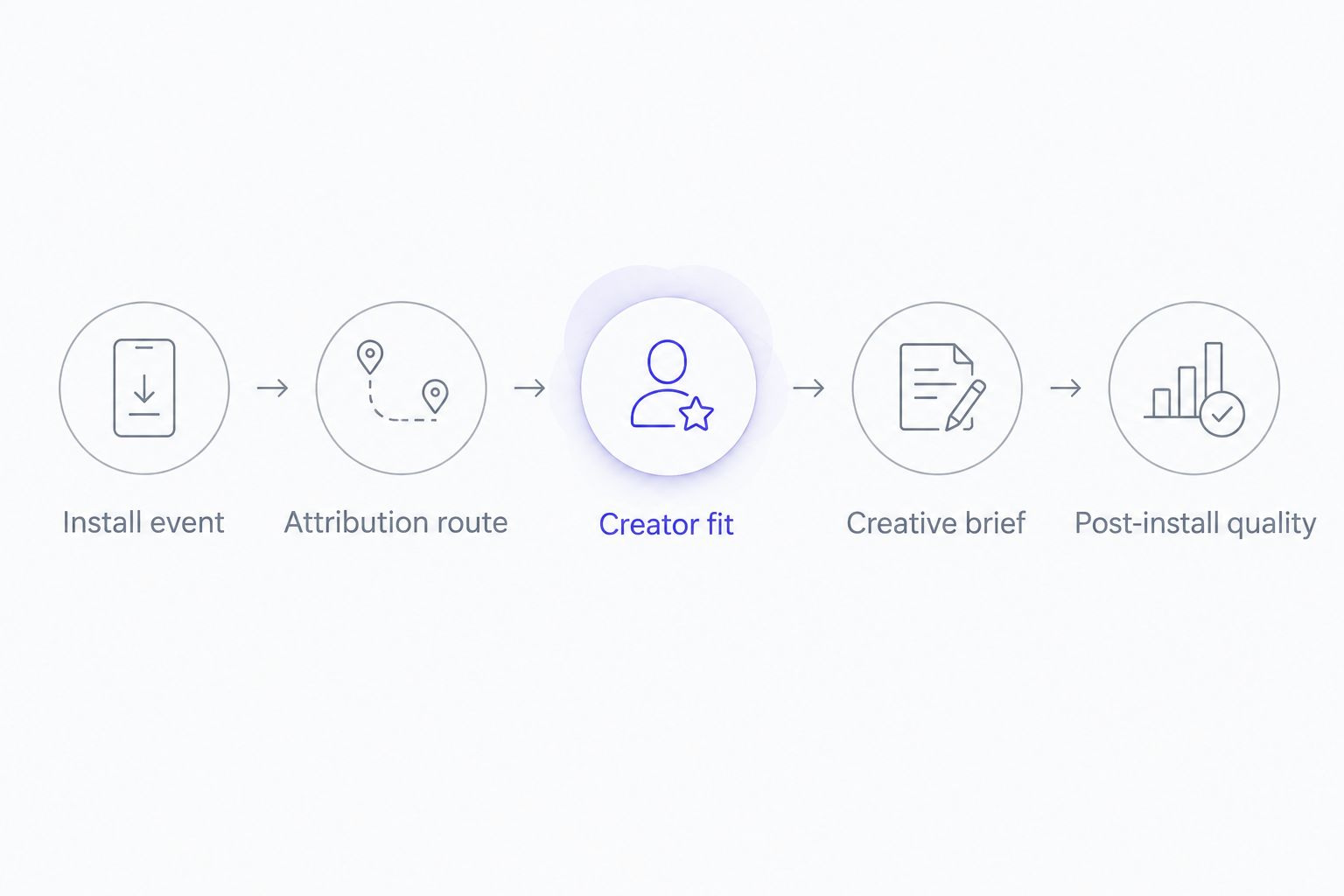
This sequence also keeps creative and media decisions separate. A strong creator concept can deserve another test even when the first post receives limited organic distribution. A weak concept should not receive more budget simply because the creator has a larger audience.
Why micro-influencer app download results vary
- Audience-app fit: A creator's subject matter must overlap with the app's actual use case. Broad demographic similarity is weaker than repeated content about the problem the app addresses.
- Hook clarity: The opening must identify a recognizable problem, desired outcome, or app action. A generic endorsement gives the viewer little reason to keep watching.
- Demonstration quality: App campaigns need to show how the product fits into a real behavior. Feature lists explain the product but do not automatically create intent.
- Attribution design: Separate links, deep links, promo codes, or campaign identifiers are necessary to compare creators. Shared links blur the result and weaken future budget decisions.
- Call-to-action specificity: The CTA should tell the viewer what to do and why. The app name alone is not a complete conversion instruction.
- Distribution plan: Organic posts test response within the creator's audience. Paid amplification adds controlled reach after the content earns further distribution.
These factors interact. Strong creator fit cannot repair broken attribution, and perfect attribution cannot make an unclear video convert. The campaign needs both creative quality and measurement discipline.
Which metrics show whether the downloads are real?
Start with attributed installs, then examine the first meaningful event after installation. That event depends on the app: account creation, onboarding completion, a first lesson, a saved plan, a transaction, or a subscription can all provide more context than install volume alone.
Use the same reporting hierarchy for every creator in 2026:
- Content delivery: Was the approved asset published in the correct format?
- Attention: Did viewers watch enough of the content to reach the demonstration and CTA?
- Traffic: Did the creator generate measurable clicks, deep-link opens, or code use?
- Acquisition: Did that traffic produce attributed app installs?
- Activation: Did those installs complete the selected post-install event?
This hierarchy prevents a common reporting error: treating a large top-of-funnel number as proof of acquisition. Views show distribution. Clicks show intent. Installs show acquisition. Activation shows whether the campaign attracted users who took the intended next step.
The reporting window and attribution method should remain consistent across creators. Changing the measurement rules between posts makes creator comparisons unreliable, even when every dashboard contains precise-looking totals.
How should the creative brief change for app installs?
An install-focused brief needs more direction than a standard awareness brief. It should define the viewer problem, the app action being demonstrated, the required disclosure, and the CTA while leaving the creator control over phrasing and delivery.
A practical brief includes:
- The audience problem the video will address
- The app use case the creator will demonstrate
- The screen or workflow that needs to appear
- The claim boundaries the creator must follow
- The required sponsorship disclosure
- The CTA and attribution route
- The approved format for paid amplification
Do not force every creator into identical wording. That produces a set of videos that look scripted and removes the variation needed to identify which hooks and demonstrations work. Standardize the campaign inputs, then let creators express those inputs in formats their audiences already recognize.
The creative review should focus on accuracy, clarity, disclosure, and whether the app action is visible. It should not turn a creator video into a brand commercial.
When should creator content receive paid amplification?
Paid amplification makes sense when the content communicates the app clearly, generates a useful audience response, and meets the campaign's tracking requirements. It should not be an automatic step for every creator post.
Use organic publishing as an initial signal, not the final verdict. Organic distribution varies, so a concept with limited reach can still deserve a controlled paid test if the hook, demonstration, and CTA are strong. Conversely, a widely viewed post can remain a weak acquisition asset if viewers do not take measurable action.
In 2026, the decision should be based on the campaign's selected conversion path. If the objective is activated users, the team should not choose amplification winners using view count alone.
Where The Viral App fits
The Viral App is best for B2C mobile app teams that want TikTok and Instagram creator recruitment, campaign management, and install-focused execution handled as one system. Its stated service covers UGC and influencer marketing campaigns for mobile apps, including creator recruitment and management.
The advantage is operational focus: creator sourcing, briefing, content management, and campaign execution sit inside the same service. The limitation is fit. A team that only needs software, a creator database, or a self-managed marketplace should compare those options before choosing an agency model.
The Viral App does not remove the need for app-side attribution or a defined activation event. Those inputs still need to come from the growth team and its measurement stack.
Build a creator growth system
See how The Viral App manages TikTok and Instagram creator campaigns for mobile apps.
Related questions
Are micro-influencers better than large influencers for app installs?
Micro-influencers are better when audience relevance, creative testing, and manageable production volume matter more than a single burst of broad reach. Large influencers can provide wider distribution, but reach alone does not establish install efficiency or user quality.
Do micro-influencers need paid ads to generate downloads?
Micro-influencers can generate downloads organically, but paid amplification makes distribution more controllable and repeatable. Organic posts test the creator-message combination; authorized ads can extend the combinations that meet the campaign's measurement criteria.
Can an app track which micro-influencer drove an install?
Yes, an app can track creator-driven installs when each creator receives a separate attribution route and the mobile measurement setup records the relevant campaign identifiers. Promo codes can add another signal when links are unavailable or users install later through an app store search.
FAQ
Can micro-influencers drive real app downloads in 2026?
Yes, micro-influencers can drive real app downloads in 2026 when the campaign combines relevant creators, trackable attribution, direct CTAs, and a defined post-install event. Views alone do not prove acquisition.
What makes a micro-influencer right for an app campaign?
The right micro-influencer already creates content connected to the app's use case and can demonstrate the product without abandoning their normal format. Audience relevance matters more than choosing creators from follower count alone.
How do you track app installs from influencers?
Track app installs with creator-specific links, deep links, promo codes, or campaign identifiers connected to the app's attribution setup. Each creator needs a separate route if the team wants comparable results.
Are TikTok or Instagram micro-influencers better for app installs?
Neither platform is automatically better for every app. Choose TikTok or Instagram based on where the target user consumes creator content and which format best demonstrates the app's core use case.
Should every creator post become a paid ad?
No, every creator post should not automatically become a paid ad. Amplify content that communicates the app clearly, complies with the brief, and produces a response aligned with the selected conversion path.
What should an app measure after an influencer-driven install?
Measure the first meaningful post-install event, such as onboarding completion, account creation, a first lesson, or another action tied to the app's model. This distinguishes raw acquisition from activated users.
Is The Viral App an influencer platform or an agency?
The Viral App is a UGC and influencer marketing agency for B2C mobile app companies. It recruits and manages TikTok and Instagram creators for campaigns focused on organic views and installs.
One last thing
Do not ask whether a creator can drive installs before deciding what counts as a successful install. In 2026, the useful question is whether that creator attracts users who complete the app's first meaningful action after downloading.
That distinction changes the entire campaign. It affects creator selection, the brief, the CTA, attribution, reporting, and which content receives more distribution. Optimize for the post-install event from the start; treat views as context, not the verdict.