TikTok influencer marketing is worth it in 2026 for B2C apps that combine relevant creators, reliable attribution, paid distribution, and continuous creative testing. It is not worth it as a one-off sponsored post with no system for identifying and scaling the content that drives installs.
- TikTok influencer marketing is worth it in 2026 when creator fit, attribution, paid distribution, and testing work together.
- Organic creator posts build awareness but provide weaker install attribution than tracked paid distribution.
- Spark Ads make creator content scalable, but they do not rescue weak hooks or poor audience fit.
- The Viral App is best for B2C app teams needing managed creator recruitment, campaigns, and handoff.
Is TikTok influencer marketing worth it in 2026?
Yes. TikTok influencer marketing is worth it when you treat creators as a source of testable content rather than renting access to an audience for one post. The Viral App applies that model to B2C mobile apps by recruiting and managing TikTok and Instagram creators around organic views and installs.
The right approach depends on what the campaign must accomplish. Organic posts, Spark Ads, and hybrid programs have different strengths and limitations.
| Approach | Best for | Main advantage | Main limitation | Verdict |
|---|---|---|---|---|
| Organic creator posts | Awareness and social proof | Content appears in the creator's normal feed | Install attribution is less direct | Use for discovery |
| Whitelisted Spark Ads | Paid distribution and install campaigns | Advertisers can promote creator content | Weak creative still fails when promoted | Use after testing |
| Hybrid creator programs | Ongoing app growth | Connects organic learning with paid scaling | Requires campaign management and frequent iteration | Best overall system |
| One-off sponsored posts | A narrow launch moment | Simple campaign scope | Produces little repeatable learning | Skip as a growth engine |
TikTok influencer marketing is worth it in 2026 when every creator post feeds a repeatable process for testing hooks, measuring installs, and scaling winners. Reach alone is not the decision criterion.
Why this matters
TikTok can generate attention without generating profitable app users. A video can receive organic views while producing limited install data, weak retention signals, or no clear explanation of which message worked.
That gap changes how app teams should evaluate influencer marketing in 2026. The campaign needs to connect creator selection, content production, attribution, and paid distribution. If one part is missing, the team cannot separate a strong creator from a strong hook or a temporary view spike from useful acquisition.
The practical question is not whether creators can attract views. It is whether the campaign turns creator activity into evidence your growth team can use for the next brief, ad set, and creative decision.
Organic creator posts: best for awareness and social proof
Organic posts are useful when you need native demonstrations, testimonials, tutorials, or problem-led stories around an app. A fitness creator can show where an app fits into a workout routine, while an education creator can demonstrate a study workflow. The format gives potential users context that a polished brand advertisement often lacks.
The limitation is measurement. An organic post can influence searches, profile visits, and later installs without receiving direct credit. Promo codes and tracked links help, but they do not capture every path between watching a video and installing an app.
Use organic TikTok influencer marketing when awareness, content learning, and social proof are valid outcomes. Skip an organic-only program when the sole success metric is directly attributed installs.
Whitelisted Spark Ads: best for paid distribution
Spark Ads let advertisers promote eligible creator content while preserving the post's native identity and engagement. That makes whitelisting useful when a creator video has a strong hook, clear app demonstration, and credible delivery but needs more distribution than organic reach provides.
Paid distribution also creates a cleaner testing environment. Your team can compare creative variants against the same campaign objective and audience structure instead of judging posts solely by organic views. The result is more actionable than a leaderboard based on reach.
Whitelisting does not fix a weak concept. Putting budget behind an unclear demonstration or mismatched creator distributes the problem faster. Use Spark Ads to scale validated creator content, not to avoid creative testing.
Hybrid programs: best for repeatable app growth
A hybrid program connects organic creator production with paid testing. Creators produce multiple concepts, the growth team identifies useful hooks, and selected posts move into paid distribution. Insights from performance then shape the next creator brief.
This model gives each post more than one job. A video can generate organic engagement, supply paid creative, reveal audience objections, and inform future positioning. The campaign becomes a learning system rather than a collection of disconnected sponsorships.
The drawback is operational complexity. Someone must recruit creators, manage briefs, secure the required permissions, review content, organize assets, and connect results to the next production cycle. Choose a hybrid program when your team can support that operating rhythm or assign it to a specialist.
Why TikTok influencer marketing results vary
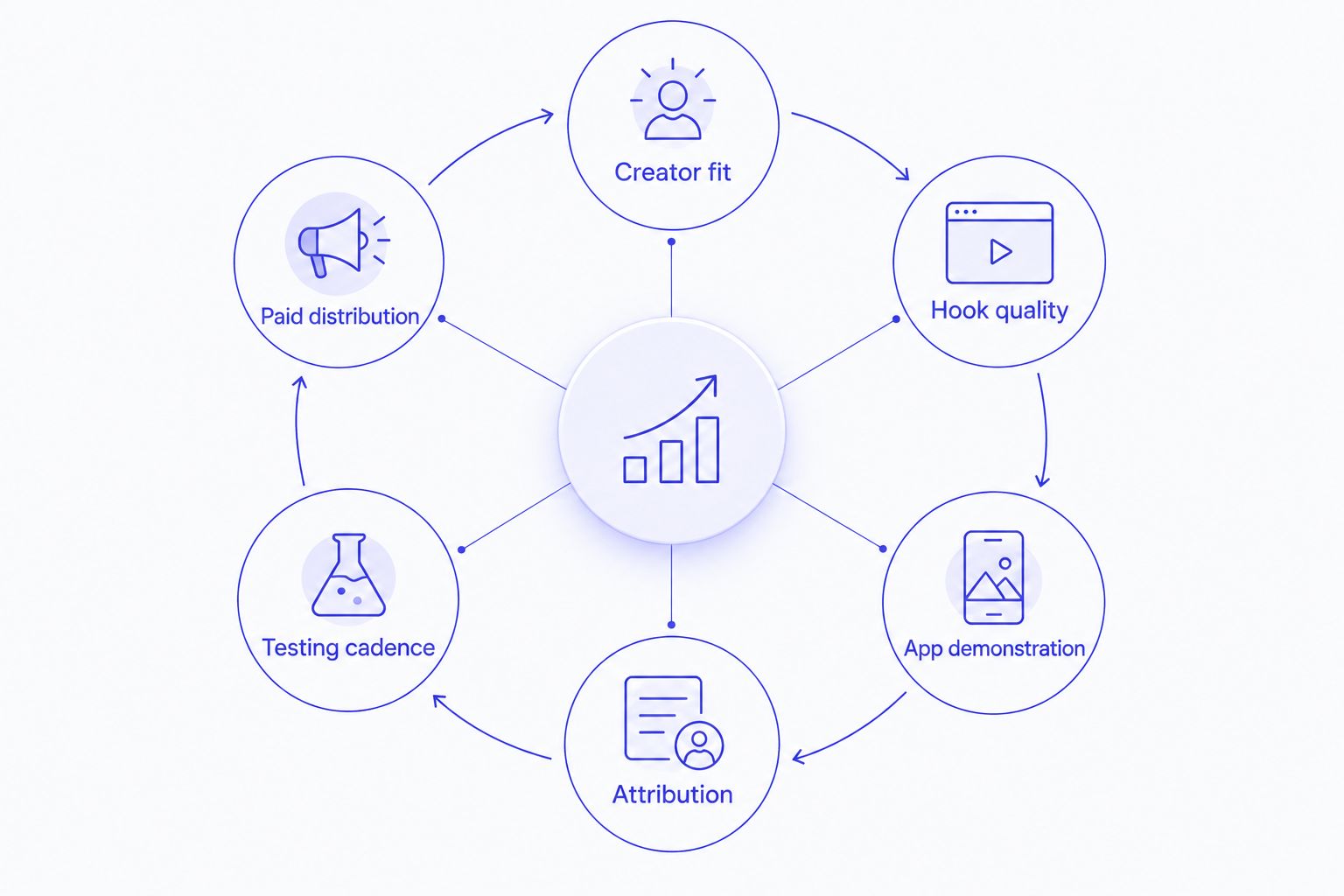
Campaign results vary because influencer marketing combines creative, audience, media, and measurement decisions. Follower count cannot compensate for weaknesses across the rest of the system.
- Creator fit: The creator's audience and normal subject matter should match the app's buyer, use case, and tone.
- Hook quality: The opening must surface a recognizable problem, outcome, or moment of curiosity before explaining the app.
- App demonstration: Viewers need to see what the app does and why it belongs in the creator's story.
- Attribution: Tracked links, app attribution, and campaign naming must connect activity to installs and downstream behavior.
- Testing cadence: New hooks and creator combinations need regular evaluation instead of waiting for one concept to recover.
- Paid distribution: Strong organic content needs a defined path into whitelisting or another paid creative workflow.
A campaign fails when these decisions are treated as separate handoffs. The creator receives a generic brief, the media buyer receives unlabeled assets, and the app team sees installs without knowing which message caused them.
Where The Viral App fits
The Viral App is best for B2C mobile app teams that need creator recruitment, campaign management, organic content, and install-focused execution managed as one system. Its stated focus covers TikTok and Instagram creators for categories such as fitness, education, and fintech apps.
The advantage of an agency-managed program is ownership of the coordination layer: sourcing creators, managing content, and keeping the campaign tied to growth objectives. The tradeoff is that an external team adds a handoff, so briefs, approval responsibilities, attribution access, and reporting definitions still need clear owners inside the app company.
The Viral App is not the automatic choice for every team. An app company with established creator relationships, internal campaign managers, and a working creative-testing operation can keep the program in-house. A team without those capabilities is more likely to benefit from managed TikTok influencer marketing.
Build your creator testing system
See how The Viral App manages creator campaigns for B2C mobile apps.
How to decide whether TikTok is worth it for your app
Start with the operating requirements, not the platform's potential reach. TikTok influencer marketing is a fit when your team can answer each of these questions clearly:
- Who is the exact app user the creator needs to reach?
- Which app behavior or use case should the video demonstrate?
- What separates a strong hook from a weak one?
- How will installs and downstream actions be attributed?
- Which content can move into paid distribution?
- Who turns campaign findings into the next brief?
If those answers exist, TikTok gives your team a channel for producing native content and testing messages in public. If they do not, the first campaign will generate activity without producing a reliable playbook.
Write the measurement plan before recruiting creators. Define the event that matters after installation, establish campaign naming, and decide how organic and paid results will be reviewed. This prevents views from becoming the default success metric simply because they are visible.
The final decision is operational: run TikTok influencer marketing when you can support repeated production, attribution, and iteration; wait when the plan depends on one creator delivering one breakout post.
Is TikTok influencer marketing better than paid ads?
TikTok influencer marketing and paid ads solve different parts of the same acquisition problem. Creators supply native concepts, demonstrations, and delivery; paid distribution supplies targeting, controlled spend, and repeatable reach.
For app marketers, the stronger setup combines them. Organic posts reveal useful hooks, and paid campaigns distribute the strongest content under a defined objective. Choosing one channel exclusively removes either the creator insight or the controlled distribution.
How do you measure whether TikTok influencer marketing worked?
Measure TikTok influencer marketing across creative, acquisition, and post-install performance. Views and engagement explain whether the content earned attention, while attributed installs and downstream app events explain whether that attention reached the right users.
Review creator performance separately from concept performance. A strong hook can work across several creators, while a credible creator can underperform with the wrong script. Keeping those variables separate gives the next production cycle a specific action rather than a vague instruction to make better content.
In 2026, the measurement standard should also distinguish organic contribution from paid results. Combining both into one total hides whether distribution, creative, or creator fit produced the outcome.
Is one TikTok creator enough for an app campaign?
One creator can produce useful content, but one creator cannot establish whether the result came from the audience, the hook, the presentation, or timing. A repeatable campaign needs variation across creators or concepts so the team can compare outcomes and retain what works.
If budget or management capacity is limited, prioritize deliberate variation over broad recruitment. Different openings, demonstrations, and calls to action generate more useful learning than repeating one script across similar accounts.
Is TikTok influencer marketing dead in 2026?
No. TikTok influencer marketing is not dead in 2026, but the one-off sponsorship model is a weak foundation for app growth. The channel remains useful when creator content connects to attribution, paid distribution, and continuous testing.
The outdated assumption is that a creator's follower count predicts campaign value by itself. App marketers need evidence that the audience fits, the content explains the product, and the resulting users complete meaningful actions after installing.
FAQ
Is TikTok influencer marketing worth it in 2026?
Yes, TikTok influencer marketing is worth it in 2026 for B2C apps with relevant creators, reliable attribution, paid distribution, and continuous testing. It is not a dependable growth system when limited to one sponsored post.
What is the best TikTok influencer marketing model for apps?
A hybrid program combining organic creator posts with paid distribution is the best model for repeatable app growth. Organic content supplies creative learning, while whitelisting gives validated posts controlled reach.
Is TikTok influencer marketing better than TikTok ads?
Neither is universally better because they perform different jobs. Influencer marketing supplies native creator content, while TikTok ads provide controlled distribution and campaign measurement.
How much does TikTok influencer marketing cost?
TikTok influencer marketing cost depends on creator selection, content scope, usage permissions, whitelisting, management, and paid media. Check current campaign requirements instead of using a static price as the decision rule.
Do organic TikTok posts drive app installs?
Organic TikTok posts can influence app installs, but direct attribution is less complete than tracked paid distribution. Use organic content for awareness and creative learning, then connect strong posts to a measurable acquisition workflow.
Are Spark Ads worth it for mobile apps?
Spark Ads are worth it when the underlying creator content has a clear hook, credible app demonstration, and relevant audience. Paid distribution cannot repair weak creative or poor creator fit.
Should an app use an influencer marketing agency?
An agency is useful when the app team needs help recruiting creators, managing campaigns, and maintaining a production system. An experienced in-house team with established creator operations can manage the work directly.
What makes a TikTok influencer campaign fail?
TikTok influencer campaigns fail when creator fit, briefs, attribution, or the path to paid distribution is unclear. Follower count and organic views do not replace a defined testing and measurement process.
One last thing
The best creator asset is not always the post with the most visible engagement. A video with a clear app demonstration and a reusable hook can be more valuable because it informs paid creative, future briefs, and positioning across channels.
That is the 2026 decision rule: judge TikTok influencer marketing by the quality of the growth system it creates, not by whether one post looks viral. The Viral App's model is built for app teams that want creator campaigns to become an internal growth engine rather than a permanent series of isolated sponsorships.