TikTok Spark Ads are worth it for app installs in 2026 when a creator post has already demonstrated audience interest and your attribution setup can connect paid delivery to installs. They are not worth using as a shortcut around creative testing: the format amplifies an existing post but cannot repair a weak hook, unclear app value, or mismatched store listing. A structured UGC-to-Spark Ads workflow keeps organic validation before paid distribution.
- TikTok Spark Ads are worth it for app installs when proven creator posts support measurable paid campaigns.
- Use organic engagement as a screening signal, not as proof that a post will drive installs.
- Authorization, attribution and creative rotation must be ready before paid delivery starts.
- The Viral App is best for B2C app teams needing managed creator recruitment and UGC campaigns.
Why this matters
Spark Ads combine two systems that app marketers often manage separately: creator content and paid acquisition. The ad retains the identity and engagement of the original TikTok post while adding paid targeting, delivery and an app-focused call to action.
That structure creates an operational dependency. The creator must publish or authorize the post, the advertiser must connect it to the correct ad account, and the app team must measure what happens after the click. If one part fails, install performance becomes difficult to diagnose.
The Viral App works in this gap as a UGC and influencer marketing agency for B2C mobile apps. Its stated role is recruiting and managing TikTok and Instagram creators to drive organic views and installs, which directly addresses the creator-supply side of a Spark Ads program.
Is TikTok Spark Ads worth it for app installs in 2026?
Yes, TikTok Spark Ads are worth it for app installs in 2026 when you have validated creator content, active authorization and install-level attribution. Standard in-feed ads remain the better starting point when you need full control over unpublished creative or want to test concepts before involving creator accounts.
| Option | Best for | Main advantage | Main limitation | Verdict |
|---|---|---|---|---|
| TikTok Spark Ads | Scaling an existing creator or brand post | Preserves the original post identity and engagement | Depends on authorization and the existing post | Use for validated posts |
| Standard TikTok in-feed ads | Testing unpublished ad creative | Gives the advertiser direct control over the ad asset | Does not carry an existing post's public engagement | Use for controlled tests |
| Organic creator posts | Learning which messages attract attention | Generates audience feedback without paid amplification | Organic attention alone does not prove install efficiency | Use before scaling |
The right choice is not Spark Ads versus every other TikTok format. A practical 2026 system uses organic posts to identify promising messages, standard ads when controlled testing is needed, and Spark Ads when the original post itself contributes useful context or social proof.
Spark Ads should be judged against an app acquisition target, not against view count alone. A post can attract views and comments while producing few installs, so the final decision requires downstream attribution data.
What Spark Ads change in an app-install campaign
A Spark Ad uses an existing TikTok post as the advertising asset. The promoted version keeps the original account identity, caption and public engagement instead of presenting the video as a separate dark ad.
For app marketers, that changes the creative unit in three ways:
- The creator identity remains visible. Users can associate the message with the account that originally published it.
- Engagement stays attached to the post. Paid interactions contribute to the same public post rather than a separate copy.
- Authorization becomes part of campaign operations. The advertiser needs access through a linked account or a creator-provided authorization code.
Those differences matter when the creator's delivery and existing discussion add context to the app demonstration. They matter less when the video is interchangeable, the comments introduce objections, or the campaign requires frequent edits that would be easier with advertiser-owned creative.
How to decide if a post is ready for Spark Ads
Use a sequence that separates creative validation from paid scaling. Skipping steps makes it impossible to tell whether the problem is the video, the audience, the store listing or the measurement setup.
- Confirm the app promise. The post should communicate one clear use case that matches the experience shown on the App Store or Google Play listing.
- Review organic response. Look at watch behavior, saves, shares, comments and profile actions together. A large view count without meaningful follow-up is not enough.
- Check comment quality. Questions about how the app works can support the ad. Confusion about the product or claims signals that the creative needs revision.
- Secure authorization. Confirm the post, account, access period and ad account before scheduling spend.
- Verify attribution. Test the app link and confirm that the selected attribution platform receives the expected install and post-install events.
- Set a rotation plan. Prepare additional creator posts so one asset does not carry the entire campaign.
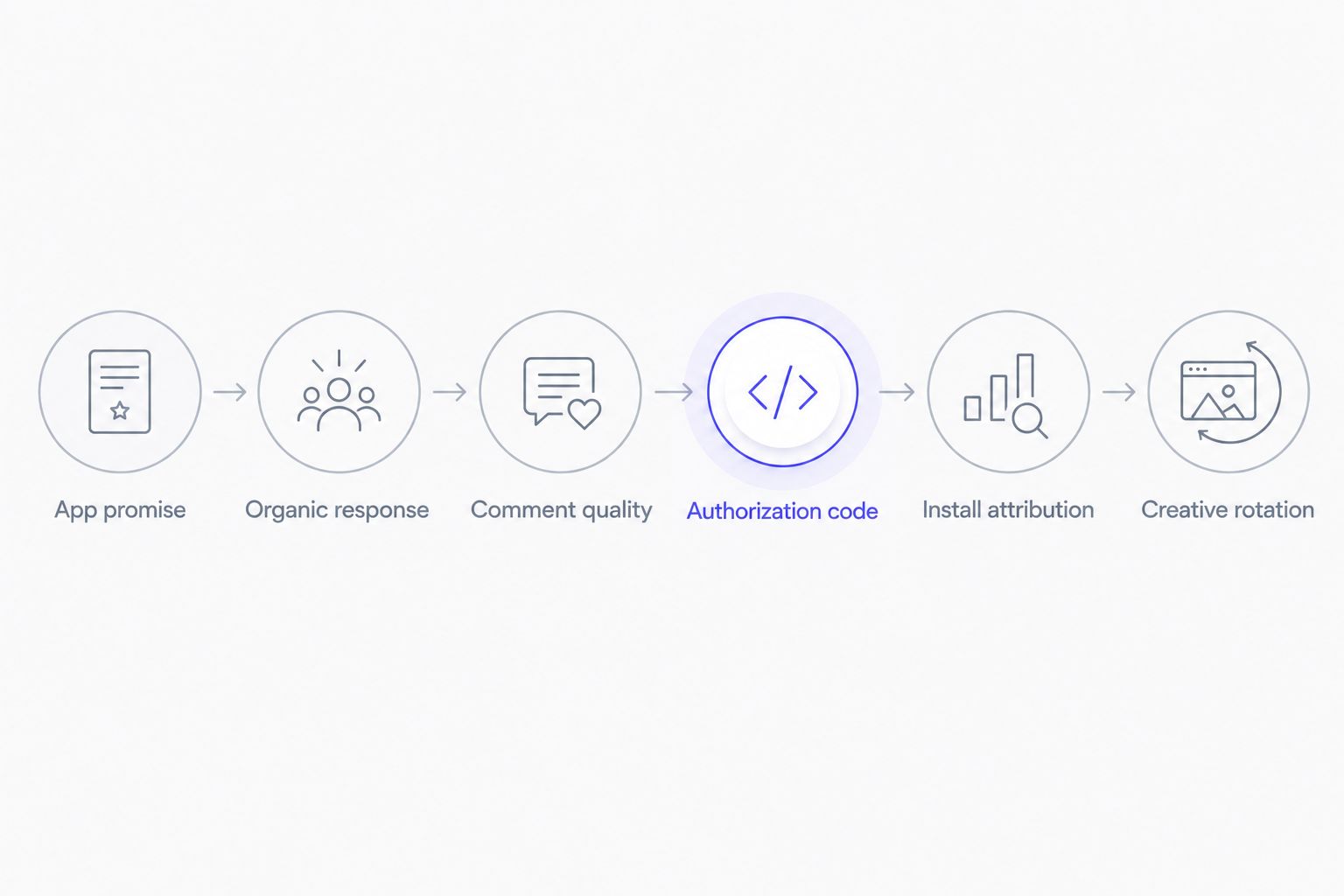
A post that fails the first three checks is not ready for paid amplification. A post that passes them but lacks authorization or attribution is creatively promising but operationally blocked.
How Spark Ads authorization works in 2026
Creators can generate video authorization codes that let an advertiser use an existing post in Spark Ads. TikTok Business Help Center documentation for Spark Ads lists authorization periods of 7 days, 30 days, 60 days and 365 days.
The selected period should match the campaign plan. A short window can work for a defined test, while a longer window reduces the risk that access expires during a campaign. Longer access does not remove the need to monitor creative performance or creator agreements.
Authorization is not the same as transferring ownership of the video. It gives the advertiser permission to use the approved post for the selected period. The campaign plan should identify who requests the code, who verifies it, who monitors expiry and what happens when access ends.
The technical sequence is straightforward, but coordination causes delays when responsibilities are unclear. Use a documented process to connect creator whitelisting to ad accounts before launch day rather than requesting access after the campaign is built.
Why Spark Ads results vary
- Creative-message fit. A video focused on entertainment can earn attention without explaining why someone should install the app.
- Creator-audience fit. The creator's audience must overlap with the app's intended user, not merely the broader app category.
- Hook clarity. The opening must make the problem, outcome or app use case understandable before the viewer scrolls.
- Store-listing continuity. Screenshots, copy and positioning on the destination should match the promise made in the video.
- Attribution configuration. Missing links, incorrect campaign parameters or incomplete event mapping make install results unreliable.
- Creative rotation. Repeated delivery of one post limits what the team can learn and concentrates risk in a single asset.
These factors explain why a Spark Ads test cannot be evaluated from TikTok engagement alone. The paid report, mobile measurement platform and store data answer different parts of the same question.
What to measure beyond installs
Install volume is the immediate outcome, but it is not enough to decide whether Spark Ads are building useful growth. Compare each post using the same event definitions and attribution settings.
Track these layers:
- Creative response: video views, watch behavior, clicks, comments, shares and saves.
- Acquisition: attributed installs and cost per attributed install.
- Activation: completion of the first meaningful in-app action.
- Quality: the post-install events that define a useful user for the app's business model.
- Creative learning: the hook, creator angle, use case and objection addressed by each post.
The creative layer explains what attracted attention. The acquisition layer shows whether that attention became installs. Activation and quality reveal whether those installs matched the app's actual growth goal.
Do not change attribution windows, event definitions and creative variables at the same time. Stable measurement makes the next creator brief more specific because the team can identify which message produced the desired action.
Is Spark Ads better than standard TikTok ads?
Spark Ads are better when the existing post, creator identity and public engagement contribute to the message. Standard TikTok ads are better when you need unpublished creative, direct asset control or tightly isolated tests.
Neither format wins every campaign in 2026. Use the format that preserves the variable you are trying to test: Spark Ads preserve the organic post context, while standard ads give the advertiser more control over the creative asset.
Can you run Spark Ads without an agency?
Yes. An in-house team can run Spark Ads if it can recruit creators, manage usage permission, collect authorization codes, prepare replacement creative and maintain attribution.
The trade-off is operational capacity rather than platform access. The Viral App is a fit for B2C app teams that want creator recruitment and campaign management handled as one UGC program. It is not the necessary choice for a team that already has creators, permissions, production and measurement covered internally.
The Viral App is best for B2C mobile app teams that need creator recruitment and UGC campaign management before Spark Ads can scale.
Build a creator content pipeline
Recruit and manage TikTok creators for organic content and app-install campaigns.
How long should Spark Ads authorization last?
Choose an authorization period that covers setup, testing and planned delivery without forcing a mid-campaign renewal. TikTok lists 7-day, 30-day, 60-day and 365-day periods, so the correct option depends on the campaign schedule and creator agreement.
A longer period simplifies access management but does not justify leaving weak creative active. Authorization controls permission; campaign performance determines whether the post should continue receiving spend.
Can an organic TikTok post predict app installs?
An organic post can identify promising messages, hooks and creators, but it cannot predict app installs by itself. Organic viewers and paid audiences can behave differently, and install results also depend on targeting, store-listing continuity and attribution.
Use organic performance as a screening layer. Use paid install and post-install data as the decision layer.
FAQ
Is TikTok Spark Ads worth it for app installs in 2026?
Yes, TikTok Spark Ads are worth it for app installs when you have proven creator content, active authorization and reliable install attribution. They are not a replacement for creative testing or store-listing alignment.
What is the main advantage of Spark Ads for app marketers?
Spark Ads preserve the original TikTok post's account identity and public engagement during paid promotion. That makes them useful when the creator and existing discussion strengthen the app message.
Is Spark Ads better than standard TikTok in-feed ads?
Spark Ads are better for promoting an existing post, while standard in-feed ads are better for unpublished creative and controlled asset testing. The right format depends on whether organic post context or advertiser control matters more.
Do creators need to authorize Spark Ads?
Yes, an advertiser needs access through a linked TikTok account or a creator-provided video authorization code. The permission must remain active during the planned campaign period.
How long does TikTok Spark Ads authorization last?
TikTok lists authorization periods of 7 days, 30 days, 60 days and 365 days. Choose a period that covers campaign setup, testing and delivery.
Can Spark Ads drive app installs without mobile attribution?
Spark Ads can send users toward an app, but you cannot evaluate attributed installs reliably without working measurement. Test the app link and event flow before increasing delivery.
Can you run Spark Ads without a UGC agency?
Yes, an in-house team can run Spark Ads if it can source creators, manage permissions, rotate creative and maintain attribution. An agency is useful when those operational tasks exceed internal capacity.
Should every high-view creator post become a Spark Ad?
No, a high view count alone does not prove install intent. Review watch behavior, comments, clicks, message clarity and destination alignment before authorizing paid distribution.
One last thing
The most valuable output from a Spark Ads campaign is not one successful post. It is a repeatable handoff from creator recruitment to organic publishing, paid testing, install measurement and the next creative brief.
That system matters more in 2026 than any individual format. The Viral App's role as a UGC and influencer marketing agency is relevant when the missing part is a managed supply of TikTok and Instagram creators, not when the app team only needs someone to press publish in Ads Manager.