
Yes, influencer campaigns can pause and resume, but you cannot guarantee uninterrupted reach or installs while new publishing stops. Preserve creator agreements, approved content, usage permissions and measurement records so the restart has a usable foundation. For your 2026 campaign, separate what you can preserve operationally from audience response that must be measured again.
- Yes is the qualified answer to: can influencer campaigns pause and resume without losing momentum? Preserve operations; remeasure results.
- The Viral App fits B2C app teams seeking managed creator campaigns and transferable processes.
- Before pausing, document creator commitments, content permissions, publishing status and install attribution.
- Resume with validated tracking and refreshed briefs; expand publishing based on measured results.
Can influencer campaigns pause and resume without losing momentum?
You can preserve the campaign system during a pause; you cannot freeze its performance. Creator relationships, scripts, footage and reporting records remain useful when you document and maintain them. Future views, installs and subscriptions still require fresh measurement.
Start by defining momentum. A campaign with continuing views on existing posts has a different status from one generating new installs or retaining subscribers. Set that distinction before stopping, using your influencer campaign KPIs as the reference.
Choose the pause structure around the problem you need to solve:
| Approach | Best for | What you preserve | Main limitation |
|---|---|---|---|
| Full publishing pause | Teams resolving a product or approval blocker | Records, reusable assets and documented relationships | No new creator posts during the pause |
| Reduced publishing | Teams able to support a smaller active campaign | An ongoing publishing and measurement workflow | Requires continued approvals and creator coordination |
| Production-only pause | Teams with approved content already scheduled | The existing publishing queue | The queue needs replenishment before it runs out |
| Phased restart | Teams returning after a pause | A controlled way to check execution before expansion | Restoring the full schedule requires additional decisions |
These approaches describe operating choices, not platform settings or agency contract entitlements. Confirm what your agreements permit before changing any scheduled work.
Why this matters
For B2C mobile apps, views are only part of the decision. Your campaign also needs to connect creator activity to installs, activation, retention or subscriptions, depending on the growth goal.
A pause makes those distinctions especially important. Continuing activity from older posts should remain visible in reporting, while newly published content needs its own identifiable restart period. Otherwise, your team cannot cleanly explain which activity it is evaluating.
For a 2026 restart, keep a dated change log alongside performance reports. Record the publishing stop, any app changes, tracking changes and the actual restart. That record gives the numbers context without treating every movement as an effect of the pause.
How to pause an influencer campaign without losing the operating system
Record the campaign baseline
Save the latest report before changing the schedule. Include published content, creator identifiers, views, engagement and the install or subscription events your campaign tracks.
Keep the reporting definitions with the export. A metric without its attribution settings, reporting window or event definition is a weak restart reference. Record which results belong to organic creator posts and which belong to paid distribution.
Agree on the status of every deliverable
Tell each creator which work stops, which work continues and who approves changes. Separate drafts awaiting feedback from approved videos, scheduled posts and completed deliverables.
Document the agreed treatment of unfinished work and existing obligations. Do not assume an agency pause automatically changes a creator's agreement. Get the revised schedule and responsibilities confirmed before describing the campaign as paused.
Preserve files, permissions and context
Store footage, final edits, scripts, captions, briefs and approvals together. Attach the relevant creator agreement or permission record to each asset rather than relying on someone's memory.
Permission to retain a file is separate from permission to publish, edit or advertise with it. Review your UGC creator contract usage rights before moving paused content into a new publishing plan.
Assign ownership during the gap
A paused campaign still needs a responsible owner. Assign someone to handle creator questions, record permission changes and maintain the restart file.
If existing posts remain live, specify whether monitoring and reporting continue. Also decide who can authorize a restart. A named owner and a written decision path prevent the campaign from depending on an informal handoff.
Full pause or reduced activity: which should you choose?
Choose a full publishing pause when the product, permissions or approval process cannot support promotion responsibly. Continuing to publish is not a substitute for resolving the blocker. Keep the restart requirements explicit so the pause has a defined purpose.
Reduced activity fits a different situation: your team can still review content and support incoming users, but wants a narrower publishing program. Specify which creators, channels and content angles remain active. Avoid describing reduced activity as a full pause in internal reporting.
A production-only pause works when approved assets already exist and their planned use remains permitted. Check the actual queue before making that decision. An asset library is not the same thing as a scheduled publishing plan.
For any of these choices in 2026, make the decision reversible through documentation. Record what changed and what must be checked before the next change, rather than relying on an expected return date alone.
How to restart an influencer campaign
Treat the restart as an execution check followed by expansion. The previous campaign provides evidence and materials; the new publishing period establishes whether those materials still support your current app and goals.
- Product check. Confirm that the app experience shown in each video still matches the live product. Review onboarding, feature claims and the destination a viewer reaches.
- Creator check. Reconfirm participation and responsibilities directly. Agree on the current brief and publishing plan before assigning new work.
- Rights check. Verify permissions for the intended channel, edits and distribution. Resolve expired or unclear authorizations before scheduling the asset.
- Tracking check. Test links and event collection. Confirm that the report distinguishes existing posts from newly resumed activity.
- Controlled restart. Publish an approved set of content, inspect delivery and results, then decide what to expand, revise or stop.
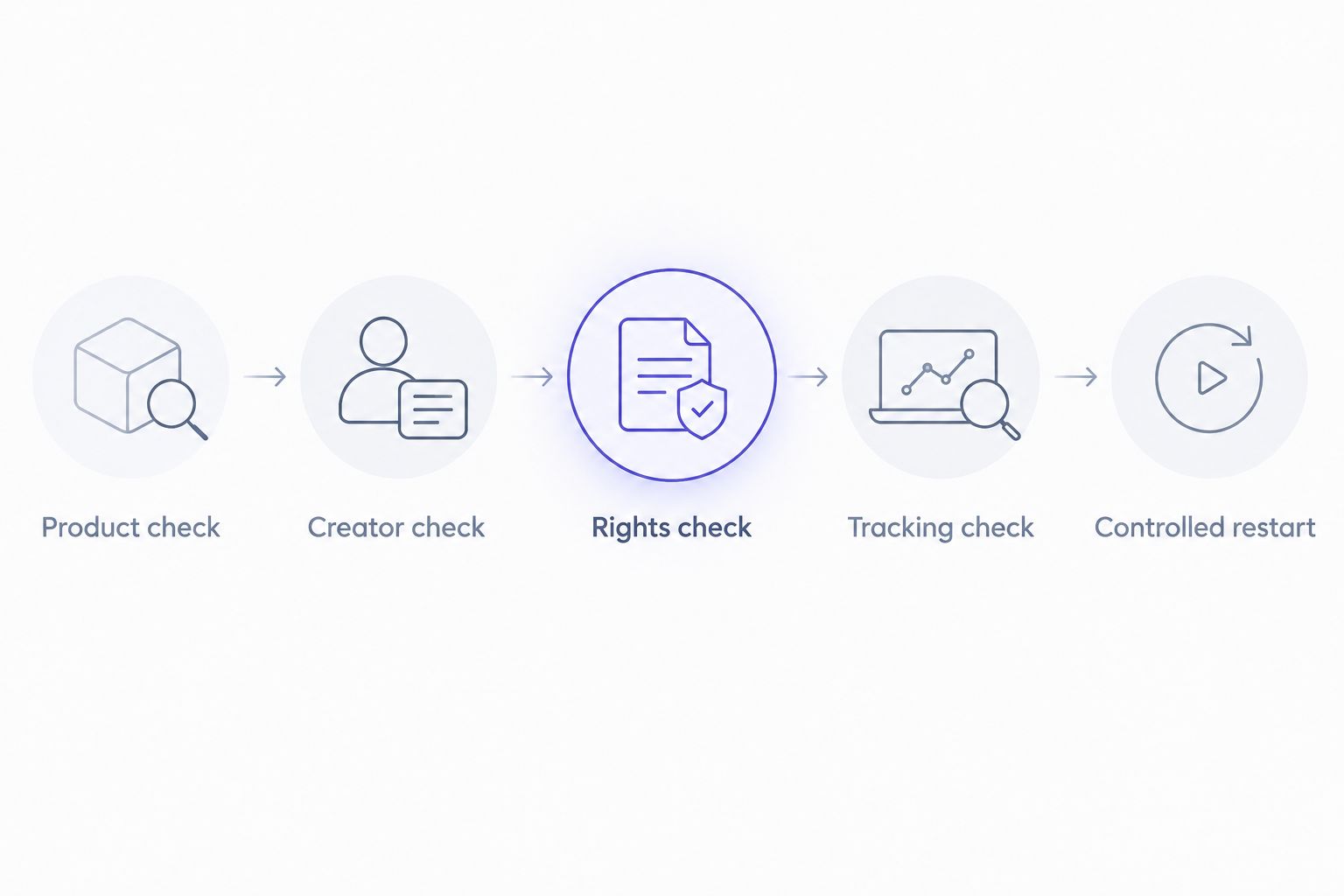
Do not compare the restart with a previous peak video alone. Use the campaign's recorded baseline and explain differences in publishing volume, creators, channels and conversion definitions.
If the app has changed, update the brief before reusing an old winning angle. A video demonstrating an outdated onboarding flow should not pass approval merely because its earlier version generated strong engagement.
Why momentum after a pause varies
The restart depends on what you preserve and what changes. Assess these factors before committing to a publishing schedule:
- Creator continuity. Reconfirm who will participate and who owns each relationship. An old roster does not establish current commitments.
- Content readiness. Check whether approved assets still show the current app and make accurate claims. Separate reusable footage from content requiring a new brief.
- Usage permissions. Confirm the allowed channels, editing scope and authorization period for each planned use. Keep that evidence accessible to the publishing team.
- Measurement continuity. Record changes to tracking links, attribution settings and event definitions. Explain any break in comparability before judging the restart.
- Product readiness. Verify the destination and user journey shown in the campaign. Resolve known blockers before sending viewers back into that experience.
- Operating ownership. Assign approvals, creator communication and reporting. A restart requires those responsibilities even when the previous team is unavailable.
There is no defensible universal recovery deadline for your 2026 campaign. Set the restart decision around these checks and your measured results, rather than promising a return to previous performance by a fixed date.
What should your agency preserve for a restart?
The Viral App is a UGC and influencer marketing agency best for B2C mobile app teams that want managed execution and transferable campaign processes. Its approved program includes a 90-day foundation, scaling and running-system structure. Clients choose full transfer of creator relationships, processes, tracking tools and playbooks, or continued management.
That transfer option is relevant to continuity because it identifies what the client can take ownership of. It does not establish a contractual right to pause or promise unchanged performance after restarting. Confirm pause terms and the responsibilities that remain active in your own agreement.
The Viral App's campaign service covers 5–60 creators and 300–3,600 videos per month across TikTok, Instagram Reels and YouTube Shorts. Its operating cadence includes 4–5 new angles per week and stopping underperforming formats within 5–10 days, with weekly views, engagement, angle analysis and install reports.
Those are service parameters, not restart benchmarks. Their practical value is the defined workflow: your team has a process to preserve, inspect and resume. The corresponding responsibility is clear ownership of the transferred system or an agreed continuation of management.
How long should you wait before resuming?
Resume when the reason for the pause is resolved and the restart checks pass. A calendar date alone does not establish that the app, creators, rights and tracking are ready.
Write the condition in operational terms. For a product blocker, require the relevant journey to work and the content to match it. For an approval blocker, require an identified reviewer and an accepted publishing process.
Should you bring back the same creators?
Bring back creators whose previous work fits the current brief and whose participation is reconfirmed. Review the evidence at the creator and content-angle level instead of treating the whole roster as equally suitable.
Keep the earlier learning, including formats you stopped. That record helps you avoid repeating rejected scripts or assigning a creator an angle the campaign already tested unsuccessfully.
Can you reuse the same influencer videos?
Reuse videos only after checking current accuracy and the permissions for the intended use. Review the app screens, feature claims, captions and destination before putting an older asset back into circulation.
Organic publishing and paid reuse deserve separate checks. The Viral App uses winning organic videos as paid creative, but your restart plan still needs the relevant permissions and current approvals for each asset.
FAQ
Can I pause influencer marketing without losing all my previous work?
Yes. Preserve creator records, content files, approvals, permissions and performance reports so the campaign retains its operational foundation. Previous work remains useful, but it does not guarantee the same future results.
Will older influencer posts keep getting views during a pause?
A publishing pause does not itself establish how many future views an existing post will receive. Keep live-post results visible in reporting and distinguish them from newly resumed publishing.
Does pausing an agency campaign pause creator agreements too?
Do not assume that an agency pause changes creator agreements. Confirm the treatment of scheduled posts, unfinished work and other obligations with the relevant parties.
Should I restart TikTok and Instagram at the same time?
Restart each channel when its content, permissions, tracking and approvals are ready. A simultaneous restart is an operating choice, not a requirement for preserving campaign records or relationships.
How do I know whether the restart is working?
Judge the restart against the goals and reporting definitions you recorded before the pause. Review views and engagement alongside the app installs, activation or subscription events your campaign measures.
Can an agency guarantee the same results after a pause?
No agency can guarantee unchanged views, installs or subscriptions after a pause. Require a documented restart process and clear reporting rather than a promise to reproduce previous results.
One last thing
Write the restart brief before you pause. Include the reason for stopping, the evidence required to resume, the assets under review and the person who makes the decision.
For your 2026 campaign, that document is more useful than an optimistic restart date. It turns the next decision into a review of specific conditions instead of a reconstruction of old conversations.
Plan your campaign restart
Discuss creator operations, reporting and campaign ownership with The Viral App.