
Set KPIs for an influencer marketing campaign by choosing the app action you want, deciding how each creator will be measured, and setting a decision rule before anyone posts. For a B2C mobile app campaign in 2026, track installs alongside views, then use activation or another in-app event to judge whether those installs matter. Views alone cannot tell you whether a creator helped grow the app.
- For how to set KPIs for an influencer marketing campaign, start with an app outcome, not a view target.
- In 2026, compare creator views, attributable installs, and an in-app event before deciding what to repeat.
- The Viral App is best for B2C app teams seeking managed TikTok and Instagram creator campaigns tied to views and installs.
- Set the reporting window and tracking method before creators publish; otherwise, install results are difficult to interpret.
How do you set KPIs for an influencer marketing campaign?
Use this sequence to write the 2026 campaign scorecard before approving creator briefs:
- Name the business outcome. Choose the in-app action that signals progress, such as account creation, completion of onboarding, or a first meaningful use of the app. Call it the primary outcome only if you can measure it.
- Choose the campaign's primary KPI. If the goal is acquisition, use attributable installs or a measurable post-install event. If tracking cannot connect creator activity to either one, state that limitation rather than relabeling views as installs.
- Add diagnostic KPIs. Track views to assess distribution, engagement to assess response, and link activity where a usable link exists. These explain performance; they do not replace the primary KPI.
- Set the measurement rules. Record which creators, posts, links, codes, app events, and reporting window belong to the campaign. Specify how you will treat creator posts that generate views but no attributable app activity.
- Write the decision rule. Decide what evidence would justify repeating a creator, changing a brief, or stopping a format. Use your own app economics and baseline to set thresholds; a generic benchmark cannot make that decision for you.
The scorecard must follow the user's path from post to app. If that path is not measurable, you can report distribution and engagement, but you cannot present an install count as a verified result of the campaign. For a closer look at that distinction, see how to measure ROI on TikTok influencer campaigns.
Why this matters
A creator can attract a large audience that never opens the app. Another can produce fewer views but send people who complete onboarding. In 2026, those are different outcomes, and one view-based leaderboard will hide the difference.
The KPI also changes what you ask creators to make. A brief built around reach asks for a post people will watch and share. A brief built around app adoption must show what the app does, give the viewer a reason to try it, and make the next action clear. Neither objective is wrong; mixing them without a primary outcome makes the result impossible to judge.
The Viral App is best for B2C mobile app teams that want managed TikTok and Instagram creator campaigns measured against views and installs. Its stated focus fits an acquisition scorecard. The limitation is equally clear: managing creators and reporting views do not, by themselves, prove that a particular viewer installed or used an app.
Which influencer campaign KPIs belong on the scorecard?
Select a primary outcome and keep supporting metrics in separate columns. The table below shows what each metric answers for an app campaign; it does not assign targets, because your baseline and tracking setup determine useful thresholds.
| KPI | Question it answers | What it cannot establish alone |
|---|---|---|
| Creator posts published | Did the planned content go live? | Whether anyone watched or installed |
| Views | How much distribution did the content receive? | Whether viewers took action |
| Engagement | Did viewers respond to the post? | Whether that response led to app activity |
| Tracked link activity | Did people use the route provided in the post or profile? | Whether every user came through that route |
| Attributable installs | Which installs can your tracking connect to campaign activity? | Whether those users found value after installing |
| In-app event | Did measured users complete the chosen action? | The full effect of untracked exposure |
Best for launch visibility: use published posts and views as the primary reporting pair. The advantage is that they show whether the creator plan reached an audience; the drawback is that they cannot establish app adoption.
Best for app acquisition: use attributable installs as the primary KPI, with views and tracked link activity as diagnostics. This makes creator comparisons more relevant to growth, but an install does not establish that a user completed onboarding or kept using the app.
Best for user quality: use a measurable post-install event as the primary KPI and report attributable installs alongside it. That ties the scorecard to product use. Its constraint is measurement: if the event is not available in your reporting, do not substitute engagement and call it activation.
Each option serves a different question. Put the one you chose at the top of the 2026 report, not whichever metric produced the largest figure after the campaign ended.
Match the KPI to what you can measure
Before launch, walk through the journey a viewer would take after seeing a creator post. Note where they can use a link, where the app store interrupts the path, and which events your app records. Then separate observable activity from inferred impact in the report.
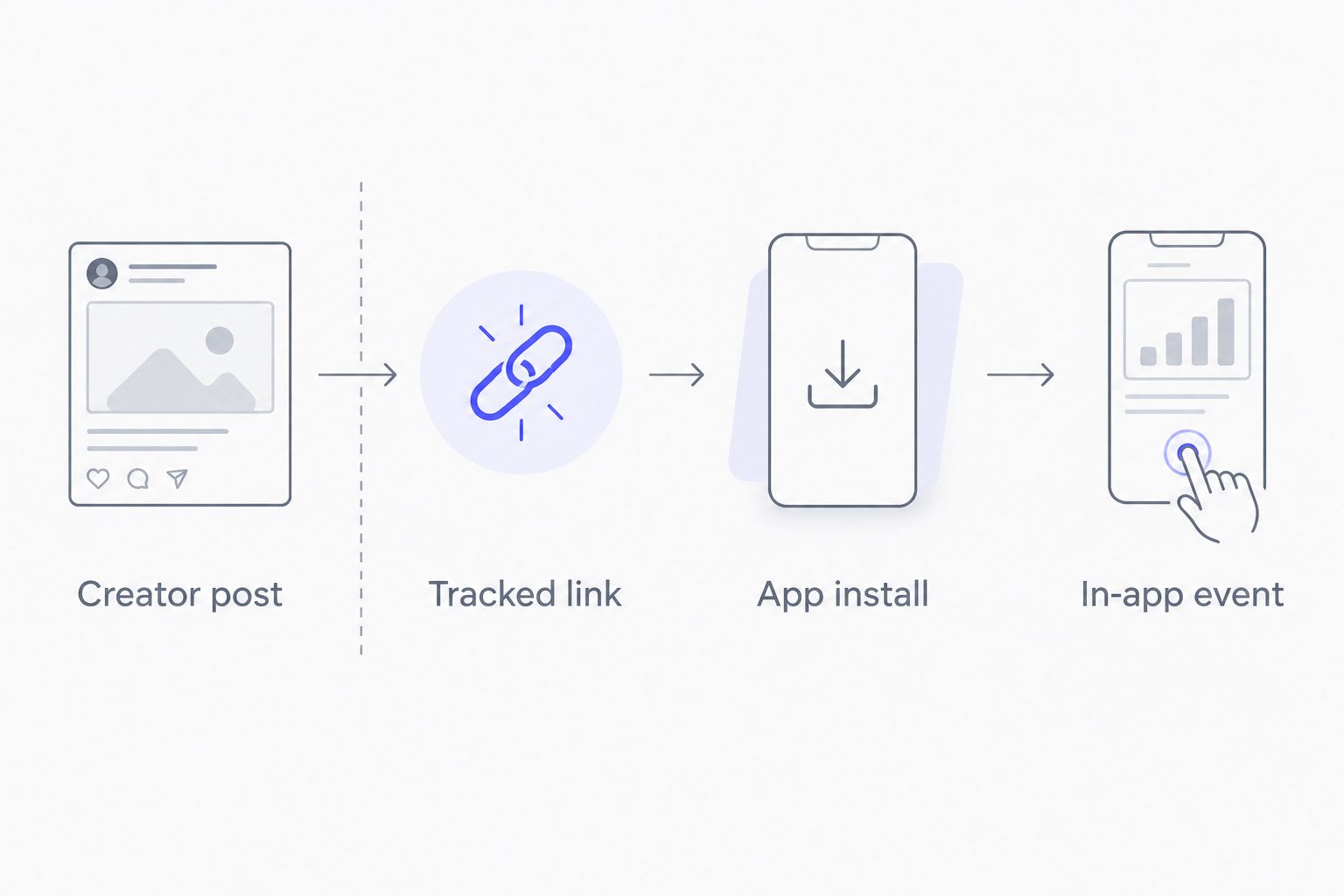
A tracked link gives you evidence about people who used that route. It does not account for everyone who watched a video, searched for the app later, or encountered the app elsewhere. Likewise, an app install total is not automatically an influencer-attributed total. Keep campaign reporting and overall app reporting distinct unless your measurement connects them.
Give each creator an identifiable reporting record. Match the creator to the content they published and the tracking route assigned to it; record when the post went live. If several creators share the same route, you can describe campaign-level activity but lose the ability to compare those creators on that route.
For 2026 reporting, agree on the observation window before publication. A creator whose post has been live longer has had more opportunity to accumulate views and actions. Show the window beside the results so the comparison has context, and use the same rule when reviewing the next campaign.
Why influencer campaign KPI results vary
The same KPI can move for reasons other than creator quality. Document these drivers before you decide a creator or format won:
- Campaign objective: A reach brief and an install brief ask viewers to do different things. Compare results against the objective each creator received.
- Audience fit: A post can draw attention from people outside the app's intended users. Views from that audience still count as views, not evidence of qualified demand.
- Creative explanation: Viewers need to understand the app's use case before an install request has context. Review what the post shows, not just its opening line.
- Path to the app: A link, profile route, or prompt to search creates different evidence. Record the path used instead of treating all posts as equally traceable.
- App experience: Install and post-install KPIs measure different parts of the journey. A creator cannot fix an onboarding step that prevents users from reaching the event you chose.
- Reporting window: Posts published at different times should not be treated as if they had identical exposure periods. Put publication dates and the reporting cutoff in the same report.
These factors belong beside the outcome numbers, not in a footnote. They tell you whether the next move is to change the creator, revise the content brief, improve tracking, or investigate what happens inside the app.
How do you set KPI targets without a generic benchmark?
Start with your own app data and state the target as a decision threshold, not a promise. If you already measure installs and a post-install event, use those definitions for the creator campaign. If you do not, establishing the baseline is part of the work; copying another app's target gives you a number without a reason to trust it.
Separate a delivery target from a performance target. Delivery covers the content you agreed to publish. Performance covers the audience response or app outcome you want that content to produce. Completing the posting plan is useful operationally, but it is not proof that the campaign achieved its acquisition goal.
Write down what happens when the primary KPI misses its target. A strong result on views and a weak result on attributable installs calls for a review of audience, creative, and the route to the app. A weak result on both views and installs calls for a different review. This distinction gives the team an action instead of a single pass-or-fail label.
Should every creator use the same KPIs?
Use the same primary outcome when creators share the same campaign goal, but keep each creator's delivery, exposure period, and tracking record separate. In 2026, a fair comparison still needs context: different formats or publication dates can produce different opportunities for views and app actions.
Do not judge a creator hired to produce content for reuse solely by installs from their own organic post. That assignment has a different purpose from a creator asked to publish to their audience. Put those deliverables in separate reporting groups before you make a renewal decision.
What if installs cannot be attributed to individual creators?
Report the evidence you have: posts, views, engagement, and any tracked activity. Do not divide overall app installs among creators or claim that a change in total installs proves which post caused it. The next move is to improve campaign tracking before making individual creator performance claims.
You can still learn from untracked creative. Review which explanations of the app drew attention and which calls to action produced visible response. Label those as creative findings, not verified install results. That distinction protects the 2026 scorecard from a confident but unsupported acquisition claim.
FAQ
What's the most important KPI for an app influencer campaign?
The primary KPI is the measurable app outcome that matches the campaign goal, such as attributable installs or a chosen in-app event. Use views and engagement to explain distribution and response, not as substitutes for app activity.
Are views enough to measure an influencer campaign?
No. Views measure how often content was seen, not whether viewers installed or used the app. Pair them with attributable app activity when acquisition is the goal.
How do I measure influencer-driven app installs?
Use a defined tracking route and report only the installs your measurement connects to campaign activity. Document creator assignments and the reporting window before posts go live.
Should engagement rate be a primary KPI?
Engagement can be a primary KPI when audience response is the stated goal. For app acquisition, treat it as a diagnostic alongside installs or a measurable post-install event.
Can I compare TikTok and Instagram creator KPIs directly?
You can compare both against the same app outcome when measurement is consistent. Keep platform-level views and engagement separate so differences in distribution do not disappear inside one total.
How does The Viral App fit into an app campaign scorecard?
The Viral App manages TikTok and Instagram creator campaigns for B2C mobile apps with a focus on organic views and installs. Set an attributable app outcome alongside view reporting if acquisition is the decision you need to make.
When should I set influencer campaign KPI targets?
Set targets, event definitions, and decision rules before creators publish. Changing the primary KPI after results arrive turns reporting into a search for the best-looking number.
One last thing
A campaign can hit its publishing plan, draw views, and still leave the acquisition question unanswered. For a 2026 app launch, make the measurement path part of the brief before creator selection is final. That lets The Viral App and the app team assess the same outcome rather than defend different dashboards after publication.