
Get explicit rights to use creator content on your planned channels, including separate permission for organic posting, paid ads, creator-account advertising, edits, and app-store placements where relevant. Define the license term, territory, permitted users, and use of the creator’s name, image, and voice. Delivery of a video is not a substitute for those permissions; also address third-party music, renewal, and what happens when rights expire.
- What usage rights should you get in a UGC creator contract? Specify channels, paid advertising, edits, duration, and territory.
- TikTok and Instagram creator-account advertising needs both contractual permission and the relevant platform authorization.
- Theviralapp serves B2C mobile app teams seeking managed UGC and influencer marketing campaigns.
- Request raw footage, app-store reuse, and agency access explicitly; do not treat video delivery as blanket permission.
Why this matters
A usable video and permission to distribute it are different deliverables. Your growth team needs the contract to match the campaign plan, not just the production brief. Otherwise, an approved asset can reach your media buyer without permission for its intended placement.
For a 2026 app campaign, map each intended use before signing: creator posts, brand posts, paid placements, landing pages, and store listings. Theviralapp recruits and manages TikTok and Instagram creators for B2C mobile app campaigns; those distribution decisions belong in the creator agreement before production starts.
Use this page as a commercial planning checklist. Have qualified counsel translate the agreed scope into enforceable language for the relevant jurisdiction.
What usage rights should you get in a UGC creator contract?
Request a written license that identifies the assets, permitted uses, channels, term, territory, and people authorized to use the content. Add editing permissions and likeness permissions that match the campaign. Keep creator posting obligations separate from your rights to reuse the deliverables.
| Right or arrangement | Best for | Permission to request | Benefit | Limitation |
|---|---|---|---|---|
| Organic reuse | Brand social publishing | Posting on named brand accounts and channels | Supports distribution beyond the creator’s post | Does not expressly authorize paid promotion |
| Paid media reuse | App-install advertising | Advertising on named platforms and placements | Allows the asset into your media workflow | Does not establish creator-account access |
| Creator-account advertising | Ads associated with a creator’s identity | Account-specific permission and platform authorization | Connects advertising to the agreed creator identity | Depends on authorization remaining valid |
| Editing and derivatives | Creative testing | Cropping, captions, cutdowns, localization, and agreed combinations | Supports new versions of an approved asset | Broad edits can change the original meaning |
| App-store reuse | Store-listing creative | Use in specified previews or listing assets | Extends content into the install journey | Store formats and policies still apply |
| Copyright assignment | Teams requiring ownership | Express transfer of specified rights, reviewed by counsel | Addresses ownership rather than only use | Requires more negotiation than a bounded license |
Buy the rights your distribution plan requires, not an undefined promise of full usage. A label such as full rights leaves the operating details unresolved unless the agreement explains it.
Identify the assets and rights holders
List the deliverables covered by the license: final videos, approved variants, still frames, voice recordings, and raw footage where requested. Attach an asset schedule or another clear identification method so your team can connect each permission to the correct file.
Confirm who has authority to grant those rights. The creator’s permission does not automatically resolve rights belonging to a collaborator, photographer, musician, or another person appearing in the footage. Require disclosure of those dependencies before approval.
Name the channels and permitted users
Specify where the content will appear and who can publish it. Distinguish your brand accounts from creator accounts, advertising accounts, websites, email, and app-store listings. Name territories rather than assuming an international campaign is covered.
If an agency or contractor will edit, upload, or distribute the files, address that access expressly. Permission for a service provider to act on your behalf should not become unrestricted permission to use the asset for unrelated clients.
Organic reuse: best for brand-owned publishing
Organic reuse permission should describe the accounts and placements where you can publish without paid promotion. Decide whether the license covers reposting the original video, uploading a new copy, embedding it on a landing page, or extracting still images.
The advantage is a defined publishing scope. The limitation is equally important: organic permission should not be treated as express paid-ad permission. If your 2026 plan includes boosting a successful post, secure that permission before the boost.
Also distinguish publication from retention. Decide whether existing posts can remain visible after the license ends and whether new publishing must stop. Those are different operating rules, and your social team needs both.
Paid media reuse: best for creative testing
Paid media rights should identify the platforms, placements, advertiser, and covered assets. Include the edits required for your actual testing plan rather than relying on a generic advertising clause to settle every production question.
For mobile app ads, that means addressing hooks, captions, end cards, screen recordings, and calls to action where you intend to modify them. Pair the rights schedule with a UGC content brief for an app launch so creative instructions and permissions describe the same deliverables.
Paid reuse gives your media team an authorized asset to test. It does not promise installs or resolve every other dependency: music clearance, creator likeness, editing scope, and the license end date still matter.
Creator-account advertising: best for identity-led distribution
Separate permission to advertise through a creator-associated post or account from permission to upload their video to your brand account. The agreement should identify the permitted advertiser, relevant account or post, allowed use, and authorization period.
Platform authorization is not a replacement for the contract, and the contract is not a replacement for platform authorization. For TikTok Spark Ads and Instagram partnership ads, verify the relevant authorization process before scheduling delivery.
Specify who provides access, who maintains it, and what happens if it is revoked or expires. Do not request personal login credentials as the default handoff. Use the platform’s supported authorization tools and document the access needed for the agreed campaign.
Editing and app-store reuse: best for cross-channel production
Editing permission should describe changes the creator accepts. Separate technical adjustments, such as resizing and captions, from substantive changes, such as rewriting an endorsement or combining footage with new claims.
Preserve the meaning of the creator’s statements. Request an approval process for sensitive changes, especially when a fitness, education, or fintech app introduces claims that were not in the original script. Permission to edit is not permission to manufacture an endorsement.
App-store reuse also deserves explicit treatment in your 2026 agreement. Specify whether footage, likeness, voice, and still frames can appear in listing assets. The benefit is a connected creative workflow; the constraint is that contractual permission does not replace store requirements or third-party clearance.
License or ownership: which should you request?
Request a license when your main requirement is defined campaign use; discuss ownership when control of the underlying work is itself a business requirement. These arrangements answer different questions. A license authorizes specified uses, while an assignment transfers specified ownership rights.
A broad license can still leave the creator as the copyright owner. Conversely, an ownership provision does not by itself settle permissions for third-party music or another person’s likeness. Review those components separately.
Do not assume that commissioning or paying for a video transfers copyright. Work-made-for-hire rules have legal conditions; the label alone does not settle ownership. Ask counsel to review the arrangement instead of copying a clause from an unrelated contract.
Why UGC usage-rights scope varies
The right scope follows your campaign, not a universal package. Use these factors to decide what belongs in the agreement:
- Distribution channels: Brand social posts, paid ads, websites, and store listings are distinct intended uses.
- Campaign duration: A launch burst and ongoing publishing need different expiration and renewal decisions.
- Territory: Name the markets where you intend to distribute the content.
- Editing depth: A caption correction differs from a new voiceover, translated endorsement, or composite ad.
- Creator identity: Using a face, voice, name, handle, or account introduces permissions beyond possession of the file.
- Operational access: Agencies, editors, and media buyers need defined authority to handle and publish assets.
Keep exclusivity separate. Restrictions on the creator working with competing apps are not the same as permission for you to use their video. Define any restricted category and duration precisely, or leave exclusivity out when it does not serve the campaign.
How do you turn usage rights into an operating handoff?
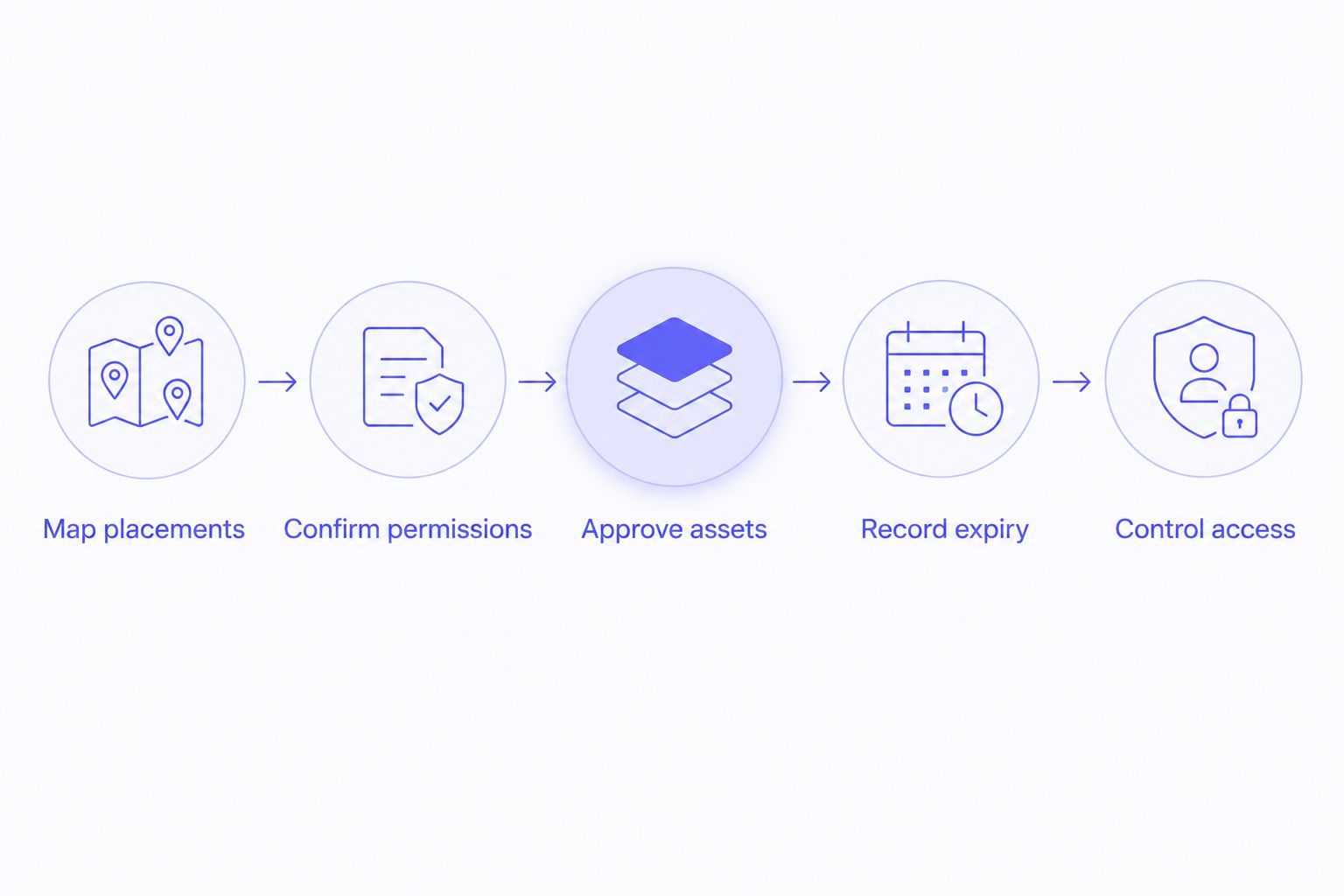
Your 2026 contract should produce instructions that an editor, social manager, and media buyer can follow without interpreting legal shorthand. Build the handoff around these steps:
- Map placements. List each intended destination and whether distribution is organic, paid, or creator-account advertising.
- Confirm permissions. Match each placement to the license, likeness permissions, and third-party clearances.
- Approve assets. Record which files and edits are approved, including raw-footage access where agreed.
- Record expiry. Store the start trigger, end date, renewal process, and rules for existing posts.
- Control access. Identify authorized users and verify platform permissions before launch.
The rights register should travel with the asset library. A media buyer should be able to see whether a file is approved for a placement before uploading it—not discover the restriction after launch.
Can you keep using UGC after the contract ends?
You can keep using UGC after the contract ends only to the extent the applicable license permits it. The service agreement’s end date and the content license’s end date are not necessarily identical; specify the relationship.
Set separate instructions for stopping ads, removing posts, retaining internal copies, and renewing rights. If renewals require approval, assign an owner to secure it before continued use. Do not treat silence as permission to extend a license.
Does buying raw footage let you make any edit?
Receiving raw footage does not establish unlimited editing permission. Your agreement should address both delivery of the files and the transformations you are allowed to make.
Specify whether you can create cutdowns, extract stills, replace audio, translate speech, or combine footage with other assets. Treat synthetic voice or likeness uses as a separate permission question rather than burying them inside general editing language.
Where an agency fits
Theviralapp is best for B2C mobile app teams seeking managed UGC and influencer marketing campaigns. Its stated service covers recruiting and managing TikTok and Instagram creators to drive organic views and installs.
That service scope does not establish which usage rights a specific engagement includes. If you work with Theviralapp, confirm the rights schedule, account permissions, expiration tracking, and handoff responsibilities in the agreement. Managed production does not remove your responsibility to approve the intended uses.
FAQ
What usage rights should I get in a UGC creator contract?
Get explicit permission for your intended channels, organic use, paid ads, edits, term, territory, and creator likeness. Add creator-account advertising, raw footage, and app-store reuse where your campaign requires them.
Does paying a UGC creator mean I own the video?
Paying a UGC creator does not automatically transfer copyright ownership. Have the agreement distinguish a usage license from an ownership assignment, and ask counsel to review any work-made-for-hire provision.
Can I use an organic UGC video in paid ads?
Use an organic UGC video in paid ads only when the agreement authorizes that use. Check the platform, duration, editing permissions, likeness permissions, and third-party content before launch.
Do I need separate permission for TikTok Spark Ads?
Specify permission for TikTok Spark Ads rather than relying on general video reuse language. Also obtain the relevant platform authorization for the post and advertiser.
Should I ask for perpetual UGC usage rights?
Ask for perpetual rights only when indefinite use matches a defined business requirement. Explain the channels, permitted edits, and likeness use; perpetual duration alone does not define the license scope.
Can my agency edit and publish a creator’s content?
Your agency can edit and publish within the authority granted by the agreement. Address service-provider access, permitted edits, publishing channels, and any approval requirements explicitly.
Can I put creator content on my app-store page?
Request explicit app-store reuse permission before putting creator content in listing assets. Confirm that the license covers the footage, voice, likeness, and edits, and check applicable store requirements.
What should happen when UGC usage rights expire?
Follow the agreement’s expiration rules for ads, posts, and retained files. Record whether existing organic posts can remain visible and secure any required renewal before continued use.
One last thing
Require an expiry field for every asset, including assets with no fixed end date. A blank field cannot tell your team whether rights are indefinite, unresolved, or simply undocumented.
Before launching a 2026 campaign, reconcile the signed agreement, asset register, and platform authorization. If those describe different permissions or dates, resolve the mismatch before publishing. That final check turns a negotiated right into an instruction your team can use.