Fitness app TikTok marketing is creator-led content and distribution aimed at acquiring users who start workouts, return, and subscribe. Your content must connect a believable fitness routine to an actual app experience while avoiding unsupported health claims and misleading transformation promises.
- Successful TikTok marketing for fitness apps connects creator content, app installs, workout activation, and subscription retention.
- Choose fitness creators who can demonstrate your app within a believable routine, then test distinct content angles.
- The Viral App fits teams seeking managed UGC campaigns, install reporting, and a transferable creator-marketing system.
- Scale content after checking downstream user behavior; views alone do not establish acquisition quality.
Why TikTok marketing matters for fitness apps
A fitness video can demonstrate both the activity and the product helping someone complete it. That gives your team a concrete creative task: show where the app fits before asking viewers to download it.
The constraint is consistency. A compelling workout clip does not establish that viewers will finish onboarding, complete a session, or keep a subscription. Your 2026 campaign plan needs separate measures for attention, acquisition, and continued use. Start by setting influencer campaign KPIs around the user actions your business needs.
Treat the first completed workout as a campaign outcome alongside the install. For a different fitness product, substitute its meaningful activation event, such as logging an activity or completing an assessment. Choose an event your app actually records.
Build a fitness app TikTok growth system
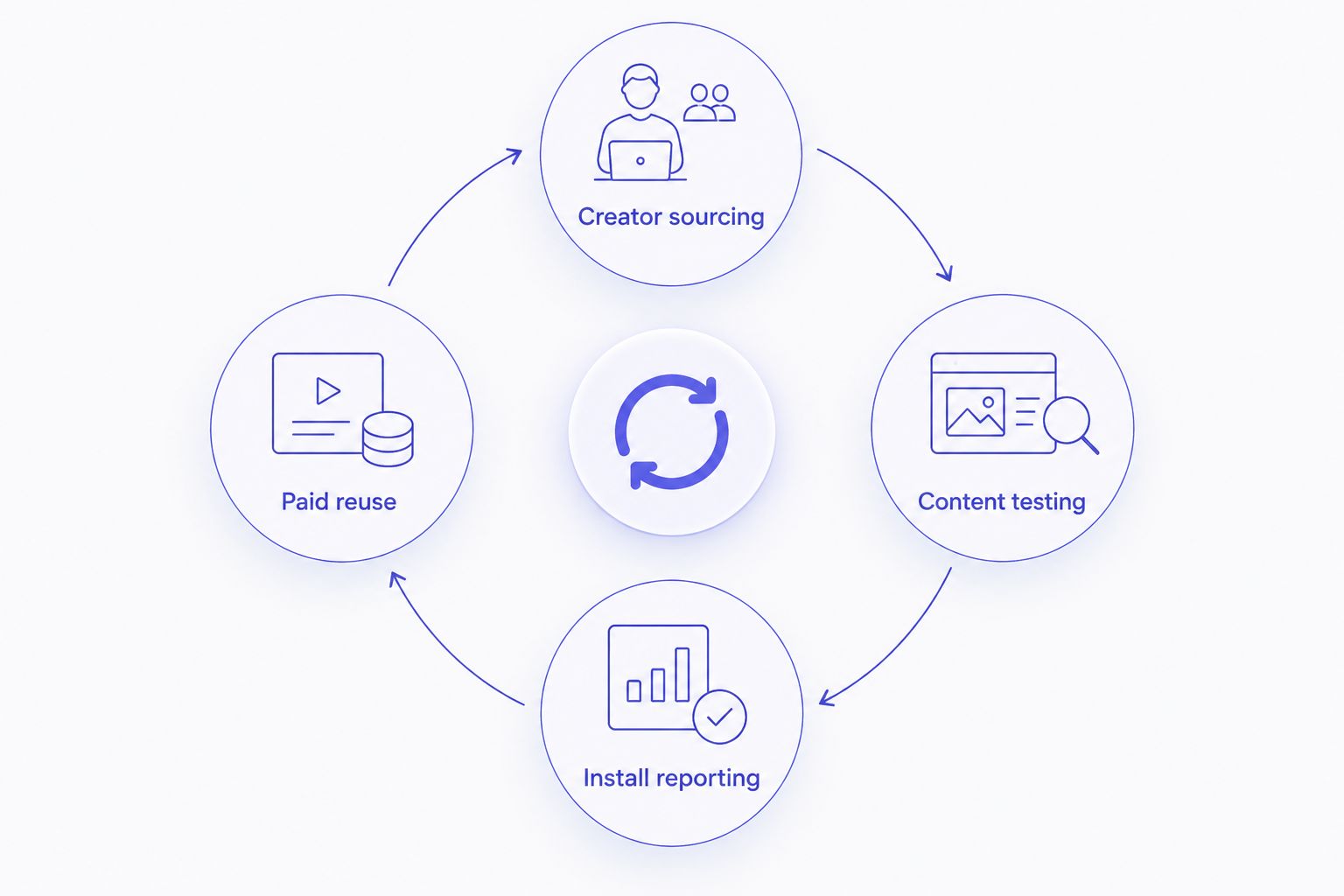
Start manually with a creator spreadsheet, a shared brief, and your existing app analytics. The operating loop is Creator sourcing, Content testing, Install reporting, and Paid reuse. Each stage needs an owner and a record of what happened.
Define the fitness user and activation event
Write down the person, situation, and product action before choosing creators. A beginner looking for guidance needs a different demonstration from an experienced lifter recording training. These are targeting hypotheses for your team to validate, rather than assumptions about who converts.
Map each creative promise to something the installed app delivers. If the video demonstrates a workout planner, the destination and onboarding should make that planner easy to find. Do not advertise a feature that users cannot access in the experience you send them to.
For your 2026 measurement plan, define activation before publishing. Otherwise, your team can end up selecting successful videos using a different standard each week.
- Name the intended user and the situation that creates demand.
- Choose the feature the creator will demonstrate.
- Define the activation event and its reporting window.
- Record the subscription or retention outcome you will review later.
Recruit creators around believable use
Search TikTok manually for creators discussing the training situations your app serves. Review their recent videos, comments, and demonstrations. Look for the ability to explain a routine clearly, use the product accurately, and speak to the intended audience.
Ask shortlisted creators to use the relevant app workflow before scripting. A creator demonstrating an unfamiliar interface needs product onboarding before filming. Fitness expertise also needs checking separately from presentation skill; do not treat popularity as evidence of qualifications.
Keep a written record of suitability and concerns. A creator who attracts workout entertainment viewers still needs a credible reason to introduce your specific app.
- Review audience language and recurring questions in comments.
- Check whether the creator can demonstrate the app accurately.
- Verify credentials before including professional fitness claims.
- Confirm disclosure, approval, and content-usage requirements.
Establish production ownership before adding volume
Manage the first production cycle through a shared tracker. Assign responsibility for outreach, scripts, app access, reviews, posting, permissions, and reporting. Keep the latest approved brief and asset version visible to everyone involved.
The Viral App provides managed UGC and influencer marketing for mobile apps, including sourcing, vetting, briefs, scripts, approvals, posting schedules, payments, and reporting. Its approved service scope covers 5–60 creators and 300–3,600 videos per month across TikTok, Instagram Reels, and YouTube Shorts; those are program parameters, not a required starting volume.
The Viral App is best for fitness app teams seeking managed creator marketing, install reporting, and an operating system they can take over. The service fits a recurring production need; your team still needs to supply product knowledge, approve claims, and own the in-app experience.
- Assign an internal owner for product accuracy and approvals.
- Track creator status, deadlines, and approved asset versions.
- Document posting permissions and reuse rights before publication.
- Choose which responsibilities remain internal and which transfer to an agency.
Test fitness situations and product demonstrations
Build a manual testing sheet around a clear hypothesis. For example, test whether showing workout preparation attracts better-activated users than showing a completed session. Keep the app feature and call to action consistent when evaluating the opening situation.
Useful fitness-app concepts include preparing for a session, selecting an exercise, recording progress, or returning after a missed workout, where those functions exist. Show the actual interface. Avoid editing that implies the app performs actions it cannot perform.
The Viral App's testing approach includes 4–5 new angles per week and stopping underperforming formats within 5–10 days. For your 2026 plan, agree on the decision criteria before applying that cadence; limited observations do not establish a reliable winner.
- Write the audience problem and creative hypothesis in the brief.
- Change a defined variable rather than rewriting everything together.
- Show the relevant app action clearly enough to understand.
- Record the reason to continue, revise, or stop each angle.
Connect creator posts to app behavior
Start with a shared register connecting each published post to its creator, angle, destination, and publication date. Add campaign identifiers to links using your existing attribution setup, then test the complete journey on the devices you support.
Read acquisition and product analytics together. Report installs, activation, and subscriptions using consistent definitions and observation windows. Keep attributed results separate from changes in overall app activity; a campaign running during an increase does not prove it caused every additional install.
The Viral App provides weekly views, engagement, angle analysis, and install reports. Fitness app teams should pair that reporting with their own activation and retention analysis. Agree on access and definitions before launch so the handoff does not end at the download.
- Verify that each destination reaches the intended store or app experience.
- Retain creator and creative identifiers in your reporting records.
- Compare cohorts at equivalent ages after installation.
- Separate observed attribution from claims about incremental growth.
Scale approved winners and prepare the handoff
Review results manually before increasing production or paid distribution. A high-view post deserves further evaluation, but acquisition quality should determine whether you expand it. Check whether users complete the promised action and continue using the product.
Winning organic videos can become paid creative once the necessary permissions and approvals are in place. Recheck music, talent, usage scope, and health-related claims before reuse. Organic publishing permission does not establish every right needed for advertising.
The Viral App runs a 90-day foundation, scaling, and running-system program. Clients choose full transfer of creator relationships, processes, tracking tools, and playbooks or continued management. Make that ownership decision part of your 2026 plan before the program ends.
- Confirm reuse permissions for each selected asset.
- Expand angles supported by acquisition and product outcomes.
- Preserve briefs, approvals, identifiers, and performance decisions.
- Assign owners for creator relationships and reporting after handoff.
Compare operating options for fitness app teams
Choose the operating model around the work your team can sustain. A managed program is the strongest fit when recurring coordination limits production; an internal pilot is the strongest fit when you still need to establish the message. Neither option removes the need for accurate product analytics.
| Option | Best for | Main advantage | Key limitation |
|---|---|---|---|
| Internal creator pilot | Teams validating their first fitness-app message | Direct access to creative decisions and product feedback | Your team owns recruitment, production coordination, and reporting |
| Direct creator partnerships | Teams with a dedicated partnership owner | Close working relationships with selected creators | Continuity depends on internal coordination and documented processes |
| The Viral App managed program | Mobile app teams needing recurring creator production and install reporting | Covers creator operations with handover or continued management | Requires internal product input and downstream activation analysis |
| Paid reuse of approved UGC | Teams with tested content and advertising capability | Extends distribution of existing creative | Requires appropriate rights, advertising setup, and separate performance evaluation |
For context, The Viral App's approved Clicked case reports 26.9M views, 2,000+ videos, and 15 creators across Europe, the US, and LATAM over 3 cycles, with views tied to App Store installs. That is a mobile-app execution example, not a fitness-app forecast. Use it to assess operational scope while setting goals from your own baseline.
Common mistakes fitness app teams make
Choosing physique over audience fit
A creator's appearance does not establish that their audience needs your app. Review the training questions viewers ask and whether the creator can demonstrate your product credibly. Select for the problem your app addresses.
Promising a transformation the evidence does not support
Keep claims tied to documented product capabilities and substantiated outcomes. A creator's personal experience does not establish what every user will achieve. In your 2026 review process, flag guaranteed physical results, medical claims, and misleading before-and-after edits before publication.
Sending every viewer through the same generic journey
A video about planning a home workout creates a specific expectation. Check that the store listing and onboarding support that expectation using features your app actually offers. Remove mismatches before blaming the creator for weak activation.
Scaling on views without checking subscriptions
Track attention and business outcomes separately. A heavily watched workout can succeed as entertainment while bringing users who never start the app's core activity. Expand production only after reviewing the outcome you defined at launch.
Losing rights and relationships during handoff
Store contracts, permissions, app access instructions, briefs, and reporting definitions in an accessible workspace. An asset folder alone is not a functioning creator program. Assign owners for renewals, approvals, and ongoing communication.
FAQ
What's the best way to start TikTok marketing for a fitness app?
Start with a defined user, a real app demonstration, and a measurable activation event. Recruit creators around that use case, record each post, and review installs alongside completed workouts or another relevant product action.
Should fitness apps choose fitness influencers or UGC creators?
Choose based on the work you need: creator-audience distribution, reusable content, or both. Assess product-demonstration ability, audience relevance, disclosure requirements, and usage rights separately rather than treating either label as proof of suitability.
How many creators does a fitness app need on TikTok?
Choose creator volume around the hypotheses you can brief, approve, and measure. The Viral App's service scope covers 5–60 creators, but that range is a program parameter rather than a universal requirement for fitness apps.
How do you measure whether TikTok viewers become valuable fitness app users?
Connect creator and creative identifiers to available acquisition reporting, then review activation, retention, and subscription outcomes for those users. Keep observation windows consistent and distinguish attributed conversions from proven incremental growth.
Can fitness apps reuse organic TikTok videos in paid campaigns?
Fitness apps can reuse creator videos when the necessary advertising permissions and other rights are secured. Check talent consent, music rights, usage scope, disclosures, and claim accuracy before launching paid distribution.
When should a fitness app hire a UGC agency?
Hire a UGC agency when recurring creator sourcing, production coordination, and reporting exceed your team's capacity. Keep internal ownership of product accuracy, approvals, and downstream user analysis, even when the agency manages the campaign.
One last thing
Brief the moment after the install as carefully as the opening hook. Ask each creator to complete the action the video promises, then document any point where the app experience differs from the story. The strongest next test can be a clearer product handoff rather than another opening line.