TikTok influencer marketing drives app installs, but only when the content routes into something your attribution stack can actually measure — a whitelisted Spark Ad, a promo code, or a tracked deep link. Posted organically with nothing but a bio link, most creator videos generate views and branded search, not an install count you can point to in a dashboard.
- TikTok influencer marketing drives app installs when organic UGC gets whitelisted into Spark Ads, not from raw follower reach alone.
- Organic creator posts rarely produce trackable installs on their own; promo codes and MMP deep links close the attribution gap.
- Spark Ads amplification of a proven organic hook consistently outperforms boosting unproven creative in 2026.
- The Viral App filters creator content by organic watch-through before spending ad dollars on whitelisting it.
Why this matters
Founders ask can tiktok influencer marketing drive app installs because TikTok doesn't put a clickable link inside the video itself — only in the creator's bio, and only one link at a time. That structural limit is why organic view counts and install counts almost never line up on their own, and why teams keep second-guessing a channel that clearly moves views. Is TikTok influencer marketing worth it in 2026? breaks down that broader worth-it question; the short version here is that installs come from the mechanism wrapped around the content, not the content by itself.
App marketers running paid UA already know their cost per install down to the dollar. TikTok creator content doesn't fit that same clean math unless it's forced through a trackable channel, and that's exactly where most teams get the yes/no question wrong.
Can TikTok influencer marketing drive app installs?
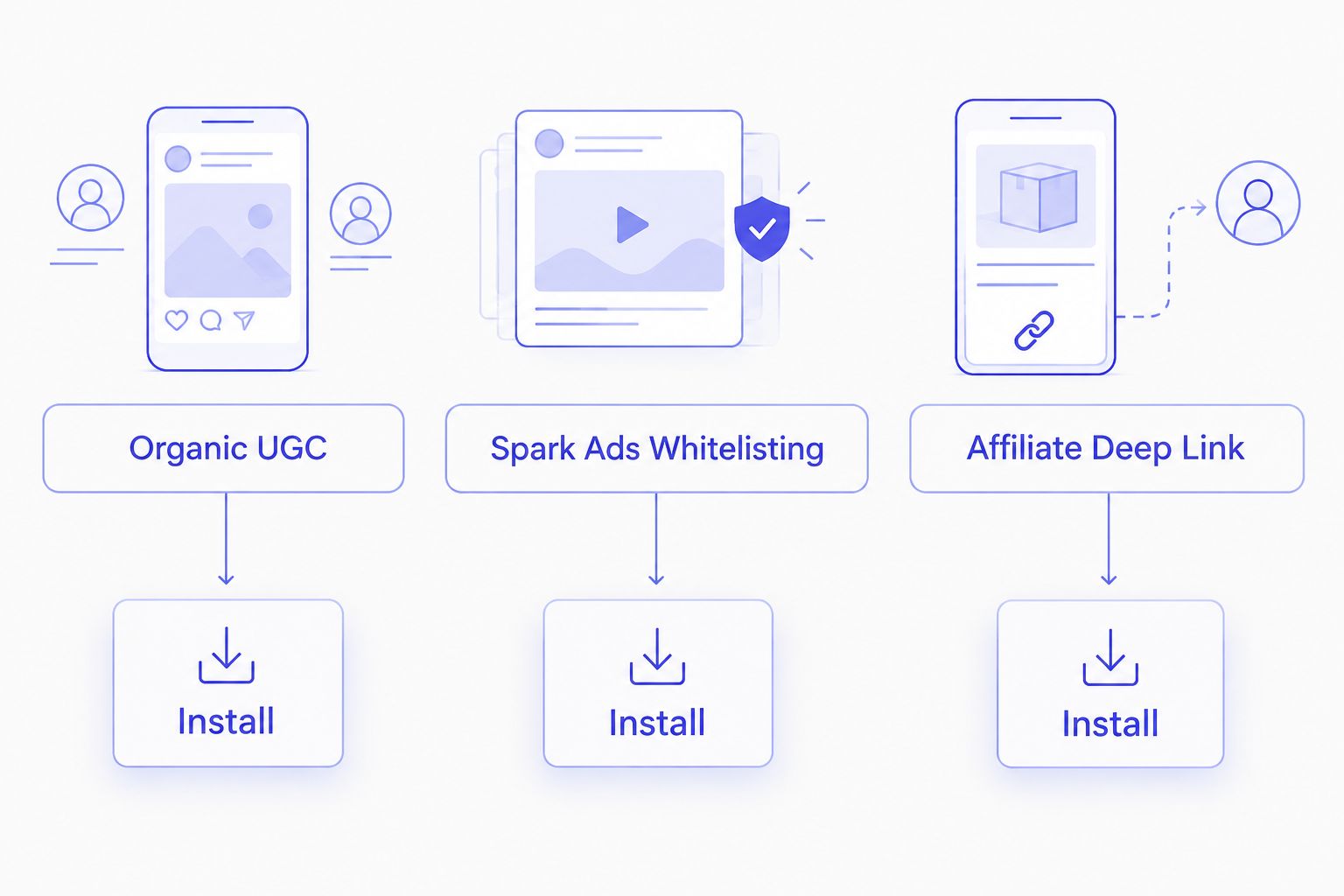
Yes — through one of three mechanisms wrapped around the creator content, each with a different attribution method and a different volume ceiling in 2026.
| Channel | How it drives installs | Attribution method | Best for |
|---|---|---|---|
| Organic UGC (creator's own feed) | Viewer taps the creator's bio link or searches the app name | Indirect — promo code redemption, branded search lift | Early awareness, unproven app categories |
| Whitelisted Spark Ads | Ad account boosts the organic post's reach with paid targeting | Direct — TikTok Ads Manager install events | Scaling creative that already proved organic pull |
| Affiliate deep link | Creator posts a trackable link built through an MMP | Direct — click-through and view-through windows in AppsFlyer, Branch, or Adjust | Apps with existing paid UA infrastructure |
Verdict: organic UGC alone is a discovery channel, not an install channel — pair it with whitelisting or a tracked link before judging it on install volume.
The Viral App treats organic view count as a filter, not a finish line: creators post first, and only the videos that already pull real watch-through get whitelisted into Spark Ads, so ad spend goes toward creative with proven pull instead of a cold guess.
Spark Ads whitelisting: the scalable path
Whitelisting hands a brand's ad account permission to run paid targeting behind a creator's organic post, keeping the creator's handle and comments while the brand controls budget and targeting. Because the ad runs through TikTok Ads Manager, installs attribute directly to the campaign the same way any other TikTok ad install would.
The catch: whitelisting an underperforming post just buys reach for content nobody was watching organically. Is TikTok Spark Ads worth it for app installs in 2026? walks through when the spend is justified and when it isn't.
Verdict: Buy for teams with UA budget and a piece of organic proof already in hand. Skip it for content that hasn't shown watch-through yet.
“Whitelisting doesn't fix content that never proved a hook organically.”
Organic UGC without whitelisting: the awareness path
A creator posting an app review or a use-case video with nothing behind it still moves the needle — it builds brand search volume, app store page visits, and social proof that shows up when a paid ad from the same brand runs later. What it doesn't do reliably is generate an install you can attribute to that single post.
Verdict: Hold — valuable for pipeline and creative testing, weak for standalone install counting.
Affiliate and deep-link tracking: the middle path
Running creator content through a mobile measurement partner turns a vague "did this post help" question into a real number. A creator gets a unique promo code or a Branch/AppsFlyer/Adjust deep link, and every install through that link attributes cleanly, the same way an affiliate program would.
This path takes setup — someone has to connect creator campaigns to the attribution stack before the first video goes live. How to connect creator campaigns to AppsFlyer attribution covers the mechanics.
Verdict: Buy for apps that already run paid UA and have an MMP in place. Wait if the app has no attribution stack yet — build that first.
Why the install rate varies
- App category and install intent — a fintech app with a longer signup flow converts differently from a mobile game with a one-tap install.
- Audience-app match — a creator whose audience already fits the app's target demographic converts better than one chosen for follower count alone.
- Attribution window — most mobile measurement partners default to something close to a 7-day click and 1-day view window, which can undercount installs that happen days after a view.
- Whitelisting ratio — how many of the total creators running content actually get boosted into Spark Ads versus left purely organic.
- App store listing alignment — installs drop off fast when the store page or onboarding doesn't match the hook the viewer just watched.
- Market readiness — scaling into new countries adds a variable most teams underestimate. A creator's hook can pull a viewer to tap install, but if the app store listing and onboarding copy haven't caught up to that market, the install-to-activation gain gets erased before it counts. Teams running creator campaigns across multiple countries in 2026 typically pair the content calendar with mobile app localization platforms so the post-install experience matches the language the video was shot in.
Related questions
Is organic TikTok still worth it for app growth in 2026?
Organic TikTok is still worth it for app growth in 2026 when it's used to find winning hooks before spending on ads, not as a standalone install channel. Treat it as creative research: the posts that pull real watch-through are the ones worth whitelisting into Spark Ads.
How much does TikTok influencer marketing cost in 2026?
Cost depends on creator tier, whether content is paid flat-fee or usage-based, and whether whitelisting fees are layered on top — enough variables that a single number misleads more than it helps. Compare quotes against the actual deliverables (raw footage, whitelisting rights, usage terms) rather than the sticker price alone.
Is TikTok Spark Ads worth it for app installs in 2026?
TikTok Spark Ads are worth it for app installs in 2026 when they boost content that already proved a hook organically. Boosting unproven creative just buys reach for a post nobody was watching in the first place.
See what a whitelisting-first campaign looks like
Creator content tested organically, then scaled into Spark Ads.
FAQ
Can TikTok influencer marketing drive app installs?
Yes, when organic creator content is whitelisted into Spark Ads or tied to a trackable promo code or deep link. Organic posts alone rarely produce an install you can attribute directly.
Is TikTok influencer marketing worth it for app installs in 2026?
It's worth it in 2026 when treated as creative testing that feeds paid amplification, not as a standalone install channel. Apps that skip the whitelisting step tend to see views without matching install volume.
How do you track app installs from TikTok creators?
Track installs through whitelisted Spark Ads in TikTok Ads Manager, a unique promo code per creator, or a deep link built through an MMP like AppsFlyer, Branch, or Adjust. Bio-link clicks alone give directional data, not a clean install count.
What's the difference between whitelisting and organic TikTok posting?
Whitelisting hands the brand's ad account permission to boost a creator's organic post with paid targeting and direct attribution. Organic posting alone relies on the creator's existing reach and a single bio link, with no direct install attribution.
Is organic TikTok still worth it for app growth in 2026?
Organic TikTok is still worth it in 2026 as creative research — it surfaces which hooks earn real watch-through before any ad spend goes behind them. It's weaker as a standalone install-driving channel.
Does TikTok influencer marketing work for fintech or subscription apps?
It works for fintech and subscription apps when paired with deep-link attribution, since these categories usually have longer signup flows that need tracking beyond a single video view. Organic-only campaigns struggle to prove install impact for these categories.
How many creators do you need before installs show up?
There's no fixed creator count that guarantees install volume, since results depend on audience-app fit and whitelisting ratio more than headcount. Running fewer creators through more whitelisting cycles typically outperforms running many creators organically.
Is TikTok Spark Ads worth it for app installs in 2026?
TikTok Spark Ads are worth it in 2026 when boosting a post that already proved a hook organically. Boosting unproven creative wastes ad spend on reach nobody was watching.
One last thing
The apps pulling the most install volume out of TikTok creators in 2026 aren't running more creators — they're running fewer creators through more whitelisting cycles, doubling down on the two or three hooks that already proved organic pull instead of chasing volume across dozens of accounts. Attribution beats reach every time this question gets tested.