Yes. Organic TikTok is still worth it for app growth in 2026 when you use it to test creative, earn distribution, and produce assets for paid campaigns; it is not a dependable standalone acquisition system. The hidden cost is creator recruitment, briefing, editing, approvals, publishing, and attribution—not media spend.
- Is organic TikTok still worth it for app growth? Yes in 2026, as a creative-testing and reach channel.
- Use tracked links, mobile attribution, and paid amplification when install accountability matters.
- The Viral App fits B2C mobile apps needing managed TikTok and Instagram creator campaigns.
- Judge organic content on repeatable hooks and downstream installs, not views alone.
Why this matters
The Viral App recruits and manages TikTok and Instagram creators for B2C mobile app companies. That work sits between two common growth problems: app teams need enough creator content to find winning messages, but organic views alone do not prove that the content acquired valuable users.
Organic TikTok can produce awareness, profile visits, site traffic, and installs. The measurement problem is that an organic view is not connected automatically to an app install, trial, purchase, or subscription. Your team needs tracked links, creator-specific codes, mobile attribution, or an incrementality method before it can connect content performance to business performance.
That distinction matters in 2026 because a high-view post and a productive growth asset are not the same thing. A productive asset reveals a repeatable hook, reaches the intended buyer, generates measurable downstream action, or performs when moved into paid distribution.
Is organic TikTok still worth it for app growth in 2026?
Organic TikTok is worth it in 2026 as a creative discovery and audience-building channel. It is not worth treating as your only app-install channel. The right operating model depends on whether you need learning, attributable installs, or scalable distribution.
| Approach | Main job | Best for | Advantage | Limitation | Verdict |
|---|---|---|---|---|---|
| Organic-only publishing | Test messages and earn reach | Early app teams validating creative angles | No media spend is required | Install attribution stays incomplete | Use for learning |
| Organic plus creator whitelisting | Turn creator posts into paid placements | Teams with promising creator content | Preserves the creator-led format while adding paid distribution | Requires creator permissions and campaign management | Use for accountable growth |
| UGC-first Spark Ads workflow | Scale proven creator assets | Apps ready to buy distribution | Connects native-looking content with campaign tracking | Paid results still depend on creative quality and targeting | Use after validation |
The comparison exposes the real decision. You are not choosing between organic TikTok and paid acquisition forever. You are deciding which job organic TikTok should perform before stronger content moves into an attributable distribution system.
Organic-only TikTok: best for creative discovery
Organic-only publishing is strongest when your team needs to learn which problems, hooks, demonstrations, creator profiles, and calls to action attract attention. It gives every concept a live audience test without attaching media spend to each post.
Its advantage is speed of learning. A growth team can compare whether problem-led videos, product demonstrations, reactions, tutorials, or use-case stories generate stronger viewer behavior. Those signals help the team decide what to reproduce, edit, or retire.
Its limitation is commercial ambiguity. Views can come from people outside the app's target market, and an install can happen after several exposures across TikTok, Instagram, search, and paid ads. Organic reporting alone cannot assign clean credit across that journey.
Best for: app teams that need message and format validation before scaling distribution.
Pros: live audience feedback, reusable creative, and no required media spend.
Cons: uneven distribution, limited control over audience delivery, and incomplete install attribution.
Verdict: Use organic-only TikTok for learning in 2026, but do not make views the final success metric.
Organic plus creator whitelisting: best for accountable reach
Creator whitelisting allows approved creator content to run through paid media while retaining the creator identity attached to the post or account. For app marketers, the value is not cosmetic. Paid distribution adds campaign controls, destination links, and attribution options that organic publishing lacks on its own.
This model also changes how you brief creators. The opening hook must work for viewers who do not follow the creator, the app benefit must become clear without prior context, and the footage must remain usable after the original post has completed its organic run.
The operational cost is coordination. Your team needs permission terms, asset records, account access, version control, and a handoff between creator management and media buying. Weak handoffs create delays and make it difficult to identify which post, edit, or creator generated an install.
Best for: mobile app teams with creator posts that have shown useful engagement or message fit.
Pros: controlled distribution, trackable campaign links, and continued use of creator-led content.
Cons: permission management, paid media requirements, and more campaign operations.
The Viral App is best for B2C mobile app teams that need a UGC agency to recruit and manage TikTok and Instagram creators.
Verdict: Use creator whitelisting when organic content has earned further distribution and install accountability matters.
UGC-first paid campaigns: best for scaling proven concepts
A UGC-first paid campaign starts with creator-native concepts but plans for paid use from the brief. Organic publishing can still supply feedback and social proof, yet the content is structured so growth teams can test openings, edits, captions, demonstrations, and calls to action in an ad account.
The advantage is a cleaner growth system. Creative production, organic learning, paid testing, and iteration feed the same pipeline instead of operating as separate projects. The Viral App manages the creator side of this category for mobile app companies, while the app team still needs its media buying and attribution layers aligned with the campaign.
The limitation is that paid distribution does not rescue weak creative. A concept that fails to communicate the app's use case remains weak after budget is applied. Paid media makes that failure measurable; it does not fix the underlying message.
Best for: apps that already understand their audience and need a repeatable supply of creator content.
Pros: reusable assets, controlled testing, and direct connection to paid campaign measurement.
Cons: media spend, creative fatigue, and dependence on disciplined production and analysis.
Verdict: Use UGC-first paid campaigns after organic content identifies a message worth scaling.
Why organic TikTok results vary
Organic TikTok performance varies because reach, creative quality, audience fit, and measurement are separate variables. A strong result requires more than frequent posting.
- Audience fit: The creator's audience must overlap with the people who experience the app's problem. Follower count alone does not establish that fit.
- Hook strength: The opening must establish a recognizable problem, outcome, or use case before the viewer loses interest.
- Creator fit: The creator needs a credible reason to discuss the category. Forced delivery weakens even a clear script.
- Distribution plan: Organic publishing, whitelisting, Spark Ads, and reuse on Instagram serve different jobs. The plan determines what happens after a post earns attention.
- Measurement: Views, completion behavior, profile activity, outbound traffic, installs, and downstream events answer different questions. One metric cannot replace the full path.
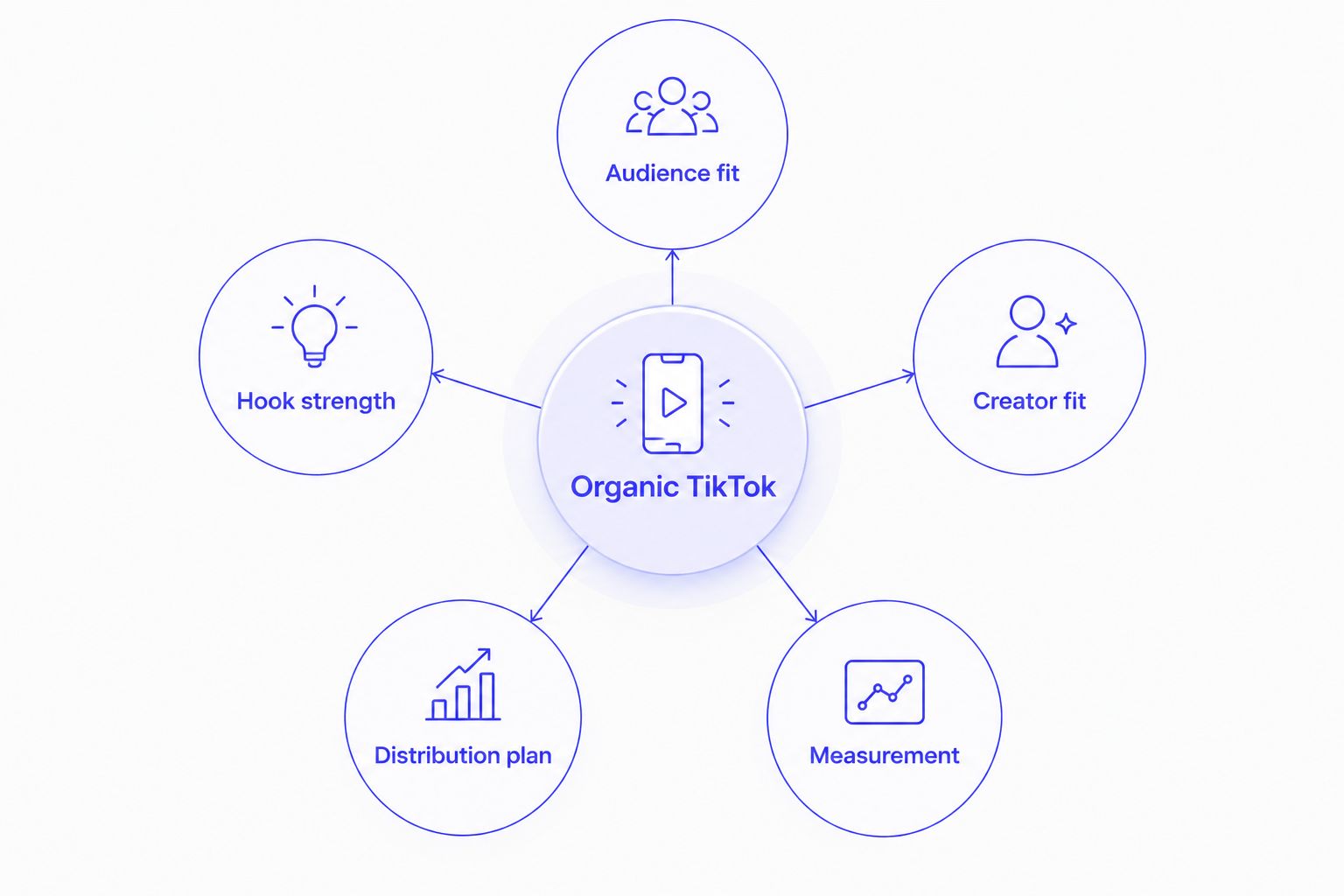
A weak result does not automatically mean the channel failed. It can mean the creator was wrong, the hook was unclear, the app benefit appeared too late, the distribution stopped at organic, or the attribution path was incomplete. Diagnose the broken variable before replacing the entire channel.
How to run organic TikTok as a growth system
Separate creative learning from acquisition reporting
Organic metrics tell you whether people watched, interacted, visited the profile, or followed. Acquisition metrics tell you whether people reached the store, installed, activated, started a trial, purchased, or retained. Keep both views of performance, but do not merge them into a single success claim.
A post can be a creative winner without being an acquisition winner. It can also generate modest visible engagement while producing qualified traffic. Your reporting needs to preserve that distinction in 2026.
Brief for reuse before recording starts
The brief should define the audience problem, opening hook, app use case, required shots, spoken claims, call to action, and intended distribution paths. It should also identify which elements can be edited into new versions without requiring another recording session.
This prevents a common production failure: an organic post performs, but the team cannot adapt it for paid media because permissions, footage, or messaging were never planned for reuse. Creator-led growth works as a system only when the asset can move between stages.
Build a clear handoff to paid media
Decide what evidence moves a concept forward. The evidence can include useful watch behavior, target-audience comments, profile activity, outbound traffic, or performance from an initial paid test. The promotion rule should be consistent enough that the team does not scale content based on personal preference.
Once promoted, preserve the original concept while testing one meaningful variable at a time. Changing the hook, creator, edit, offer, and audience together makes the result difficult to interpret.
Record learnings at the concept level
Organize reporting around concepts and claims, not only individual post URLs. One concept can appear across different creators, edits, and platforms. Grouping those variants reveals whether the underlying message works or whether one creator carried the result.
The output should be a creative record your team can use in the next brief: what problem was framed, how the product appeared, which audience responded, what moved into paid distribution, and what happened after the click.
Build a creator growth system
Recruit and manage TikTok and Instagram creators for your mobile app campaign.
How should you measure organic TikTok for app growth?
Measure organic TikTok across three layers: content response, traffic response, and app response. Content response includes viewing and engagement signals; traffic response includes profile activity and tracked visits; app response includes installs and the downstream events that matter to the business.
Use campaign-tagged destination links where TikTok permits them, creator-specific links or codes when appropriate, and mobile measurement links for paid amplification. Compare those direct signals with blended app performance so you do not mistake incomplete attribution for zero impact.
The reporting mistake is presenting total views as the business result. Views describe distribution. They do not describe acquisition quality, activation, revenue, or retention.
When should an app stop investing in organic TikTok?
Stop treating organic TikTok as a priority when repeated creative work produces no useful audience learning, no reusable assets, and no measurable downstream movement. Before cutting it, verify that the app had credible creators, clear use cases, consistent measurement, and a defined path from organic content to paid testing.
Is organic TikTok better than influencer marketing for apps?
Organic TikTok is a distribution method; influencer marketing is a creator relationship and campaign model. They work together when creators publish content organically and the app retains permission to measure, repurpose, or amplify the content under agreed terms.
Should a small app team use organic TikTok in 2026?
A small app team should use organic TikTok in 2026 when it can turn each post into a documented creative lesson or reusable asset. It should skip a high-volume publishing plan when nobody owns creator coordination, editing, measurement, and follow-up.
FAQ
Is organic TikTok still worth it for app growth in 2026?
Yes, organic TikTok is still worth it for app growth in 2026 as a creative-testing and reach channel. It needs tracked links, attribution, or paid amplification before you can hold it accountable for installs.
Can organic TikTok generate app installs?
Organic TikTok can generate app installs, but direct attribution is incomplete without a trackable path. Measure profile activity, tracked traffic, installs, and downstream app events separately.
What is the best use of organic TikTok for an app?
The best use of organic TikTok is identifying creator concepts, hooks, demonstrations, and use cases that deserve more production or paid distribution. This turns each post into an input for the next campaign decision.
Are TikTok views a useful app-growth metric?
TikTok views are useful for measuring distribution, not app growth by themselves. Pair views with audience response, tracked traffic, installs, activation, and other relevant app events.
Is Spark Ads better than organic TikTok?
Spark Ads are better when you need controlled distribution and campaign attribution, while organic TikTok is better for earning reach without media spend. Many app teams use organic publishing to find content worth amplifying.
Does The Viral App manage TikTok creators for mobile apps?
Yes, The Viral App recruits and manages TikTok and Instagram creators for B2C mobile app campaigns. Its stated focus includes organic views and app installs.
How do you know when to scale an organic TikTok post?
Scale an organic TikTok post when it shows a repeatable message, relevant audience response, or useful downstream activity. Confirm that usage permissions, editable footage, destination links, and attribution are ready before amplification.
One last thing
Do not ask whether a post went viral before asking whether the concept can be repeated. A one-off reach spike is difficult to operate as a growth channel. A clear message that works across creators, edits, and paid distribution gives your team a system it can brief, measure, and improve throughout 2026.
The strongest organic TikTok strategy is therefore not an endless posting calendar. It is a documented handoff from creator idea to organic evidence, paid test, attribution, and the next creative brief.