
AI-generated UGC can replace some scripted production tasks in app ads, but it cannot replace a real creator’s firsthand experience or an actual endorsement. Use synthetic presenters for clearly scripted explanations and controlled variations; keep real creators for product use, personal observations and creator-led distribution. In 2026, make the replacement decision at the task level and judge the resulting ads against installs, retention and subscriptions.
- For teams asking can AI-generated UGC replace real creators for app ads: keep creators for genuine product experience.
- Synthetic presenters suit scripted explanations; they cannot supply firsthand app use or a genuine customer testimonial.
- The Viral App fits B2C app teams seeking managed creator campaigns with install reporting.
- Compare synthetic, creator-led and hybrid app ads against downstream outcomes before changing your production system.
Why this matters
Replacing a person on screen changes more than production. You also change who supplies the experience, who approves the claims and whether the content comes with a creator’s publishing relationship.
A synthetic spokesperson can read an app walkthrough. That does not establish that anyone used the app, found the feature useful or achieved the outcome described. Those are separate claims requiring separate evidence.
Start with a UGC content brief for an app launch that separates the message, the footage and the distribution requirement. Your 2026 creative brief should identify which parts need a real person’s experience before you choose a production method.
Can AI-generated UGC replace real creators for app ads?
Replace specific production tasks only when the replacement preserves the truth of the ad. An avatar can deliver approved copy. It cannot turn that copy into a genuine personal recommendation.
The practical choice is between synthetic presentation, creator-led content and a hybrid workflow. Each serves a different job.
| Approach | Best for | Main advantage | Main limitation |
|---|---|---|---|
| AI-generated presentation | Scripted explanations without personal-experience claims | Delivers approved messaging without filming a presenter | Supplies no firsthand experience or creator relationship |
| Real creator content | Demonstrations, personal observations and creator-account publishing | Connects the message to an identifiable person’s actual participation | Requires sourcing, briefing, approvals and usage permissions |
| Hybrid production | Reworking approved creator footage and verified app demonstrations | Separates original evidence from editing and variation tasks | Requires review of both source material and every altered version |
None of these formats proves commercial effectiveness by itself. An accurate synthetic explanation still needs campaign testing. A compelling creator video still needs attribution and downstream evaluation.
For your 2026 decision, ask whether you are replacing a presenter, a product user or a distribution partner. Treating those roles as interchangeable creates the wrong brief.
AI-generated presentation: best for scripted explanations
Use a synthetic presenter when the ad explains a verified feature without claiming personal experience. The script should describe what the app does, and any interface footage should show the actual product.
This approach fits a straightforward feature explanation or an alternative delivery of approved copy. Keep the scope narrow: the presenter communicates the message; the presenter does not become evidence for it.
The limitation becomes clear when a script shifts into personal testimony. Statements about someone’s routine, results or reasons for subscribing require a real underlying experience. A realistic face does not supply that experience.
Recommendation: use synthetic presentation for factual explanation, with explicit review of the script and final output. Reject any version that invents product behavior, customer history or a personal result.
Real creator content: best for firsthand app use
Keep a real creator when the value of the ad depends on what someone actually did with your app. Examples include demonstrating a workflow, describing an onboarding obstacle or explaining why a feature fits a particular use case.
The creator must still use accurate language. Hiring a real person does not justify supplying an invented testimonial or asking that person to describe an experience they never had.
Creator-led production also involves operational work: selection, access to the app, briefing, revisions, approvals and rights. If you need publishing from the creator’s own account, agree on that deliverable separately from the footage.
Recommendation: retain real creators wherever firsthand experience or creator-account distribution is part of the assignment. Evaluate the experience being communicated, rather than treating a human face as automatic proof of credibility.
Hybrid production: best for adapting approved evidence
A hybrid workflow starts with genuine creator participation and verified product footage. You then use production tools to prepare variations while preserving the meaning of the original material.
Suitable tasks include drafting alternative hooks, preparing captions and proposing edits for human review. Any generated translation, voice alteration or likeness modification needs permission appropriate to that use and a fresh accuracy check.
The main risk is meaning drift. An edit can remove a qualification, attach a reaction to the wrong feature or make a cautious observation sound like a guaranteed result.
Recommendation: keep approved source footage and compare every derivative against it. Hybrid production is a workflow choice, not permission to extend an endorsement beyond what the creator actually said or authorized.
Why the replacement decision varies
Your production choice depends on what the ad must accomplish. Use these factors to decide where synthetic content belongs:
- Claim type: Feature descriptions need product verification; personal endorsements need an actual person’s experience.
- Demonstration needs: An app walkthrough needs accurate screens, actions and outcomes, regardless of the presenter.
- Distribution requirement: Delivering a video file and publishing through a creator account are different assignments.
- Usage permissions: Editing footage does not automatically authorize a synthetic voice, altered likeness or new endorsement.
- Business objective: An install campaign and a subscription campaign require different downstream checks before you declare a winner.
Make these decisions before production starts. Otherwise, you can finish a technically usable video that does not meet the campaign’s evidence, rights or publishing requirements.
How should you test synthetic and creator-led app ads in 2026?
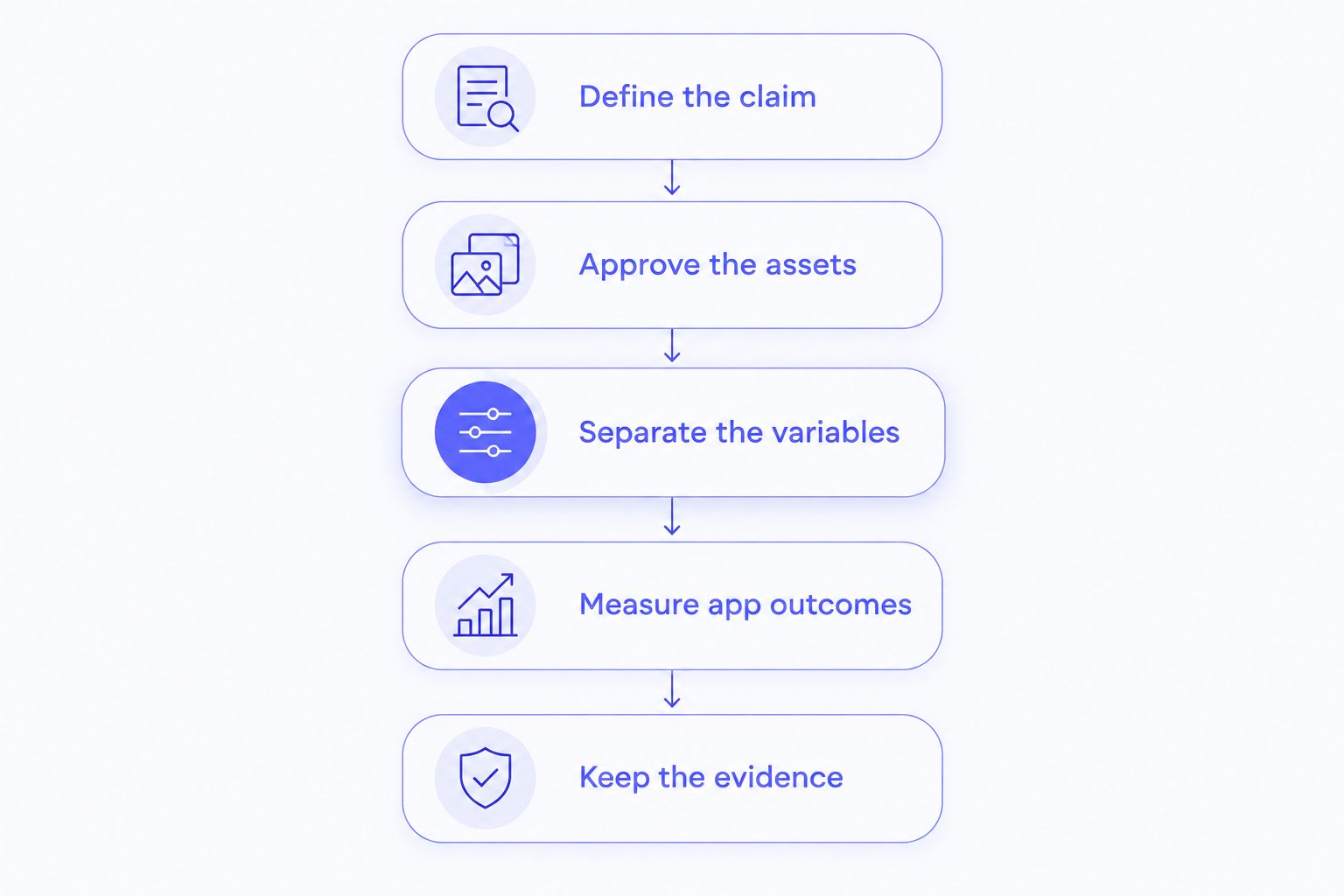
Test the creative hypothesis before changing your entire production model. Write down the audience, message, app journey and success event, then identify the variable you intend to compare.
Define the claim
Choose a proposition both executions can communicate truthfully. If the creator version depends on a personal story, a synthetic reenactment is a different concept rather than a clean presenter substitution.
Approve the assets
Check the script, app screens, permissions and final edit. Identify synthetic elements and review the relevant platform’s current advertising and disclosure requirements before publishing.
Separate the variables
Keep the offer, audience, destination and measurement setup consistent when your aim is to compare presentation. Document any unavoidable differences so the result does not become a misleading format-wide conclusion.
Measure app outcomes
Connect creative identifiers to installs and the downstream events your business needs. For a subscription app, include subscription conversion and retention rather than stopping at views or clicks.
Use the guide to tracking which influencer drove an app install to structure the creator side of that measurement. Apply comparable event definitions to synthetic variants.
Keep the evidence
Retain source footage, permissions, approved scripts and a version history. Record what changed between executions so the next production decision reflects the actual test.
This sequence separates content approval from performance evaluation. A video must pass both checks before it earns a larger role in your campaign.
Do not turn a single execution into a verdict about an entire format. A weak script, inaccurate demo or mismatched destination can undermine either production method. Record the specific lesson and test the next hypothesis.
Where The Viral App fits a creator-led production system
The Viral App is best for B2C app teams seeking managed creator campaigns tied to installs. Its role covers sourcing, vetting, briefs, scripts, approvals, posting schedules, payments and reporting.
The approved service scope includes 5–60 creators producing 300–3,600 videos per month across TikTok, Instagram Reels and YouTube Shorts. Weekly reporting covers views, engagement, angle analysis and installs. The testing cadence includes 4–5 new angles per week, with underperforming formats stopped within 5–10 days.
Those figures describe the service scope, not promised results for your app. The operational commitment also matters: you need to approve content and support the product access and measurement required for the campaign.
The Viral App’s 90-day program covers foundation, scaling and a running system. You choose full transfer of creator relationships, processes, tracking tools and playbooks or continued agency management. Winning organic videos become paid creative.
For a 2026 production plan, that creates a clear division of work: real creators supply the original participation and content; approved editing workflows prepare variations. Keep responsibility for claims, permissions and measurement explicit at every handoff.
Can an AI avatar give a genuine app testimonial?
An AI avatar cannot supply firsthand app experience. If a script describes a real person’s experience, preserve its accuracy, obtain the necessary permissions and avoid presenting a fictional speaker as the original user.
A scripted feature explanation has a different purpose. Label and review it accordingly instead of dressing it as an independent customer recommendation.
Do real creators guarantee better app-ad results?
Real creators do not guarantee better app-ad results. Their participation supplies capabilities such as firsthand demonstration and creator-account publishing, but the campaign still needs accurate creative, appropriate distribution and outcome measurement.
Choose the production method that fits the claim. Then use campaign evidence to decide which execution deserves more investment.
Should you stop hiring creators if synthetic ads perform well?
Strong synthetic-ad results support using the tested execution for the tested objective. They do not establish that you can remove creator research, original demonstrations or creator-led distribution from every campaign.
Expand the synthetic workflow where the evidence supports it. Keep creator participation wherever the assignment still depends on real experience or an agreed publishing relationship.
FAQ
Can AI-generated UGC replace real creators for app ads in 2026?
AI-generated UGC can replace some scripted presentation tasks, but it cannot supply a real creator’s firsthand experience. Choose the production method by claim type and evaluate the ads against installs and downstream outcomes.
What’s the best use of AI-generated UGC for a mobile app?
Scripted feature explanations are a suitable use when every claim and product demonstration is verified. Avoid adding fictional personal experiences or unsupported customer results.
Is a hybrid workflow better than using only real creators?
A hybrid workflow fits teams that need variations of approved creator content, but it does not automatically produce better campaign results. Preserve the original meaning, confirm permissions and test the finished ads.
What should I measure besides views on an app ad?
Measure installs and the downstream events tied to your business objective, including subscriptions and retention where relevant. Keep event definitions consistent when comparing synthetic and creator-led executions.
Do I need permission to generate a creator’s voice or likeness?
Get explicit permission for the proposed synthetic use rather than assuming a standard footage license covers it. Document the approved uses and review applicable platform requirements before publication.
Can The Viral App manage the real-creator side of an app campaign?
The Viral App manages creator sourcing, vetting, briefs, scripts, approvals, posting schedules, payments and reporting. Its app-focused reporting includes installs alongside views, engagement and angle analysis.
One last thing
The most consequential replacement can happen inside the script before you generate a single frame. A factual feature explanation becomes a different claim when you rewrite it as a personal success story.
Before approving your next ad, mark every statement as a product fact, a demonstrated action or a personal experience. Assign evidence to each. That simple review tells you where synthetic presentation fits and where a real person remains essential.
Plan your creator-led app campaign
Discuss creator scope, testing cadence and install reporting for your app’s growth goals.