The complete journey from running your first micro-influencer test to building an evergreen creator system that scales installs predictably. Covering organic-first testing, vetting and onboarding, campaign structures, UGC repurposing for paid ads, ROI-focused attribution, long-term relationship building, and the 2026 shifts redefining creator-led app growth.
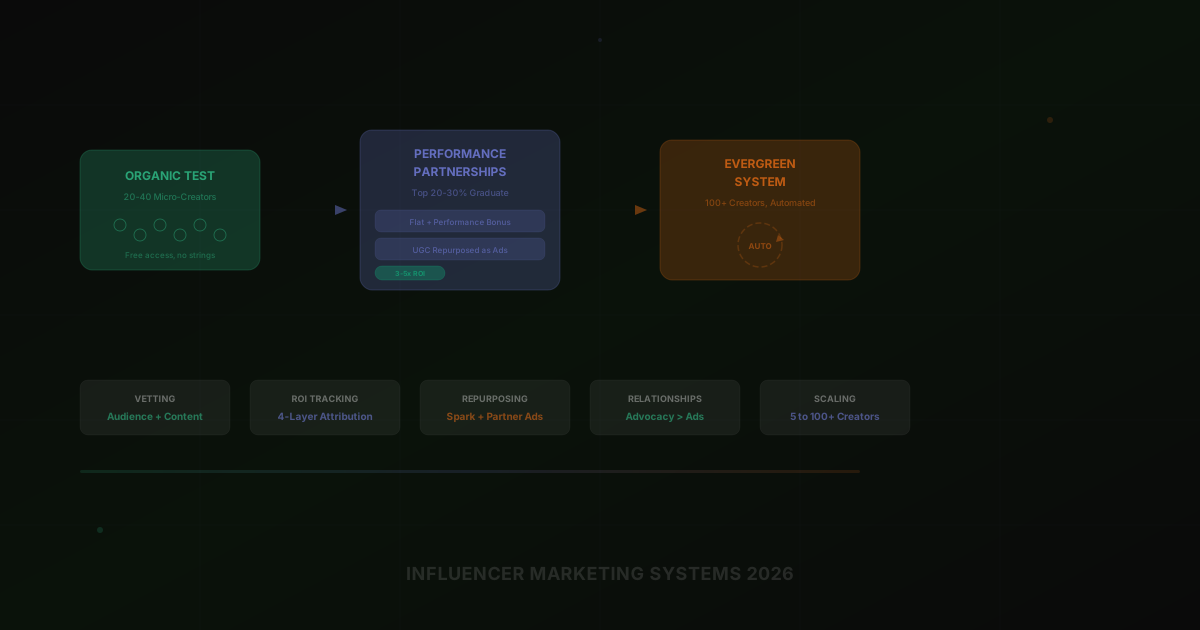
Influencer marketing for mobile apps has matured significantly since the early days of flat-fee sponsored posts. In 2026, the highest-performing app growth teams treat influencer partnerships not as a marketing channel but as a system — one that starts with organic micro-tests, graduates the best creators into performance-based partnerships, repurposes their content across paid channels, and compounds into an evergreen acquisition engine that runs with minimal ongoing management.
This guide maps the full journey from zero to a scaled influencer system. Whether you are running your first creator campaign or looking to systematize an existing program, the framework below will give you a clear path forward.
The core principle is simple: start organic, prove performance, then invest. Every dollar of influencer spend should be validated by organic testing data before it scales. This approach eliminates the single biggest failure mode in influencer marketing — paying for reach that does not convert.
Most app marketers approach influencer marketing backwards. They start by negotiating fees, signing contracts, and investing thousands of dollars before knowing whether a creator’s audience will actually convert into app users. The organic-first model flips this sequence.
Instead of paying for a sponsored post upfront, you provide the creator with free access to your app and a lightweight brief. They create content about your app organically — no sponsorship disclosure required because there is no payment. You track the performance of this organic content: views, engagement, profile visits, and (via UTM links or promo codes) actual installs.
This approach gives you three things no paid test can provide:
Step 1: Identify 20–40 micro-creators in your app’s niche (5K–50K followers). Look for creators who already post content related to your app’s category — fitness creators for fitness apps, study creators for education apps, cooking creators for recipe apps. The closer the organic content alignment, the higher the conversion potential.
Step 2: Send a value-first outreach message. Do not pitch a partnership. Instead, offer genuine value: “We built [app name] and think you’d genuinely love it based on your content about [specific topic]. Happy to give you full premium access — no strings attached. If you end up making content about it, that’s awesome, but zero pressure.”
Step 3: Track everything. For each creator who posts about your app, track: views, engagement rate, comments mentioning the app, profile visits to your account, link clicks (if they use your UTM link), installs, and day-1 retention of those installs. Build a simple scorecard for each creator.
Step 4: Graduate the top performers. After 2–4 weeks of organic testing, you will have clear data on which creators drive real results. The top 20–30% of your test cohort become candidates for paid partnerships. The rest remain in your “organic network” — you keep sending them app updates and new features, and they continue posting occasionally because they genuinely use the product.
Once a creator passes your organic test, the vetting process shifts from “can they create good content?” (already proven) to “can we work together reliably and at scale?”
Audience authenticity. Check for inflated follower counts. Tools can analyze a creator’s follower growth curves, engagement-to-follower ratios, and comment quality. A creator with 15K followers and 8% engagement is far more valuable than one with 100K followers and 1.5% engagement driven by bots.
Audience demographics. Request the creator’s analytics screenshots showing age, gender, and geographic distribution of their audience. If your app targets US females 18–25 and 60% of the creator’s audience is male or outside the US, the partnership will underperform regardless of content quality.
Content consistency. Review their last 30–60 posts. Do they post regularly (at least 3–5 times per week)? Is the content quality consistent or erratic? Have they done brand partnerships before, and how did those perform relative to their organic content?
Communication reliability. How responsive were they during the organic test phase? Creators who take 3–5 days to respond during the low-stakes organic phase will be even harder to coordinate during paid campaigns with deadlines.
Brand safety. Review their content history for anything that could create reputational risk if associated with your brand. This is not about policing opinions — it is about ensuring alignment with your app’s values and audience expectations.
Once a creator passes vetting, onboard them with a structured kit that sets clear expectations from day one:
The campaign structure you choose determines both the economics and the scalability of your influencer program. Here are the four main models, ranked from simplest to most sophisticated:
The simplest structure: you pay a fixed amount per video. Typical rates for micro-influencers (5K–50K) range from $100–$500 per video in 2026. This model is easy to budget and manage, but it creates no incentive for the creator to optimize for your conversion goals. Best for: initial paid tests with new creators where you need cost predictability.
A base fee per video plus a bonus tied to performance metrics — typically installs, but it can also be tied to views or engagement thresholds. Example: $200 base + $1 per verified install above 50 installs. This structure aligns the creator’s incentive with your goals while providing enough base compensation that creators feel fairly valued. Best for: creators who have proven they can drive installs during the organic test phase.
No flat fee — the creator earns purely based on installs, activations, or even revenue generated. This is the most capital-efficient model but requires creators who trust your tracking and are willing to take on risk. Typical structures: $2–$5 per install, or 10–20% of first-month revenue from attributed users. Best for: established relationships with proven creators who have consistently driven installs. Not recommended for new partnerships.
A monthly retainer for ongoing content creation — typically 4–8 videos per month plus ad-hoc content (stories, comments, community engagement). This model builds the deepest creator-brand relationship and produces the most authentic content because the creator becomes a genuine long-term user and advocate. Monthly retainers for micro-creators range from $500–$2,000 in 2026. Best for: your top 3–5 creators who have consistently outperformed across multiple campaigns.
Recommended Progression:
Organic test → Flat fee (2–3 videos) → Flat fee + bonus (next 5–10 videos) → Retainer (for top performers). This progression lets you validate ROI at every stage before increasing commitment. Never jump straight to retainers with unproven creators.
One of the highest-leverage moves in influencer marketing is repurposing top-performing creator content as paid ad creative. Organic UGC that has already proven it resonates with audiences consistently outperforms purpose-built ad creative by 2–3x on ROAS.
Step 1: Secure ad usage rights upfront. Include ad usage rights in every creator contract from day one. Specify: platforms where the content can be used as ads, duration of ad usage rights (we recommend 6–12 months minimum), and whether the content can be modified (cropped, re-edited, combined with other elements). If you do not have ad rights, you will need to renegotiate — which is more expensive and slower than including it in the original deal.
Step 2: Identify repurposing candidates. Not every organic post makes a good ad. Look for content that has: high engagement rate (above your baseline), strong watch-time completion (above 50% average), positive comment sentiment (people asking about the app, not just engaging with the creator), and a clear product demonstration or value proposition within the first 3 seconds.
Step 3: Adapt for paid formats. Organic content needs adjustments for paid distribution. Add a stronger, more direct CTA (organic posts can be subtle; ads need to drive action). Tighten the pacing — paid content has even less margin for slow moments. Add branded end cards or overlays if required by the platform. Ensure the hook works for cold audiences who do not know the creator.
Step 4: Use Spark Ads and Partnership Ads. On TikTok, Spark Ads let you promote existing organic posts from the creator’s account, preserving the social proof (existing likes, comments). On Instagram, Partnership Ads (formerly Branded Content Ads) serve the same function. These formats consistently outperform running the same content from your brand account because they carry the creator’s authority and existing engagement.
A single piece of creator content that costs $200–$500 to produce can generate $5,000–$50,000+ in paid media value when it resonates. The math is simple: if a creator video costs $300 and, when amplified as a Spark Ad, drives 2,000 installs at $2 CPI, that is $4,000 in acquisition value from a $300 content investment. Add the organic installs from the original post, and the ROI compounds further. This is why securing ad usage rights is so critical — it transforms a one-time content investment into a scalable acquisition asset.
Influencer marketing attribution is notoriously messy. Unlike paid ads with deterministic click tracking, influencer content drives installs through a combination of direct links, organic search, and word-of-mouth that can be hard to attribute. Here is how to build a tracking system that captures as much value as possible:
Layer 1: Direct attribution via unique links. Every creator gets a unique UTM-tagged link and/or a unique promo code. This captures installs where the user clicked the creator’s link directly. Expect this to capture only 30–50% of actual influenced installs — many users will see the content, remember the app name, and search for it later without using the link.
Layer 2: Post-install surveys. Add a “How did you hear about us?” question during onboarding. Keep it simple: one multiple-choice question with options including “TikTok/Instagram creator.” This catches the users who saw creator content but did not use the tracking link. Survey data typically attributes an additional 15–25% of installs to influencer content.
Layer 3: Correlation analysis. Compare your daily install curves against creator posting schedules. When a creator posts, you should see a measurable spike in organic installs within 24–48 hours, even from users who did not use the link or answer the survey. Correlation analysis captures the “halo effect” of influencer content that direct attribution misses.
Layer 4: Cohort quality analysis. Track the downstream behavior of influencer-attributed users versus other acquisition channels. Measure D1, D7, and D30 retention, monetization rate, and lifetime value. Influencer-acquired users often retain 20–40% better than paid ad-acquired users because they come with higher intent and trust. This retention premium should be factored into your ROI calculations.
ROI Formula:
Influencer ROI = (Total Attributed LTV − Total Influencer Cost) / Total Influencer Cost
Where Total Attributed LTV includes all four attribution layers, and Total Influencer Cost includes fees, product costs, and management overhead. A healthy influencer program targets 3–5x ROI at the portfolio level (some creators will underperform, others will massively overperform).
The most valuable influencer relationships are the ones where the creator becomes a genuine advocate for your product — not because you are paying them, but because they actually use and love it. Building these relationships requires deliberate investment beyond the transactional:
Involve creators in product development. Share upcoming features with your top creators before launch. Ask for their feedback. When they see their suggestions implemented, they develop a sense of ownership that translates into more authentic content. The best creator-brand relationships feel like collaborations, not transactions.
Create exclusive creator communities. Build a private group (Discord or Slack) for your top 10–20 creators. Facilitate peer connections, share performance insights (their own metrics, anonymized peer benchmarks), and create a sense of belonging to something bigger than individual paid posts.
Provide growth support. Help your creators grow their own channels. Share content strategy insights, offer to cross-promote their best content on your brand channels, and connect them with other opportunities in your network. When you invest in a creator’s growth, they reciprocate with deeper loyalty and better content.
Celebrate publicly. Feature your top creators on your brand’s social accounts, website, and marketing materials. Public recognition builds the creator’s personal brand while strengthening the association between your app and trusted voices in the community.
Increase compensation with performance. As a creator consistently delivers results, proactively increase their compensation before they ask. Creators talk to each other — being known as a brand that rewards loyalty attracts better talent and reduces churn from your best performers.
Creator-led advocacy over creator-led advertising. The most effective influencer content in 2026 does not look like advertising at all. It looks like a creator genuinely sharing something they use and love. This shift means that the organic-first approach described above is no longer optional — it is the baseline for competitive influencer programs. Audiences can instantly detect when a creator is reading from a script they do not believe in.
Platform-native commerce integration. TikTok Shop, Instagram Shopping, and emerging platform commerce features are creating new attribution pathways for app installs. Creators can now link directly to app store pages from in-video shopping tags, stories, and live streams. These integrations provide better tracking data and shorter conversion paths.
AI-assisted creator matching. New tools use AI to analyze creator content, audience demographics, and historical performance data to predict which creators will convert best for a specific app. This reduces the guesswork in creator selection and compresses the organic testing phase by pre-filtering for high-probability matches.
Long-form returning as a complement. While short-form (TikTok, Reels, Shorts) remains the volume play, YouTube long-form creator content is experiencing a resurgence for app promotion. A 10–15 minute “I used this app for 30 days” video builds significantly more trust than a 30-second TikTok and drives higher-quality installs (better retention, higher LTV). The best 2026 strategies pair short-form volume with long-form depth.
Regulatory maturation. FTC and international equivalents are enforcing disclosure requirements more aggressively. All paid partnerships — including gifted products and affiliate deals — require clear disclosure. Build compliance into your process from the start rather than treating it as an afterthought.
Mistake: Optimizing for follower count instead of engagement quality
Teams chase creators with 500K+ followers, paying premium rates, and get mediocre results because the audience is broad and disengaged.
Fix: Use engagement rate as your primary selection criterion. A creator with 10K followers and 9% engagement will almost always outperform one with 200K followers and 2% engagement for app installs.
Mistake: Over-scripting creator content
Providing word-for-word scripts kills the authenticity that makes creator content effective. The content looks and feels like an ad, and both audiences and algorithms penalize it.
Fix: Provide talking points and key messages, never full scripts. Let the creator interpret your brief in their own voice and style. The best creator content sounds nothing like your marketing copy — and that is the point.
Mistake: One-and-done campaigns
Running a single sponsored post with a creator and then moving on to the next one. You never build trust, never get repeat exposure, and never benefit from the compound effect of audience familiarity.
Fix: Commit to at least 3–5 posts with any creator you engage. Audiences need multiple exposures before they act. The third or fourth post from the same creator typically converts 2–3x better than the first.
Mistake: Ignoring post-install quality
Celebrating install volume without tracking whether those users actually activate, retain, and monetize. Some creators drive thousands of installs that churn within 24 hours.
Fix: Track cohort quality (D1/D7/D30 retention, activation rate, LTV) for every creator. Grade creators on downstream value, not just install volume. Reallocate budget from high-volume/low-quality creators to lower-volume/high-quality ones.
Mistake: No content repurposing strategy
Letting great creator content live only as organic posts on the creator’s account, missing the opportunity to amplify winners through paid channels.
Fix: Include ad usage rights in every contract. Build a systematic process for identifying organic winners and promoting them as Spark Ads / Partnership Ads. This one change can 3–5x the value of your influencer investment.
Scaling an influencer program is not about linearly adding more creators. It is about building systems that allow you to manage more creators with the same (or less) effort per creator. Here is the blueprint for scaling from a handful of partnerships to a full evergreen system:
This is the manual phase. You are personally managing every relationship, reviewing every piece of content, and tracking performance in spreadsheets. The goal is not efficiency — it is learning. Understand what makes a great creator for your app, which content formats drive installs, and what compensation structures motivate the best work. Document everything — these learnings become the playbook for the next phase.
Replace manual processes with systems. Create templated briefs, automated tracking dashboards, standardized contracts, and a creator CRM that tracks performance history, communication preferences, and content cadence. Hire or designate a dedicated influencer manager. Batch communication — weekly check-ins with your creator cohort instead of ad-hoc individual messages. At this scale, you should be spending less than 30 minutes per week per creator on management.
At this scale, you need automation for recruitment, onboarding, content approval, performance tracking, and payment processing. Use creator platforms for discovery and outreach at scale. Implement automated content approval workflows where straightforward content gets approved without manual review, and only flagged content requires human attention. Build automated performance reports that grade creators monthly and trigger compensation adjustments.
The ultimate state: your influencer program runs as a self-sustaining system. New creators enter through automated organic testing pipelines. Proven creators graduate into paid tiers automatically based on performance data. Content flows through AI-assisted variation and repurposing pipelines. Top performers are identified and promoted to ambassador roles. Underperformers are gracefully off-boarded. The system produces a predictable volume of installs per month with minimal management overhead.
Scaling Milestones:
The teams winning at influencer marketing in 2026 are not the ones running the best individual campaigns. They are the ones who have built systems — repeatable, scalable, data-driven systems that turn creator relationships into predictable app growth engines.
The journey from your first organic micro-test to a fully evergreen creator system takes 3–6 months of deliberate work. But the compound returns are enormous: once the system is running, it produces content, installs, and revenue with decreasing marginal cost per unit of output.
Start with the organic-first approach. Test with 20–40 micro-creators. Graduate the top performers into paid partnerships. Repurpose their best content for paid amplification. Track ROI at every layer. Build long-term relationships with your best creators. Systematize and automate as you scale. That is the path from zero to an evergreen influencer growth engine — and it starts this week.
The Viral App builds end-to-end influencer marketing systems for B2C mobile apps — from creator recruitment and organic testing to performance partnerships, UGC repurposing, and evergreen scaling. Let’s design your system.
Schedule a Strategy CallMicro-influencers vs macro for app growth: which delivers better ROI in 2026? Data-driven comparison with real campaign insights.
The complete UGC manager playbook for 2026. Learn how to recruit creators, manage operations, and scale content research.
Measure the real ROI of your UGC and influencer campaigns. Discover the metrics and attribution models that matter most for app growth in 2026.