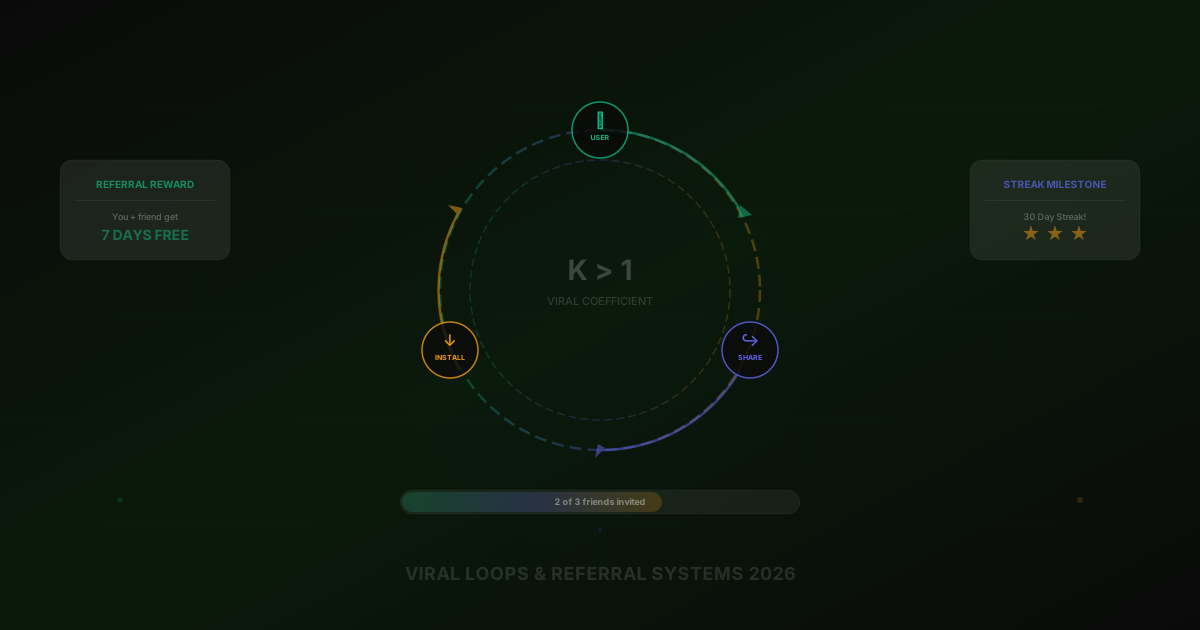
Introduction: Why K-Factor > 1 Changes Everything
Every mobile app has a viral coefficient, whether its team has measured it or not. The viral coefficient — commonly called the K-factor — answers a single question: for every user you acquire, how many additional users do they bring in?
The math is simple. K = (invitations sent per user) × (conversion rate per invitation). If each user invites 5 people and 25% of those invitations convert, K = 1.25. That means every 100 users generate 125 new users, who generate 156 more, who generate 195 more. Growth compounds exponentially. You've achieved the holy grail: K > 1.
In reality, sustained K > 1 is rare and typically short-lived. Most successful consumer apps operate with a K between 0.3 and 0.8 — meaning organic sharing amplifies every paid or content-driven install by 30–80%. That amplification alone can cut your effective cost per acquisition in half. At K = 0.5, every 100 paid installs produce 50 organic installs for free. At K = 0.7, they produce 70. Over months, this compounds into hundreds of thousands of installs you didn't pay for.
The difference between apps with a K of 0.1 and apps with a K of 0.6 isn't luck. It's deliberate loop design — engineering the moments, incentives, and mechanics that make users invite, share, and broadcast without friction. This guide covers how to build those loops from scratch: the psychology that makes them work, the specific loop types that drive installs in 2026, the technical implementation, and the measurement systems you need to optimize them.
No abstract theory. Every section includes implementation details, benchmarks, and patterns drawn from apps across habit tracking, fitness, language learning, budgeting, and social categories.
1. The Psychology of Viral Loops: Why People Share
Before building any mechanic, you need to understand why users share. No amount of clever UI can overcome a fundamentally weak psychological trigger. Three principles drive virtually all effective viral loops in consumer apps:
FOMO (Fear of Missing Out)
FOMO is the most powerful short-term sharing trigger. When users see that their friends are participating in something — a challenge, a streak, an exclusive feature — the anxiety of being left out drives action faster than any rational benefit calculation.
- How to activate it: Show users that their contacts are already using the app. Display social proof within the invite flow: "3 of your friends are already here." Use limited-time challenges or events that create urgency: "Join the 7-day challenge before Friday."
- Why it works in 2026: Short-form social media has trained users to respond to urgency and exclusivity. The same psychology that makes people watch a TikTok "before it gets taken down" makes them accept an app invite "before the challenge ends."
- Application example: A habit tracker shows a prompt: "Your friend Sarah just completed a 30-day streak. Start yours and compare progress." The implied competition + the fear of falling behind drives both the install and the first week of engagement.
Reciprocity
Reciprocity is the human instinct to return a favor. When someone gives you something of value, you feel psychologically compelled to give something back. In viral loop design, this means the inviter must receive genuine value for sharing, and the invitee must receive genuine value for accepting.
- How to activate it: Double-sided rewards where both the inviter and the invitee benefit. "You get a free month of premium, and so does your friend." The inviter doesn't feel like they're selling; they feel like they're doing their friend a favor. The invitee accepts because they're receiving a gift, not responding to marketing.
- Critical detail: The reward must feel proportional to the ask. Asking someone to download and sign up for an app (a 3–5 minute commitment) in exchange for a cosmetic badge is insulting. Offering them a free month of premium features (real value) feels fair. The perceived value of the reward relative to the perceived effort of the action determines whether reciprocity activates or backfires.
- Application example: A language learning app offers: "Give your friend 7 days of unlimited lessons. When they sign up, you get 7 days too." Both parties get genuine value. The inviter isn't selling; they're sharing access to something they already enjoy.
Social Proof & Identity Signaling
People share things that make them look good. A shared achievement, a milestone, or a piece of content that signals a desirable identity ("I'm someone who works out," "I'm disciplined," "I'm financially savvy") gets shared not because of the app but because of what sharing says about the person.
- How to activate it: Create shareable moments that double as identity statements. A completed workout summary isn't just data — it's a public signal of discipline. A savings milestone isn't just a number — it's a statement about financial responsibility. Design share cards that are visually appealing and clearly communicate the achievement.
- The identity test: Before building any share mechanic, ask: "Would a user be proud to share this on their Instagram Story?" If the answer is no, redesign the share moment. Nobody shares a generic "I used this app today" card. They share "I just completed 100 workouts" or "I saved $5,000 this year" because those achievements reflect positively on their identity.
- Application example: A fitness app generates a year-in-review card: total workouts, total weight lifted, longest streak, personal records. The card is beautifully designed with the user's name and stats. Users share it because it's a public celebration of effort, not because the app asked them to.
2. Top Viral Loop Types Ranked by Impact
Loop Type 1: Double-Sided Referral Programs
Mechanic: Both the referrer and the referred user receive a reward when the new user completes a qualifying action (install + sign up, or install + complete onboarding).
Why it works: Reciprocity eliminates the social awkwardness of inviting. The referrer isn't asking for a favor — they're offering one. This is the single most predictable and scalable viral loop for B2C apps. Well-implemented double-sided referrals consistently produce 15–35% of total new user acquisition for top consumer apps.
Optimal reward structure:
- For subscription apps: Both parties get 7–30 days of premium free. This also serves as a trial conversion mechanism for the invitee.
- For freemium apps: Both parties unlock a premium feature permanently (a specific workout plan, an advanced analytics dashboard, a special theme).
- For gamified apps: Both parties receive in-app currency, XP boosts, or exclusive cosmetic items.
Key benchmarks: Expect 8–15% of users to send at least one referral invite, and 15–30% of invited users to install. This means for every 1,000 active users, a well-designed referral loop generates 12–45 new installs per month — entirely free.
Loop Type 2: Streak & Milestone Shares
Mechanic: When a user hits a meaningful milestone (7-day streak, 50th workout, first $1,000 saved), the app generates a visually shareable card and prompts sharing to social media or messaging apps.
Why it works: This leverages identity signaling — users share milestones because they're proud, not because you asked. The shared content functions as organic advertising: friends see the achievement, see the app's branding subtly embedded, and a percentage install out of curiosity or aspiration.
Design principles:
- Make the share card beautiful. Instagram Story-optimized dimensions (1080×1920). Clean typography. The user's achievement large and center. App branding small and tasteful — bottom corner, not dominating the visual.
- Choose milestone thresholds carefully. Too frequent (every day) = annoying and ignored. Too rare (only at 365-day streak) = most users never reach it. Ideal cadence: Day 3, Day 7, Day 14, Day 30, Day 50, Day 100, then every 50. Each milestone should feel earned but achievable.
- Make sharing feel optional, not forced. A gentle prompt ("Share your achievement?") with an easy dismiss option. Never gate functionality behind sharing. Users who share voluntarily create vastly more authentic (and effective) social proof than users who share because they had to.
Benchmarks: Well-designed milestone shares see 20–35% share rates at key milestones (Day 7, Day 30 are highest). Each shared card reaches an average of 50–200 people (varies by platform and user's following). Conversion from seeing a shared card to installing averages 1–3%.
Loop Type 3: Shareable Output Visuals
Mechanic: The app generates a visual artifact from the user's activity — a workout summary, a budget breakdown, a language learning progress chart, a mood board — designed specifically for social sharing.
Why it works: Unlike milestone shares (which are event-triggered), output visuals can be generated on-demand after every session. This creates high-frequency sharing opportunities without milestone fatigue. A fitness app user might share their workout summary 3–4 times per week. Each share is a micro-impression for the app brand.
What makes an output visual shareable:
- It tells a story at a glance. "45 min full body workout | 340 calories | 12 exercises completed." The viewer instantly understands what happened.
- It looks native to social platforms. Design it to look like a naturally shared Story, not a corporate infographic. Use the same visual language as popular Instagram templates.
- The app name is present but not dominant. Small logo in the corner, "Tracked with [App Name]" in subtle text. The user's achievement is the headline, not the app.
- It includes one actionable element. A QR code, a deep link, or a simple "Try it: [appname].com" gives curious viewers a frictionless path to install.
Benchmarks: Apps with well-designed output visuals see 15–30% of active users sharing at least one visual per month. Power users (top 10%) may share 10–20 times per month. Each share generates 0.5–2 installs on average, depending on the user's social reach.
Loop Type 4: Invite-Gated Rewards & Social Unlocks
Mechanic: Specific features or content unlock when the user invites a certain number of friends. "Invite 3 friends to unlock the advanced analytics dashboard" or "Invite 5 friends to access the premium workout library for free."
Why it works: This creates a clear value exchange with a specific threshold. The user knows exactly what they need to do (invite 3 people) and exactly what they'll get (premium features). The specificity of the threshold matters: "invite friends" is vague and generates low response. "Invite 3 friends" is concrete and achievable.
Important caveats:
- Never gate core functionality. If a user can't meaningfully use the app without inviting friends, they'll churn instead of inviting. The gated reward should be a bonus, not a requirement. The free version must stand on its own.
- Make the gated content genuinely desirable. If the unlockable feature isn't something users actually want, the invite incentive falls flat. Test by surveying: "Which premium feature would you most want for free?" Use the top answer as your invite reward.
- Show progress. A visual progress bar ("2 of 3 friends invited") creates a completion drive (the Zeigarnik effect — people are psychologically compelled to finish incomplete tasks). This alone can boost invite completion rates by 25–40%.
Benchmarks: Invite-gated rewards with a threshold of 3 invites see 10–20% of exposed users completing the full invitation cycle. Higher thresholds (5+) drop completion to 5–10% but generate more total invitations per completing user.
Loop Type 5: Collaborative & Competitive Social Features
Mechanic: Features that require or are enhanced by having friends in the app — shared challenges, group streaks, leaderboards among friends, collaborative goals.
Why it works: This is the deepest form of viral loop because the product itself becomes more valuable with more users. A solo habit tracker is useful. A habit tracker where you can see your friends' streaks and compete on a weekly leaderboard is addictive. The social dynamic creates both an acquisition mechanism (you need friends in the app to compete) and a retention mechanism (you don't want to break your streak because your friend is watching).
Implementation patterns:
- Friend challenges: "Challenge a friend to 7 days of meditation. Track each other's progress." Requires both to have the app.
- Group goals: "Create a group: '10K Steps Club.' Invite friends and track collective progress toward 1 million steps."
- Leaderboards: Weekly leaderboard among the user's invited friends. Resets weekly to keep competition fresh. Only visible to connected friends (not global — global leaderboards are demotivating for most users).
Benchmarks: Users who connect with at least one friend in-app have 2–4x higher Day-30 retention than solo users. Each socially connected user invites an average of 2.5 additional friends over their lifetime, creating a powerful compounding loop.
3. Implementation Blueprint: From Design to Production
SDK Integration for Deep Linking & Attribution
The technical foundation of any viral loop is deep linking — the ability to send someone a link that opens the app (or the app store if not installed) and lands them in the right place with the right context. Without deep linking, referral flows break at every transition point.
- Choose a deep linking provider. Branch.io is the industry standard for consumer apps. Alternatives: AppsFlyer OneLink, Adjust, Firebase Dynamic Links (deprecated but still functional). All provide deferred deep linking (preserving context through the app store install) and attribution tracking.
- Implement deferred deep linking. When User A shares a referral link, and User B clicks it, goes to the app store, installs, and opens the app, the deferred deep link must: (a) attribute the install to User A, (b) apply the referral reward to both users, and (c) deep link User B to the relevant onboarding screen. If any of these steps fail, the loop breaks and both users have a bad experience.
- Configure server-side reward fulfillment. Never fulfill referral rewards client-side. A server-side system should: verify the referred user completed the qualifying action (install + sign up + complete onboarding), check for fraud (same device, same IP, suspicious patterns), and then trigger reward delivery to both users simultaneously. Client-side reward logic is trivially exploitable.
- Set up attribution windows. Define how long after clicking a referral link an install still counts as referred. Standard window: 7–14 days for click-through, 24–48 hours for view-through (if you're tracking impression-level data on shared cards).
One-Tap Sharing: Reducing Friction to Zero
Every additional tap in the share flow reduces sharing by 20–30%. The difference between a 3-tap share and a 1-tap share can be the difference between 5% of users sharing and 25%. Engineer for minimum friction:
- Use the native share sheet. iOS
UIActivityViewController, Android Intent.ACTION_SEND. Don't build a custom share modal. Users know how the native share sheet works. It surfaces their most-used apps (iMessage, WhatsApp, Instagram) automatically.
- Pre-populate the share message. The user should never have to type. Pre-fill with a short, natural-sounding message: "I've been using [App] to track my workouts — it's been awesome. Try it: [link]." Let them edit it if they want, but default to something that works as-is.
- Pre-generate the share card. For visual shares (milestones, output visuals), the image should be rendered and ready before the user taps "Share." Any loading delay between tapping and seeing the share sheet kills momentum.
- Place share triggers at emotional peaks. Don't put the share button in settings or on the profile page. Place it at the moment of maximum positive emotion: immediately after completing a workout, immediately after hitting a streak milestone, immediately after seeing a dramatic progress chart. Timing matters as much as design.
A/B Testing Incentive Structures
Never assume you know what reward will motivate sharing. Test systematically:
- Test reward type: Premium time (7 days free) vs. premium features (unlock specific tool) vs. in-app currency vs. cosmetic items. Different user segments respond to different reward types.
- Test reward magnitude: 3 days free vs. 7 days vs. 14 days vs. 30 days. There's typically a sweet spot where increasing the reward no longer proportionally increases sharing. Find it.
- Test threshold levels: "Invite 1 friend" vs. "Invite 3 friends" vs. "Invite 5 friends." Lower thresholds produce higher completion rates but fewer total invites. Higher thresholds produce lower completion but more invites per completing user. Optimize for total downstream installs, not completion rate alone.
- Test share copy: The pre-populated share message significantly impacts invite acceptance rates. Test 3–5 variations: benefit-focused ("Get free premium"), social-proof-focused ("I've been using this and it's great"), and curiosity-focused ("You need to try this").
- Run each test for a minimum of 2 weeks with at least 1,000 users per variant to achieve statistical significance. Viral loop metrics are inherently noisy — don't make decisions on small samples.
4. Combining Viral Loops with UGC: The Compounding Engine
The most powerful growth systems don't treat viral loops and UGC as separate strategies. They integrate them into a single compounding engine where shareable in-app outputs become organic content that drives new users into the same loop.
The Share-to-Content Pipeline
Here's how the integration works in practice:
- User completes an action (finishes workout, hits habit streak, reaches savings goal).
- App generates a shareable visual (progress card, achievement badge, summary graphic) optimized for Instagram Stories and TikTok.
- User shares to their social feed. The visual includes subtle branding and a call-to-action.
- Their followers see the visual. Some are inspired, some are curious, some experience FOMO. A percentage click through or search for the app.
- New users install, complete onboarding, and begin their own journey. They hit their own milestones, generate their own shareable visuals, and the cycle repeats.
This is the loop that turns user activity into organic advertising without anyone feeling like they're advertising. The key insight: the user shares because they're proud of their achievement, not because the app is paying them to share. The marketing effect is a byproduct of genuine user satisfaction.
Making User-Shared Content Algorithm-Friendly
The shareable assets you generate should be designed for platform algorithms, not just human viewers:
- For Instagram Stories: Full-screen vertical format (1080×1920). Include interactive elements that encourage responses — a question sticker prompt built into the design ("What's your longest streak?"), a poll-ready layout, or a challenge tag.
- For TikTok: Generate short video clips (5–15 seconds) rather than static images. An animated progress chart or a countdown of achievements with music performs vastly better than a still image. TikTok's algorithm prioritizes video content with motion.
- For WhatsApp/iMessage: Smaller, lighter-weight images that load instantly in chat. Include a deep link in the accompanying text that opens directly to the app or app store.
Seeding the Loop with Creator Content
The challenge with user-generated share loops is the cold-start problem: you need active users to generate shareable content, but you need shareable content to acquire users. Break the cold start by:
- Having UGC creators demonstrate the share flow. A creator's video showing them completing a workout and then sharing their result card to Stories normalizes the behavior for new users. It shows them what's possible and plants the idea of sharing before they've even installed.
- Creating challenge content that requires sharing. "7-Day Challenge: Share your daily result card on Stories and tag 3 friends." This turns the share mechanic into content, which drives installs, which drives more sharing.
- Featuring user-shared content on your own channels. Repost the best user-generated result cards and milestone shares on your brand's TikTok and Instagram. This validates the sharing behavior ("other people are doing this") and incentivizes more users to share in hopes of being featured.
5. Measurement Deep Dive: Viral Coefficient Calculation & Attribution
Calculating Your Viral Coefficient
The K-factor formula is simple, but measuring its inputs accurately requires careful instrumentation:
K = i × c
- i = average invitations per user. Count all sharing actions: referral links sent, milestone cards shared, output visuals posted, challenge invites sent. Sum across all loop types and divide by total users in the measurement cohort.
- c = conversion rate per invitation. Of all invitations/shares sent, what percentage resulted in a new install? This requires attribution data from your deep linking provider. Be precise: an "invitation" is a share action; a "conversion" is a completed install attributed to that share.
Example calculation: In a given month, 10,000 active users generated 3,500 total share actions (referrals + milestone shares + output visuals). Those 3,500 shares resulted in 420 attributed new installs. i = 3,500 / 10,000 = 0.35. c = 420 / 3,500 = 0.12. K = 0.35 × 0.12 = 0.042.
That's a low K. To reach K = 0.5, you need to either increase invitations per user (get more users to share, or get sharers to share more often) or increase conversion per invitation (improve share card design, improve the invitee landing experience, offer a better incentive).
Breaking Down K by Loop Type
Don't just track aggregate K. Track it per loop type to identify where to invest optimization effort:
- K (referral program): Typically the highest-converting loop because of the direct incentive. Expected range: K = 0.05–0.20.
- K (milestone shares): Lower conversion per share (no incentive for the recipient) but potentially high share volume. Expected range: K = 0.01–0.08.
- K (output visuals): Highest frequency sharing but lowest per-share conversion. Expected range: K = 0.005–0.05.
- K (social features): Hardest to measure but often the largest contributor at scale. Expected range: K = 0.02–0.15.
Total K is the sum of all loop-type K-values. If you have 4 loops each contributing K = 0.05, your total K = 0.20. Stacking multiple loop types is how you reach meaningful K-factor levels without requiring any single loop to carry the entire load.
Attribution Challenges & Solutions
Measuring viral loops accurately is harder than measuring paid acquisition because the attribution chain is longer and more fragile:
- Challenge: Dark social. Users share referral links via WhatsApp, iMessage, and DMs — channels your analytics can't see. A significant portion of viral installs will appear as "organic" or "direct" in your attribution. Solution: Compare install velocity on days with high sharing activity versus baseline. The delta gives you an estimate of dark social contribution. Also, use promo codes as a fallback attribution mechanism — even if the deep link attribution fails, the promo code captures the referral.
- Challenge: Multi-touch attribution. A user might see a friend's milestone card on Stories, then see a TikTok UGC video, then search in the App Store and install. Which channel gets credit? Solution: Use a multi-touch attribution model that gives fractional credit to each touchpoint. Or, pragmatically, use last-touch attribution for simplicity and accept that viral loops will be systematically undercounted — which means your true K is likely higher than your measured K.
- Challenge: Fraud. Users creating fake accounts to claim referral rewards. Solution: Require the referred user to complete a meaningful action beyond install (complete onboarding, use the app for 3+ days, or complete a first session) before triggering reward fulfillment. Device fingerprinting and IP-based fraud detection can catch the most common patterns.
The Viral Cycle Time
K alone doesn't tell the full story. Viral cycle time (ct) — the average time between a user signing up and their referred user signing up — determines how quickly K compounds. K = 0.5 with a 3-day cycle time grows dramatically faster than K = 0.5 with a 30-day cycle time. Optimize for shorter cycles by triggering share prompts early in the user journey (Day 1–3), not only after users have been active for weeks.
6. 2026 Best Practices
Seamless UX Above Everything
In 2026, users have zero tolerance for clunky share experiences. The invite/share flow must feel as native and frictionless as sending a text message. Specific standards:
- No account creation required before seeing the referral option. Let users invite friends during or immediately after onboarding, while motivation is highest.
- Instant share card generation. Any delay between tapping "Share" and seeing the share sheet breaks the emotional momentum. Pre-render share assets in the background.
- One-tap accept on the recipient side. The invitation recipient should go from tapping a link to using the app in under 60 seconds. Deep link directly into the relevant experience with the referral context preserved.
- Reward confirmation for both parties should be immediate and visible. The referrer should see "Your friend joined! You both got 7 days of premium" within seconds of the referred user completing signup.
Non-Gating Rewards: Enhance, Don't Block
The most common mistake in viral loop design is gating core functionality behind social actions. This creates resentment, not sharing. In 2026, the best-performing apps follow a clear principle: sharing enhances the experience but is never required for it.
- Do: Unlock bonus content, premium trials, cosmetic items, or advanced features through referrals.
- Don't: Block the user from using the next lesson, the next workout, or the next budget category unless they share. This feels manipulative and drives negative reviews.
- The test: Can a user who never shares or invites anyone still have a complete, satisfying experience with your app? If yes, your loop design is sound. If no, you've crossed from incentive into coercion.
Platform-Specific Optimization
Different platforms require different share formats:
- Instagram Stories: Optimized for vertical image cards with interactive sticker prompts. Users in the 18–34 demographic share here most.
- TikTok: Video clips outperform static images by 3–5x. If you can generate a short animated version of your share card, do it.
- WhatsApp/iMessage: Text + deep link. Keep the pre-populated message under 100 characters. Include a rich link preview (Open Graph tags) so the link shows a compelling thumbnail in the chat bubble.
- Twitter/X: Image card + short text. Focus on shareworthy data points ("I just saved $2,400 in 90 days with [App]").
7. Case Pattern Examples: How Different App Categories Build Loops
Habit Tracking Apps
Primary loop: Streak milestone shares. Users are deeply attached to their streaks and sharing a "30-day streak" card is a badge of honor. Day 7, 14, 30, 50, and 100 are the highest-engagement milestone points.
Secondary loop: Friend accountability groups. "Create a group of 3–5 friends and track your habits together. If anyone breaks their streak, the group gets notified." This drives invitations through social pressure and massively boosts retention — users are 3x less likely to break a streak when friends are watching.
Tertiary loop: Weekly summary output visuals. Every Sunday, the app generates a summary of the week's habits completed. Clean, colorful, designed for Stories. Shows the user's consistency rate and top habits. Shared widely because it signals discipline and self-improvement.
Combined K potential: 0.15–0.40 when all three loops are active.
Language Learning Apps
Primary loop: Double-sided referral with lesson credit. "Give your friend 10 free lessons. When they complete 5, you get 10 free too." The qualifying threshold (5 completed lessons) ensures the referred user has experienced enough value to retain.
Secondary loop: Progress comparison shares. "Share your Spanish level with friends. Compare who's learning faster." Progress-based competition between friends creates natural FOMO and friendly rivalry.
Tertiary loop: Challenge mechanics. "30-Day Spanish Challenge: Complete a lesson every day for 30 days. Share your daily progress." Each daily post becomes organic content featuring the app.
Combined K potential: 0.20–0.50 when all three loops are active.
Fitness / Workout Apps
Primary loop: Post-workout output visuals. After every session, generate a summary card: exercises, sets, duration, calories, personal records highlighted. Fitness users share these reflexively — it's both accountability and flex.
Secondary loop: Group challenges. "Create a 30-day push-up challenge with friends. Track reps daily. Winner gets bragging rights." Requires all participants to install the app. Each challenge group averages 4–6 participants, meaning each initiator invites 3–5 people.
Tertiary loop: Year-in-review summaries. Annual wrap-up cards showing total workouts, total volume lifted, longest streak, most-trained muscle group. These go viral organically every December–January.
Combined K potential: 0.25–0.60 when all three loops are active. Fitness apps tend to have the highest natural sharing rates because workout achievements are socially desirable to broadcast.
Social & Community Apps
Primary loop: Collaborative features that require friends. The app's core value proposition improves with each connected friend. This makes the viral loop inseparable from the product itself — users invite friends not because of incentives but because the app is better with friends.
Secondary loop: Content sharing. User-created content (posts, stories, media) that's designed to be shareable outside the app, with deep links back in.
Combined K potential: 0.30–1.0+. Social apps have the highest ceiling for viral coefficient because the product/loop integration is deepest.
8. Common Failures & Solutions
Failure 1: Invisible Share Triggers
Problem: You built a referral system but buried the invite button in Settings > Account > Refer a Friend. 2% of users even know it exists.
Solution: Place share triggers at emotional peaks within the core user flow. After a workout completion, after a streak milestone, after a dramatic progress chart. The share prompt should appear when the user is feeling their best about the app — not when they're managing their account settings.
Failure 2: Rewards That Don't Match Value
Problem: "Invite 5 friends to earn a badge!" Nobody invites 5 people for a cosmetic badge in an app they've been using for a week.
Solution: The reward must have genuine, perceivable value. Free premium time is the most universally effective reward because its value is concrete and immediately understood. Test different reward types and magnitudes. If your share rate is below 5% of active users, your reward is likely too weak.
Failure 3: Broken Deep Links
Problem: Users share referral links, but when recipients click, they land on the generic app store page with no referral context preserved. No attribution, no reward fulfillment, terrible recipient experience.
Solution: Test your deep link flow end-to-end on every major device and OS version. Test with the app installed and not installed. Test from every major sharing platform (iMessage, WhatsApp, Instagram DMs, email, Twitter). Deep linking is fragile — one misconfigured redirect can break the entire loop. Invest engineering time in making this bulletproof.
Failure 4: Referral Fraud That Goes Unchecked
Problem: Power users create fake accounts to claim referral rewards. You're giving away premium access to the same person 50 times.
Solution: Require meaningful qualifying actions: the referred user must complete onboarding AND use the app for a minimum of 3 days before rewards unlock. Implement device fingerprinting to detect multiple accounts from the same device. Set per-user referral caps (e.g., maximum 20 successful referrals). Monitor for unusual referral patterns and investigate outliers.
Failure 5: Measuring Shares but Not Downstream Impact
Problem: You track how many users share but not how many installs those shares produce. Your product dashboard shows "1,200 shares this month" with no connection to install or revenue data.
Solution: Build the full attribution chain from share action to install to retention to revenue. Without this end-to-end measurement, you can't calculate K, you can't A/B test incentives, and you can't prioritize which loop type to invest in. Use your deep linking provider's attribution data combined with your analytics platform to build the complete picture.
9. 30-Day Launch Checklist: Building Your First Viral Loop
Week 1: Foundation (Days 1–7)
- Day 1–2: Audit your current sharing behavior. Before building anything, check your analytics: are users already sharing screenshots, screen recordings, or mentions of your app organically? If yes, your job is to formalize and amplify what's already happening. Document every natural share moment.
- Day 2–3: Choose your primary loop type. Pick the loop with the highest expected impact for your category (referral, milestone shares, output visuals, or social features). Don't try to launch all four simultaneously. Start with one.
- Day 3–4: Integrate deep linking SDK. Set up Branch.io (or your chosen provider). Configure deferred deep links, test on iOS and Android, verify attribution tracking works end-to-end.
- Day 5–7: Design and build the share card/visual. If you're doing milestone shares or output visuals, design the card. Instagram Story dimensions (1080×1920). User's data prominent. Branding subtle. Test rendering on 5+ different devices for quality assurance.
Week 2: Build (Days 8–14)
- Day 8–10: Implement the share flow. Build the trigger point (milestone hit, session complete), the share card generator, and the native share sheet integration. One-tap from trigger to share sheet. Pre-populated message with deep link.
- Day 10–12: Build the referral reward system. Server-side reward fulfillment. Fraud prevention rules (device fingerprinting, qualifying actions, per-user caps). Real-time reward confirmation notification for both inviter and invitee.
- Day 12–14: End-to-end testing. Test the entire flow on every major device, OS, and sharing channel. Click the referral link from iMessage, WhatsApp, Instagram DMs, email, Twitter, and Facebook Messenger. Verify attribution, deep linking, and reward fulfillment in every path. Fix every broken link or failed redirect.
Week 3: Launch & Measure (Days 15–21)
- Day 15: Soft launch to 10–20% of users. Use feature flags to roll out the viral loop to a subset of users. Monitor for technical issues, unexpected behavior, and initial share rates.
- Day 16–18: Monitor and fix. Watch for: deep link failures, reward fulfillment delays, share sheet crashes, and fraud attempts. Fix issues in real time.
- Day 18–19: Measure baseline metrics. Calculate initial K-factor, share rate (% of users who share at least once), invites per sharing user, and conversion per invite. Document these as your baseline.
- Day 20–21: Full rollout. If no critical issues emerged during soft launch, roll out to 100% of users.
Week 4: Optimize (Days 22–30)
- Day 22–25: Launch A/B tests. Test two reward types (e.g., 7 days premium vs. 14 days premium). Test two share message variations. Test two share trigger placements. Run each test with at least 1,000 users per variant.
- Day 25–28: Analyze results. Which reward produced more sharing? Which message produced higher invite acceptance? Which placement had higher share rates? Implement the winners.
- Day 28–30: Plan your second loop. Based on what you've learned, design your second viral loop type. If your primary loop was referrals, add milestone shares. If it was output visuals, add a referral program. Stack loops incrementally.
What you should have by Day 30: One fully functional viral loop live to all users, baseline K-factor measured, at least one A/B test completed, initial optimization implemented, and a plan for your second loop type. Your total K should be measurable (even if small) and you should have a clear understanding of which variables to optimize to increase it.
Conclusion: Loops Are Infrastructure, Not Features
The most important mindset shift for app teams building viral loops: loops aren't features you ship once and forget. They're growth infrastructure that requires continuous measurement and optimization.
A referral program that launches with K = 0.05 can reach K = 0.20 through systematic A/B testing of rewards, messaging, placement, and timing. A milestone share system that starts with 5% share rates can reach 25% through better card design, smarter milestone selection, and improved trigger timing. Each incremental improvement to each loop type compounds into aggregate K-factor gains that transform your growth economics.
The apps that dominate their categories in 2026 don't have one magic viral trick. They have 3–5 loop types running simultaneously, each contributing K = 0.05–0.15, stacking to a total K of 0.30–0.60. That means every 100 users they acquire through content or paid channels generate 30–60 free users through organic loops. Over time, this advantage compounds until organic loop-driven installs exceed externally-driven installs — and growth becomes self-sustaining.
Start with one loop. Measure it. Optimize it. Add a second. Repeat. The math is on your side.
We'd love to hear what you're building. Share in the comments:
- What's your app's current K-factor? If you haven't measured it yet, what's stopping you?
- Which loop type are you most excited to implement first? What's your biggest hesitation?
- Have you tried a referral program before? What worked and what didn't?
- What's the most creative share mechanic you've seen in another app? How could you adapt it?
- How do you balance incentivizing sharing without making the app feel spammy or desperate?
Build the loop. Measure the coefficient. Let compounding do the rest.