Introduction: The Algorithm Is the Distribution Channel
TikTok doesn't work like other platforms. On Instagram, your reach is primarily determined by your follower count. On YouTube, it's a combination of subscribers and search ranking. On TikTok, the algorithm decides who sees your content regardless of how many followers you have. A brand-new account with zero followers can reach 500,000 people with its first video if the algorithm detects the right signals.
For mobile app marketers, this is both the opportunity and the challenge. The opportunity: with the right short-form video strategy, you can reach millions of potential users organically without spending a dollar on ads. The challenge: the algorithm is ruthlessly meritocratic. It doesn't care about your brand, your budget, or your production quality. It cares about whether viewers watch, rewatch, share, and engage. Nothing else.
In 2026, the algorithm has evolved significantly from 2023–2024. The signals it prioritizes have shifted. The content styles that earn distribution have changed. The old tricks — engagement bait, comment fishing, like-for-like pods — are now actively penalized. What works is simultaneously simpler and harder: create content that genuinely holds attention, and the algorithm will do the rest.
This guide breaks down exactly how the 2026 TikTok algorithm works, what signals matter most, how to engineer hooks that stop the scroll, and how to translate algorithmic reach into actual app installs. Everything here is specific to the current algorithm environment — not recycled advice from 2023.
1. How the For You Page Actually Works in 2026: Test → Expand Cohorts
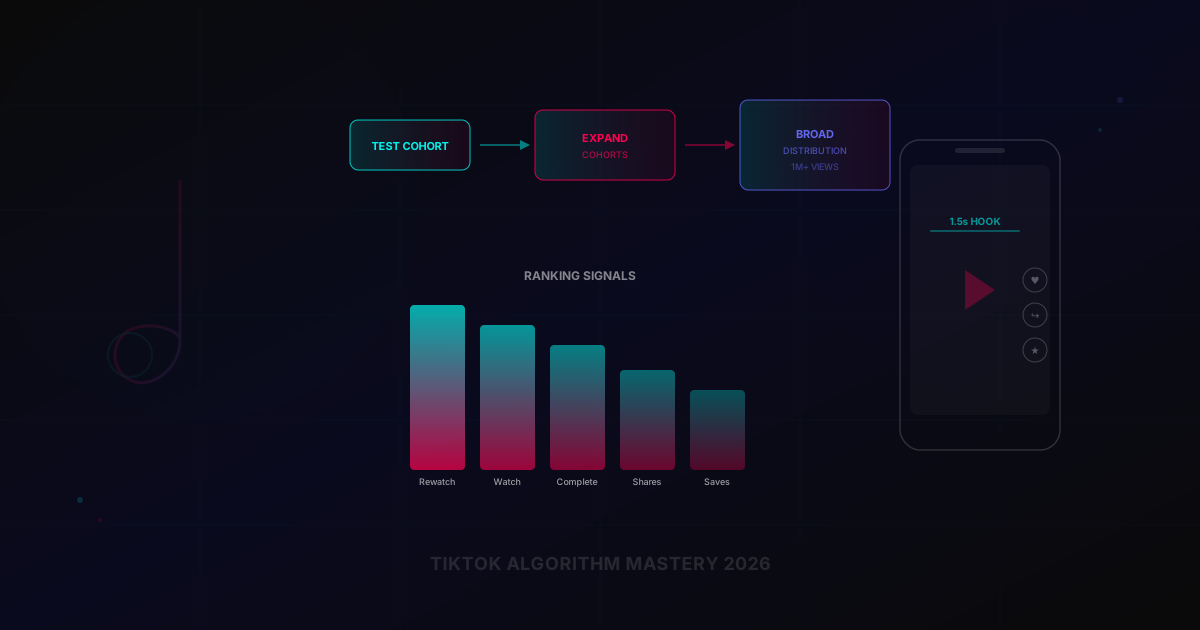
TikTok's distribution system operates on a cascading cohort model. Understanding this model is essential because it determines when and why your video either dies at 300 views or explodes to 3 million.
Stage 1: The Initial Test Cohort (0–500 views)
Every video you publish, regardless of account size, is first shown to a small test cohort of 200–500 users. These users are selected based on a combination of your account's historical topic clustering (what content you've posted before), the video's metadata (caption text, hashtags, sounds), and a degree of randomness to test new audience segments.
The algorithm monitors this test cohort intensely. Within the first 30–60 minutes of publishing, it measures: how many users swiped away immediately, how many watched past 3 seconds, how many watched the full video, how many rewatched, and how many took actions (like, comment, share, save, follow, profile visit). These signals determine whether the video advances or dies.
Critical insight: Your video's fate is largely determined by its performance with these first 200–500 viewers. If 60%+ swipe away within 2 seconds, the video is effectively dead — it won't be shown to wider audiences. If 50%+ watch to completion and a meaningful percentage take actions, the algorithm escalates.
Stage 2: The Expansion Cohorts (500–10,000 views)
Videos that clear the initial test threshold are pushed to progressively larger cohorts — 1,000 users, then 5,000, then 10,000. At each stage, the algorithm evaluates whether the content maintains its engagement signals at scale. Many videos that performed well with 500 viewers see their metrics drop at 5,000 (because the audience becomes less targeted). Only videos that sustain high retention across expanding, increasingly diverse audiences continue advancing. For more insights, read our guide on retention mastery for B2C apps.
Stage 3: Broad Distribution (10,000–1M+ views)
Videos that maintain strong signals through multiple expansion cohorts enter broad distribution — they appear on the For You Page of users with no prior connection to your account or topic. This is where viral reach happens. The algorithm continues monitoring, and a sharp drop in engagement at any point can halt distribution. This is why some videos plateau at 50K views while others push through to 500K+.
Stage 4: Extended Distribution Windows (2026 update)
A significant 2025–2026 change: TikTok now distributes content over longer time windows. Previously, a video's distribution largely peaked within 24–48 hours. Now, videos that maintain strong engagement can receive new distribution waves 3–7 days after posting, sometimes even weeks later. The algorithm resurfaces "evergreen" content that continues to perform when shown to new cohorts. This rewards content with lasting value over content that relies on momentary trends.
What this means for app marketers: Don't evaluate a video's performance after 24 hours. Wait at least 72 hours, and check again at 7 days. A video that seems to stall at 2,000 views on Day 1 may receive a second wave and reach 50,000 by Day 5. Patience and data discipline are more important than ever.
2. Top Ranking Signals in 2026, Ranked by Algorithmic Weight
Not all engagement signals are equal. The algorithm assigns different weights to different actions. Here's the hierarchy, from most impactful to least, based on 2026 behavior patterns:
Tier 1: Durable Attention Signals (Highest Weight)
- Rewatch / Loop Rate. The percentage of viewers who watch your video more than once. This is the single most powerful signal in 2026. A video that 15% of viewers loop or replay will receive exponentially more distribution than one with 2% loop rate, even if the second video has more total views. The algorithm interprets rewatching as the strongest possible indicator of content quality — the viewer found it valuable enough to consume again. Target: >8% is strong, >15% is exceptional.
- Average Watch Time / Qualified Views. Not raw view count — how long people actually watch. The algorithm calculates average watch time as a percentage of total video length AND as an absolute duration. A 30-second video with 20 seconds average watch time (67%) outperforms a 15-second video with 12 seconds (80%) because the absolute attention captured is higher. Qualified views (watched >5 seconds) are the real reach metric. Everything under 5 seconds is effectively a swipe-away. Target: >65% of total views should be qualified.
- Completion Rate. The percentage of viewers who watch to the end. This has always been important but its weight has increased relative to surface engagement (likes). For videos under 30 seconds, target >70%. For 30–60 seconds, target >50%. For 60–90 seconds, target >35%. If you're below these thresholds, your content is losing people mid-video and the algorithm will restrict distribution.
Tier 2: Active Engagement Signals (High Weight)
- Shares (especially DM shares). A share is the strongest explicit endorsement a viewer can give. DM shares — sending a video directly to a specific friend — carry more weight than generic shares to Stories because they represent personal recommendation. Target: >1.5% share rate is good, >3% is viral-tier.
- Saves. Saving a video to "Favorites" indicates the viewer found lasting value — they want to return to it. Saves have become increasingly weighted in the 2026 algorithm because they signal content depth, which TikTok rewards as it competes with YouTube for educational and informational content. Target: >2% save rate.
- Comments (quality-weighted). Not all comments are equal. Long, substantive comments (more than 5 words) carry more weight than emoji-only reactions. Comments that ask questions or start discussions signal genuine engagement. The algorithm can now distinguish between authentic discussion and engagement-bait responses ("Comment YES if you agree!"). Target: >1% comment rate with substantive responses.
Tier 3: Secondary Signals (Moderate Weight)
- Profile Visits & Follows. When a viewer visits your profile after watching, the algorithm infers that the content was compelling enough to trigger curiosity about the creator. Follows from non-followers are a strong positive signal. For app marketing, profile visits are also your bridge metric to installs (bio link).
- Likes. Yes, likes are in Tier 3. This is the biggest shift from 2022–2023. Likes are now the weakest of the major engagement signals. The algorithm treats a like as a low-effort positive signal — better than nothing but far less meaningful than a share, save, or extended watch time. Don't optimize for likes.
- Search Impressions (2026 rising signal). Content that appears in TikTok search results and receives clicks from search queries earns a distribution bonus. The algorithm increasingly treats search performance as an independent ranking factor, separate from For You Page performance. Videos that rank for high-volume search terms receive sustained, long-tail distribution.
Negative Signals (Will Kill Distribution)
- "Not Interested" taps. When viewers long-press and select "Not Interested," this is the strongest negative signal. A high rate of "Not Interested" responses indicates your content is being shown to the wrong audience or is perceived as low quality.
- Rapid swipe-away (<1 second). If a large percentage of viewers swipe within the first second, the algorithm classifies your hook as ineffective and restricts further testing.
- Report / hide actions. Any report or hide action is heavily weighted negatively.
- Detected engagement manipulation. Engagement pods, like-for-like networks, and purchased engagement are now reliably detected and result in shadow-throttling of the entire account — not just the manipulated video.
3. Hook Formulas: 20 Proven Openers for App Marketing Content
The hook determines whether your video gets 300 views or 300,000. In the 2026 algorithm, the first 1.5 seconds are make-or-break. If 50%+ of viewers swipe away before the 3-second mark, no amount of great body content or brilliant CTA can save the video. The algorithm will never show it to enough people.
Here are 20 hook formulas organized by psychological trigger, with app-marketing-specific examples: For more insights, read our guide on Twitter/X influencer marketing.
Question Hooks (Curiosity Gap)
- "Why does nobody talk about this app?" — Implies hidden value. Triggers the fear of missing something everyone else knows.
- "What if I told you that you've been tracking your habits wrong?" — Challenges existing behavior. Creates cognitive dissonance that demands resolution.
- "Can an app actually make you a morning person?" — Skepticism framing. Viewers stay to see the answer because they want to believe it's possible but doubt it.
- "Why are gym bros suddenly all using the same app?" — Social curiosity. Triggers FOMO about an in-group trend they might be missing.
- "How did I save $3,000 without even trying?" — Specific outcome + effortlessness. The combination of a concrete number and "without trying" is irresistible.
Surprise / Pattern Interrupt Hooks
- "I accidentally learned Spanish in my sleep." — Absurd claim that demands verification. Viewers stay to see if it's real.
- [Dramatic zoom into phone screen showing a shocking number] — Visual surprise with no verbal setup. Pure pattern interrupt.
- "I deleted every app on my phone except this one." — Extreme action creates curiosity about what survived the purge.
- "My boss just asked me what app I'm using and I panicked." — Narrative hook. Viewers want to know what the app is AND why the panic.
- [Creator throwing a gym bag, then freeze frame] "This app ruined my excuses." — Physical action + provocative statement. Double pattern interrupt.
Pain Point Hooks (Empathy + Solution)
- "If you set 7 alarms and still can't wake up, this is for you." — Hyper-specific pain point. Anyone who does this feels personally called out and stays.
- "I used to forget every habit by Day 4. Here's what changed." — Relatable failure + promise of solution. The viewer sees themselves in the failure and wants the fix.
- "POV: You check your bank account and it's worse than you thought." — Visceral emotional scenario. The viewer cringes because they've lived this moment.
- "Stop wasting 3 hours a day on apps that don't help you." — Direct accusation. Creates defensive curiosity: "Am I really wasting that much time?"
- "The reason your workouts aren't working has nothing to do with effort." — Contrarian reframe. Challenges the viewer's assumption and promises a surprising explanation.
Social Proof / Authority Hooks
- "5 million people downloaded this last month. I had to see why." — Massive social proof creates fear of missing out on a cultural moment.
- "My doctor told me to try this app. I was skeptical." — Authority endorsement + skepticism narrative. Viewers trust professional recommendations and want to see the creator's honest assessment.
- "I've tried 30 budget apps. This is the only one that actually works." — Experienced authority. The viewer trusts someone who's done the comparison work.
- "Every person I've shown this to has immediately downloaded it." — Implied unanimous endorsement. Creates urgent curiosity about what could be that universally compelling.
- "I'm a personal trainer and even I didn't know this existed." — Expert surprise. If a professional is impressed, it must be genuinely good.
Testing protocol: Film the same body content (app demo, transformation, tip) with 5 different hooks from this list. Publish each as a separate video. The hook alone will swing performance by 3–10x. Let the data choose the winner, not your intuition.
4. Content Styles That Earn Maximum Distribution in 2026
Native-Feeling Content
The algorithm doesn't technically penalize "professional" content, but the user behavior does. Polished, brand-style videos trigger instant ad recognition in viewers, who swipe away within 1–2 seconds. This creates a poor hook retention signal, which kills algorithmic distribution. Content that looks like a regular user's organic post bypasses the ad filter and earns those critical first few seconds of attention.
Characteristics of native content: Shot on a phone (portrait mode), natural/available lighting, real environments (bedrooms, kitchens, commutes, gyms), speaking directly to camera or reacting to screen, TikTok's native text/font overlays, trending or native sounds instead of stock music, slight imperfections (camera wobble, verbal stumbles) left in rather than edited out.
Loopable Content
Since rewatch rate is the #1 signal in 2026, engineering content that loops naturally is one of the highest-leverage tactics. A "loopable" video is one where the end connects seamlessly to the beginning, or the final reveal makes viewers want to rewatch with new context.
Techniques for loopability:
- End on a seamless loop. The last frame/word transitions naturally into the first frame/word, so the viewer doesn't realize they've looped until they've already watched a second time. For app content: end on a screen recording that cuts back to the hook's visual context.
- Fast information density. Pack so much useful information into 15–30 seconds that viewers can't absorb it all in one watch. A rapid-fire list of "5 app features you didn't know about" delivered in 20 seconds forces rewatches to catch every item.
- Reveal-and-recontextualize. End with a surprising reveal that changes the meaning of the beginning. Viewers rewatch to see the setup with new understanding. For app content: "I've been broke my whole life" [shows dramatic savings growth on app] — viewers rewatch to see the transformation arc with the payoff in mind.
- Satisfying visual loops. Oddly satisfying transitions, smooth data visualizations, or progress animations that feel complete yet invite another watch.
Quotable / Screenshottable Content
Content that contains a single, powerful statement or insight that viewers want to screenshot and share earns high save rates and extended distribution. For app marketing, this means embedding one highly shareable insight into every video:
- "The best time to start tracking your habits was a year ago. The second best time is right now."
- "You don't need motivation. You need a system that removes the need for motivation."
- "Your workout doesn't count if you can't measure what you did."
Display these as on-screen text at a key moment in the video. The text becomes the screenshotted/saved element, and saves boost algorithmic distribution over extended time windows.
5. Posting & Metadata Optimization
Posting Cadence
- Optimal frequency: 1–2 posts per day per account. Posting more than 2x/day on a single account can cause content to compete against itself for distribution. If you need more testing volume, use multiple accounts (see the fresh accounts strategy).
- Consistency matters more than volume. An account that posts 1 video every day for 30 days will outperform one that posts 10 videos on Day 1 and nothing for 3 weeks. The algorithm rewards consistent publishing cadence with baseline distribution boosts.
- Peak posting times for US audiences: Tuesday through Thursday, 6–10 PM EST. Weekend mornings (10 AM–12 PM EST) for lifestyle content. These windows maximize the quality of your initial test cohort, which determines downstream distribution.
- Don't delete underperforming videos. Deleting videos sends a negative signal to the algorithm about account quality. Let low-performers stay — they don't hurt future videos and occasionally receive delayed distribution waves.
Caption Optimization for Search & Discovery
In 2026, TikTok captions are indexed for search and used for content classification. Captions are no longer an afterthought:
- Include your primary keyword naturally. If your video is about a habit tracker, include "habit tracker app" or "best habit tracker 2026" in the caption text. Don't keyword-stuff — write a natural sentence that includes the term.
- Use 3–5 relevant hashtags. Mix one broad hashtag (#productivity, #fitnesstips), two medium hashtags (#habittracker, #morningroutine), and one niche hashtag (#habittrackingapp, #buildhabits2026). Avoid irrelevant trending hashtags — they attract the wrong audience and tank your engagement signals.
- Write captions of 50–150 characters. Long enough for keyword inclusion and context, short enough that users don't have to tap "more" to read them. The caption should complement the video, not duplicate it.
- Use a CTA in the caption when appropriate. "Link in bio" or "Comment [keyword] and I'll send you the app name" can drive profile visits and comments simultaneously.
Sound Strategy: Trending Sounds with a Twist
Trending sounds provide a distribution boost because the algorithm clusters content by sound and pushes popular sounds to wider audiences. But simply slapping a trending sound on irrelevant content hurts more than it helps. The strategy:
- Use trending sounds only when they fit your content naturally. A motivational trending sound over a morning routine video works. The same sound over a screen-recording tutorial feels forced and confuses the algorithm's content classification.
- Add a twist to the trending format. Don't replicate the trend exactly. Adapt it to your app's context. If the trend is "show your glow-up," the twist is "show your financial glow-up using [app category]." This earns the trending sound distribution boost while keeping the content relevant to your audience.
- Original audio is increasingly powerful. Voiceover with original audio (your voice explaining or narrating) performs well in 2026 because TikTok is investing in original content differentiation. A clear, engaging voiceover can outperform a trending sound if the spoken content is compelling enough to drive completion and saves.
- Monitor sound trends weekly. Use TikTok's Creative Center or tools like Tokboard to identify sounds that are rising (not peaking). A sound that's been trending for 5 days is saturated. A sound that started trending yesterday has a 48–72 hour window of maximum distribution potential.
6. Analytics & Iteration Loop: The System for Continuous Improvement
Posting content without analyzing performance is like running A/B tests and never looking at the results. Build a weekly analytics loop:
Daily Monitoring (5 minutes/day)
- Check if any video from the past 72 hours is showing signs of breakout (view velocity increasing, not decreasing).
- Note any comments that reveal audience sentiment, questions, or content ideas.
- Do not make optimization decisions based on less than 72 hours of data.
Weekly Analysis (1 hour/week)
- Rank all videos from the past week by completion rate. Not by views. Completion rate is the best predictor of algorithmic favor. Identify your top 3 and bottom 3.
- Analyze top performers. What hook type did they use? What format? What length? What sound? What time were they posted? What's the rewatch rate? Document the patterns.
- Analyze bottom performers. Where did viewers drop off? (Check the audience retention graph in TikTok Analytics.) Was it a hook problem (drop at 0–3 seconds), a pacing problem (drop at 10–15 seconds), or a length problem (drop at 60%+ of the video)?
- Calculate per-video conversion metrics. Profile visits per 1,000 views. Link clicks per profile visit. Attributed installs per link click. This funnel shows where your content-to-install pipeline is leaking.
- Update your testing matrix. Based on what you learned, draft next week's content plan: double down on winning hooks and formats, cut losing approaches, introduce 2–3 new test variants.
Monthly Strategic Review (2 hours/month)
- Aggregate monthly K-factor from content. Total installs attributed to TikTok content / total cost of content production = organic CPI. Compare month over month.
- Identify format fatigue. A format that worked in Week 1–2 may show declining performance in Week 3–4 as the algorithm and audience saturate. Rotate formats before they decay.
- Benchmark against competitors. Use tools like Pentos or Analisa to track competitor account performance. Are they testing new formats you haven't tried? Are their engagement rates trending up or down?
- Decide on scaling actions. Which top-performing videos should be Spark Ad'd? Which creators (if using micro-influencers) should get multi-video deals? Which content pillars should receive more production investment?
7. App-Specific Tactics: Turning Views into Installs
Algorithmic reach is necessary but insufficient. You need to convert viewers into installers. App-specific tactics bridge this gap:
Quick Demo Integration (The 4-Second Rule)
Show your app in use for 3–5 seconds mid-video. Not at the beginning (kills hook retention — viewers think it's an ad and swipe). Not at the very end (many viewers don't reach the end). Insert the demo at the 40–60% mark of the video, after the hook has captured attention and the narrative has built context.
- Show real usage, not a polished demo. A thumb scrolling through the app, tapping buttons, swiping between screens. Natural speed, not slowed down or sped up. The viewer should feel like they're looking over someone's shoulder, not watching a product video.
- Make the app's value visible in the demo. Don't just show the home screen. Show the moment of value: the habit being checked off, the workout being logged, the savings total updating, the language lesson completing. The demo should answer "what will I experience after I install?" in 4 seconds.
Value-First Content Architecture
The content must deliver genuine value independent of the app pitch. Viewers should learn something, feel something, or be entertained before the app is ever mentioned. This structure works:
- Seconds 0–3: Hook (pattern interrupt, question, bold claim)
- Seconds 3–12: Value delivery (tip, story, transformation, entertainment)
- Seconds 12–18: Natural app integration (quick screen demo, mention)
- Seconds 18–25: Payoff / resolution (result, punchline, conclusion)
- Final 2–3 seconds: Soft CTA ("Link in bio" or app name visible on screen)
This structure ensures the video performs as content first and marketing second. The algorithm rewards it as genuine content, and the viewer encounters the app pitch only after they're already engaged.
Profile Optimization for Conversion
Every viewer who visits your profile is a potential install. Optimize the profile page as a conversion landing page:
- Bio: One line, clear value prop. "The app that makes habits stick" or "Track workouts in 10 seconds." Not "We're a team of passionate individuals building the future of..."
- Bio link: Deep link to app store (or Linktree only if you absolutely need multiple links). The fewer clicks between "visit profile" and "install," the higher the conversion rate.
- Pinned videos: Your top 3 performers. Pin your highest-converting videos (not your highest-view videos — your highest install-driving videos) to the top of your profile. First-time profile visitors will see these first.
8. Pitfalls That Kill Reach in 2026
Pitfall 1: Engagement Bait
"Like if you agree," "Comment YES for the link," "Share this with someone who needs it." These tactics worked in 2022. In 2026, TikTok's algorithm detects engagement bait language and actively suppresses videos that use it. Worse, the engagement you do receive (low-effort likes from people scrolling past) is weighted below genuine engagement, so it actually hurts your metrics mix.
Fix: Earn engagement through content quality, not requests. If the content is compelling, people will like, comment, and share without being asked.
Pitfall 2: Watermarks from Other Platforms
Reposting content with Instagram Reels or YouTube Shorts watermarks is now reliably detected and penalized. TikTok wants original content posted natively, not recycled cross-posts.
Fix: Always upload the original, unwatermarked file to each platform directly. Save your raw files before posting anywhere, then upload native versions to each platform.
Pitfall 3: Over-Reliance on Hashtag Strategy
Some marketers still spend hours researching the "perfect" hashtag combination. In 2026, hashtags play a minor role in distribution compared to content signals. The algorithm classifies your content based on visual analysis, audio analysis, and user engagement patterns — not primarily based on hashtags.
Fix: Use 3–5 relevant hashtags for search indexing and basic topic classification. Then forget about them. Spend the time you would have spent on hashtag research on improving your hooks and scripts instead.
Pitfall 4: Inconsistent Content Identity
Posting about fitness on Monday, cooking on Wednesday, and finance on Friday confuses the algorithm's audience-matching system. The algorithm builds a model of who your content is for — if it can't figure out who to show your videos to, distribution will be poor across all topics.
Fix: Stay within your niche. If your app is a habit tracker, your content should consistently be about habits, productivity, routines, and self-improvement. Occasional tangents are fine; consistent topic drift is not.
Pitfall 5: Ignoring the Audience Retention Graph
TikTok Analytics provides an audience retention graph for every video showing exactly where viewers drop off. Most marketers never look at it. This graph is the single most actionable piece of data for improving your content.
Fix: Check the retention graph for every video you publish. If there's a sharp drop at second 3, your hook failed. If there's a gradual decline starting at second 15, your pacing slowed down. If there's a cliff at the 60% mark, the video is too long. Use this data to edit future videos: add a visual cut or mini-hook at every point where you see drops in previous videos.
9. Weekly Testing Plan: A Repeatable Cycle for Consistent Growth
Use this weekly cycle to systematically improve your TikTok performance. Each week builds on the data from the previous week.
Monday: Analysis & Planning
- Review last week's analytics. Rank all videos by completion rate and rewatch rate.
- Identify the top 2 performers and the bottom 2. Document what worked and what didn't.
- Check trending sounds and competitor content for new ideas.
- Plan this week's content: 7–10 videos. Allocate: 4 videos in proven formats (variations on winners), 3 videos testing new hooks, 2–3 videos testing new formats or trends.
- Write scripts / bullet-point outlines for all videos. Assign hooks from the 20-hook formula list.
Tuesday: Production Session
- Film all 7–10 videos in a single 2–3 hour session.
- Bring 3 outfit changes for variety. Film in 2–3 different environments.
- For each script, film 2 takes with different energy levels. You'll choose the best in editing.
- Capture any screen recordings of the app needed for demo integrations.
Wednesday: Editing & Scheduling
- Edit all videos: quick cuts, captions (AI-generated), sound selection, platform-native text overlays.
- Create 2 edit variations for your top 3 scripts (different hooks, different pacing, different sounds).
- Write captions with keywords. Select 3–5 hashtags per video.
- Schedule publishing: 1–2 videos per day, Thursday through the following Wednesday. Post during peak hours (6–10 PM EST for US audience).
Thursday–Sunday: Publishing & Daily Monitoring
- Videos publish on schedule (1–2 per day).
- Spend 5 minutes daily checking early performance signals. Reply to substantive comments (not generic responses — genuine engagement in comments boosts the video's ranking).
- Do not make any content decisions mid-cycle. Let the data accumulate for the full 72-hour evaluation window.
- If a video shows early breakout signs (view velocity accelerating after 24 hours), consider cross-posting to Reels and Shorts immediately to capitalize on the concept.
The Following Monday: Repeat the Cycle
Analyze the new week's data, identify patterns, plan the next batch. Each week should be measurably better than the previous week because you're iterating on real data, not guessing. After 4 weeks of disciplined testing, you should have identified 2–3 consistently high-performing hook/format combinations that form the foundation of your scaling strategy.
Monthly output: 28–40 published videos, with an expected hit rate of 10–20% (3–8 strong performers per month). Those 3–8 winners become templates for next month's variations and candidates for Spark Ads amplification.
Conclusion: The Algorithm Rewards Obsession with Attention
Every tactical detail in this guide points to one truth: the TikTok algorithm in 2026 rewards content that genuinely, measurably captures and holds attention. Rewatch rate, completion rate, qualified watch time, shares, saves — all these signals are proxies for one underlying question: did this content matter enough for the viewer to engage with it beyond a passive scroll?
For mobile app marketers, this is both a challenge and an enormous advantage. The challenge is that you can't shortcut attention. No amount of paid boosting, hashtag optimization, or posting cadence hacking will compensate for content that viewers swipe past. The advantage is that if you commit to producing content people genuinely want to watch — through relentless hook testing, authentic native production, and disciplined iteration — the algorithm will hand you distribution that would cost tens of thousands of dollars to buy through paid channels. For more insights, read our guide on onboarding optimization.
The system is simple: produce, publish, measure, iterate, repeat. Every week, your hit rate improves. Every month, your organic reach compounds. Every quarter, your cost per install drops. The algorithm isn't your opponent. It's your distribution partner — but only if you give it content worth distributing.
Share your TikTok experiences and questions in the comments:
- What's the highest completion rate you've achieved on an app-marketing TikTok? What made that video different?
- Have you noticed the rewatch rate signal becoming more important in your own analytics?
- Which of the 20 hook formulas resonates most with your app category? Have you tested hook variations systematically?
- How has TikTok search changed your content strategy in 2026?
- What's your biggest frustration with the algorithm right now — and what have you tried to solve it?
Master the signals. Engineer the hooks. Let the algorithm work for you.