Deep analysis of the formats, structures, and creative styles winning on short-form platforms in 2026. How native storytelling, extended durations, community challenges, and raw energy are reshaping what works — and how to align your B2C app content for maximum distribution and installs across TikTok, Reels, and Shorts.
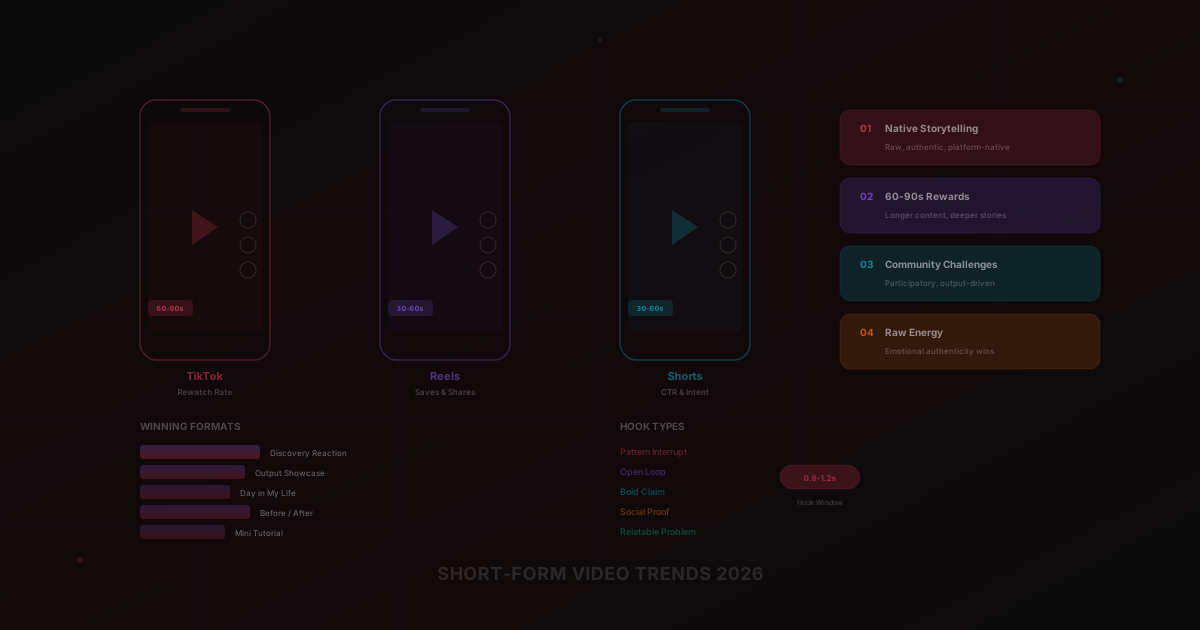
Short-form video is not just a channel for B2C app marketing in 2026 — it is the channel. Over 70% of social media time spent by users under 30 now happens in vertical video feeds. The apps winning the install race are the ones that have mastered the creative language of these platforms: what hooks stop thumbs, what structures hold attention, and what creative choices turn viewers into users.
But the creative landscape is shifting fast. The formats that dominated in 2024 and early 2025 — highly produced transitions, text-heavy listicles, aggressive sales hooks — are losing ground. The 2026 algorithm rewards something different: authentic storytelling, longer watch sessions, community-driven content, and raw creative energy that feels native to the platform rather than imported from an ad agency.
This guide breaks down every major trend shaping short-form video performance in 2026, with actionable frameworks for adapting each one to B2C mobile app marketing.
Before diving into specific formats and tactics, it is essential to understand the four structural shifts driving everything else:
The most distributed content in 2026 feels like it was made by the platform, not for the platform. Native storytelling means the content adopts the visual grammar, pacing, and energy of organic creator posts rather than traditional advertising or marketing content. Videos shot on phones outperform studio-produced content. Casual framing beats composed shots. Conversational delivery beats scripted reads. This is not a new trend, but in 2026 the gap between native-feeling and polished content has widened to the point where production quality can actually hurt distribution — platform algorithms interpret it as ad content and down-rank accordingly.
What this means for app marketers: Your UGC creators should feel empowered to shoot in their bedrooms, kitchens, and cars. Resist the urge to impose brand guidelines that result in overly composed or aesthetically “branded” content. The most effective app demo videos in 2026 look like a friend showing you something cool on their phone — because that is exactly the frame audiences respond to.
After years of favoring ultra-short content (7–15 seconds), all three major platforms are now algorithmically rewarding longer content in the 60–90 second range. The reason is economics: longer watch sessions mean more ad inventory, and platforms have adjusted their distribution algorithms to favor content that keeps users in-app longer.
TikTok explicitly announced in late 2025 that videos over 60 seconds receive a distribution bonus if they maintain strong watch-time metrics. Instagram Reels now surfaces 90-second content more aggressively in the Explore tab. YouTube Shorts extended its maximum length to 3 minutes and rewards completion-rate signals more heavily than ever.
What this means for app marketers: You now have permission to tell more complete stories. A 75-second video can take the viewer from problem awareness through product discovery to feature demonstration and CTA — a narrative arc that was impossible in 15-second clips. But the length only works if every second earns the next. A 90-second video with 40% average watch time will be penalized more harshly than a 15-second video with the same completion rate.
The resurgence of challenge-based content is one of the most significant trend shifts in early 2026. After a period where challenges felt played out, they have returned in a more sophisticated form: less “dance to this song” and more “try this and share your result.” The new challenges are output-driven — they invite participation that generates shareable content, which creates organic viral loops.
What this means for app marketers: Apps with any form of personalized output (fitness stats, AI-generated images, quiz results, learning milestones, recipe creations) are sitting on a goldmine. Design your app’s shareable outputs to be visually interesting, context-rich, and subtly branded. Then seed challenge prompts through your creator network: “Show your Day 30 transformation,” “Share your AI-generated [X],” “Post your streak screenshot.” The best challenges make the app output the content, not the app itself.
The content that earns the most engagement in 2026 carries genuine emotional charge. Not manufactured excitement or forced enthusiasm — real reactions, genuine surprise, authentic frustration-then-delight arcs. Audiences have become expert at detecting performative emotion, and they scroll past it instantly.
What this means for app marketers: Brief your creators to capture their actual first reaction to your app. The “genuine discovery moment” format — where a creator uses your app for the first time on camera and reacts in real time — consistently outperforms scripted testimonials. The imperfections (confusion, unexpected delight, “wait, it actually does that?” moments) are the content. Do not edit them out.
Based on performance data from thousands of app-promotion videos across all three platforms, these are the seven formats consistently earning the highest engagement and conversion rates:
A creator encounters your app for the first time (or discovers a new feature) and films their real-time reaction. The hook is curiosity-driven (“I just found an app that does [unexpected thing]”), the body is the live discovery process, and the payoff is the creator’s genuine reaction to the result. Duration: 45–90 seconds. This format thrives because it mirrors how people actually discover and evaluate apps in real life. Engagement rates: 8–14%.
The video leads with the impressive output your app produces — a transformed photo, a fitness achievement, a generated recipe, a study summary — and then reverse-engineers how they got there. The hook is the result, not the app. This format leverages the “how did they do that?” curiosity loop that drives both watch time and comments. Duration: 30–60 seconds. Best for apps with visually impressive or shareable outputs. Engagement rates: 7–12%.
Your app appears as a natural part of a creator’s daily routine video. It is not the focus of the content — it is a seamless element within a lifestyle narrative. The creator uses the app in context (checking their calories at lunch, using the study tool before class, running the workout in their home gym) alongside everything else they do. This format works because it positions the app as a lifestyle norm rather than a product pitch. Duration: 60–90 seconds. Engagement rates: 6–10%, but with the highest install-to-retention conversion because viewers self-select into the lifestyle.
Classic but still powerful when executed with authenticity. The key in 2026 is credibility — the “before” state must feel real and relatable, and the transformation timeline must be honest. Exaggerated or unrealistic transformations get called out in comments and trigger audience distrust. Best for fitness, productivity, learning, and self-improvement apps. Duration: 30–75 seconds. Engagement rates: 9–15% when the transformation is believable.
Positioning your app against a competitor, a manual alternative, or the “old way” of doing things. The hook establishes the comparison (“I tracked my macros with a notebook for a week, then switched to [app] for a week”), and the body shows the tangible difference. This format drives high comment engagement because it naturally invites debate and personal opinions. Duration: 60–90 seconds. Engagement rates: 7–11%.
A quick, value-packed demonstration of a specific feature or use case within your app. The hook promises a specific, valuable outcome (“This trick saved me 2 hours every week”), and the body delivers the step-by-step walkthrough. This format works because it combines entertainment value with utility — viewers save and share it because it is genuinely useful. Duration: 30–60 seconds. Engagement rates: 6–9%, but with the highest save rate of any format.
A creator posts their result from an app-centric challenge and invites their audience to participate. The content is the creator’s personal result — not a pitch for the challenge. The challenge mechanic is embedded in the CTA or caption rather than being the focus of the video itself. This format can trigger exponential organic reach when the challenge catches on, because each participant creates new content that promotes the app. Duration: 30–60 seconds. Engagement rates: highly variable (5–20%+ if the challenge gains momentum).
The hook is still the single most important element of any short-form video. In 2026, the hook window has compressed further — you have approximately 0.8–1.2 seconds before the average user decides to keep watching or scroll. Here is what is working:
1. The Pattern Interrupt
Something visually or auditorily unexpected in the first frame. An unusual camera angle, an unexpected sound, a jarring visual contrast. The brain stops to process the unexpected input. Example: Starting with a close-up of the app result before zooming out to reveal context.
2. The Open Loop
A statement that creates an information gap the viewer needs to close. “I found out why my screen time dropped 40% this month.” “This is the app everyone at my gym refuses to talk about.” The viewer must keep watching to resolve the curiosity.
3. The Bold Claim
A specific, measurable statement that invites skepticism — which keeps viewers watching to see if it is backed up. “This app replaced 3 apps on my phone.” “I gained 15 pounds of muscle tracking with this for 90 days.” The claim must be specific (not “this changed my life”) and ultimately substantiated.
4. The Social Proof Entry
Leading with evidence that others already use and trust the app. “500,000 people downloaded this last month and I finally see why.” “Every creator I follow uses this and nobody talks about it.” Social proof hooks tap into FOMO and herd behavior.
5. The Relatable Problem
Opening with a frustration the target audience immediately recognizes. “I was spending 30 minutes every morning just figuring out what to eat.” “Nobody told me studying could be this broken.” The viewer self-identifies with the problem and stays to see the solution.
The highest-performing short-form videos in 2026 follow a consistent structural pattern, regardless of format:
Despite surface similarities, each platform has distinct audience behaviors, algorithm preferences, and creative norms. Treating them as interchangeable is one of the most common mistakes app marketers make.
Audience behavior: Users open TikTok to discover new things, not to check on people they already follow. The For You Page is the primary interface — less than 15% of session time is spent on the Following tab. This means your content reaches people who have never heard of your app, which makes TikTok the strongest top-of-funnel discovery platform.
Algorithm priorities in 2026: Rewatch rate has become TikTok’s highest-weighted signal, surpassing even completion rate. Content that people watch 2–3 times (because it is information-dense, visually layered, or has a twist ending) receives exponentially more distribution. Watch time per session is the second priority — the algorithm explicitly favors 60–90 second content that maintains above-50% average watch time.
Creative norms: Rawer, faster, more chaotic. TikTok rewards creative risk-taking. Jump cuts, screen recordings, face-close-ups, casual voiceover. Text overlays are expected and heavily consumed (many users watch without sound). Music and trending audio are still significant distribution signals, though less dominant than in 2023–2024.
Audience behavior: Users come to Instagram with existing social context — they follow friends, creators they admire, and aspirational lifestyle accounts. Reels content is consumed through both the dedicated Reels tab and the home feed, meaning it competes with photos, stories, and carousels. This context makes aspirational and lifestyle-integrated content perform better than raw discovery content.
Algorithm priorities in 2026: Instagram weights saves and shares more heavily than TikTok does. Content that people save for later (“I need to remember this app”) or share via DM (“you need to try this”) gets significant distribution boosts. Completion rate matters, but the save-to-view ratio is the secret weapon on Reels.
Creative norms: Slightly more polished than TikTok, but still far from studio-quality. Reels audiences appreciate better lighting, more intentional framing, and smoother editing transitions. Captions and text overlays are important but should be cleaner and less cluttered than TikTok text. Cover images matter significantly — an optimized cover can 2x the tap-through rate from the grid.
Audience behavior: YouTube users have the strongest intent signals of any platform. Many Shorts viewers will, after watching an engaging Short, navigate to the creator’s channel to watch longer content. This intent-bridging behavior makes Shorts uniquely valuable for apps that benefit from deeper educational content — you can hook with a Short and convert with a linked long-form video that provides a comprehensive app walkthrough.
Algorithm priorities in 2026: YouTube’s Shorts algorithm weights click-through rate (from the Shorts shelf) and engagement actions (likes, comments) more heavily than watch-time metrics. The algorithm also considers viewer satisfaction signals from YouTube’s long-form recommendation system, meaning Shorts that drive viewers to longer sessions are heavily rewarded.
Creative norms: More informational and educational than TikTok or Reels. Shorts audiences expect clear value delivery. The “mini tutorial” and “comparison” formats perform disproportionately well here. Fast pacing is less important than clarity — viewers will watch a 60-second Short at a deliberate pace if the information is dense and useful.
Platform Quick Reference:
Publishing the same video across all three platforms is the simplest approach, but it is not the most effective. Here is a structured framework for multi-platform testing that maximizes learnings while respecting platform differences:
Step 1: Create a “master” version optimized for TikTok (the most algorithmically demanding platform). This version has the strongest hook, the fastest pacing, and the most aggressive visual stimulation cadence.
Step 2: Create a Reels adaptation. Start from the master but: clean up text overlays for a less cluttered aesthetic, slightly slow the pacing (add 0.5–1 second of breathing room between cuts), create a custom cover image optimized for the Reels grid, and adjust the CTA to reflect Instagram behaviors (profile visit, DM, story share).
Step 3: Create a Shorts adaptation. Start from the master but: front-load the educational value, add clearer on-screen text (Shorts viewers rely more on text for comprehension), and ensure the video title/description is keyword-optimized for YouTube search.
Step 4: Publish all three within a 24-hour window and track performance independently. After 72 hours, compare engagement rates, but weight platform-specific metrics: rewatch rate on TikTok, save rate on Reels, CTR on Shorts.
The real power of multi-platform testing is not finding which platform performs best — it is using each platform’s data to improve content on the others. If a hook underperforms on TikTok but overperforms on Shorts, that tells you the hook appeals to intent-driven audiences but not discovery audiences. If a video gets high saves on Reels but low rewatch on TikTok, the content is useful but not engaging enough for repeat viewing. These cross-platform signals are more valuable than any single-platform metric.
Engagement and views are meaningless for app growth if they do not convert into installs. Here are the specific creative and strategic levers that bridge the gap between “watched the video” and “downloaded the app”:
Embedded product demonstration. The most converting short-form videos show the app in use — not as a screenshot, but as a live screen recording or over-the-shoulder view of someone interacting with it. Viewers need to see what the app does, not just hear about what it does. Videos with 5+ seconds of in-app footage convert 2–3x higher than those without.
The “implied scarcity” CTA. Direct “download now” CTAs are the least effective in 2026. The highest-converting CTAs create a sense of discovery rather than instruction: “I can’t believe this is free,” “I don’t know how long this feature will be available,” or simply demonstrating so much value that the viewer feels compelled to try it without being told to. Let the value proposition do the selling.
Comment-section seeding. The comments section is a conversion surface. Pin a comment with the app name and a brief value statement. Respond to early comments with additional use cases or tips. When potential users see an active, helpful comment section, install intent increases measurably. On TikTok, pinned comments with the app name generate 15–25% more search traffic than bio links alone.
Search optimization for app name. Many short-form viewers do not click links. Instead, they see an app in a video and search for it directly in the App Store or Play Store. Ensure your app name is clearly visible (spoken and/or on-screen text) in the video, and that your ASO (App Store Optimization) is strong enough that your app appears as the top result when someone searches the name.
Multi-touchpoint conversion paths. A single video rarely converts a viewer into a user. The typical 2026 conversion path is: see video → visit profile → see more content confirming value → follow or save → see a second or third video over the next 1–3 days → install. This means your profile page and content library matter as much as any individual video. Your last 9–12 posts should form a cohesive portfolio that moves a curious visitor from awareness to install intent.
Understanding what algorithms reward is not gaming the system — it is creating content that genuinely serves the platform’s goals, which are the same as yours: keeping users engaged.
Maximize early engagement velocity. All three platforms measure engagement velocity — how quickly a video accumulates likes, comments, and shares relative to its view count in the first 30–60 minutes after posting. Content that sparks immediate reactions gets pushed into broader distribution faster. Design your content with a “reaction trigger” — a moment that compels viewers to like, comment, or share. Asking a genuine question, showing a surprising result, or making a debatable statement all work.
Design for rewatch and completion. Layer information density so that viewers catch new details on repeat viewing. Use visual easter eggs, fast text overlays that require pausing, or multi-step processes that viewers want to re-follow. For completion rate, front-load value (do not save the “best part” for the end) and use open loops throughout the body (“and the third one shocked me”) to maintain forward momentum.
Optimize posting cadence. Consistency signals to algorithms that you are a reliable content source worth distributing. On TikTok, 1–2 posts per day is the optimal cadence for maximum per-post distribution. On Reels, 4–7 posts per week. On Shorts, 3–5 per week. Posting too frequently (3+ per day) can actually cannibalize your own distribution as the algorithm avoids showing multiple posts from the same account in a single session.
Use trending elements strategically, not desperately. Trending sounds, formats, and hashtags still provide a distribution boost, but only when they are relevant to your content. Forcing a trending audio onto an unrelated app demo feels inauthentic and actually hurts distribution in 2026 because algorithms now evaluate content-audio coherence. Use trends when they naturally fit your message — and skip them when they do not.
Here are five representative content patterns that are driving measurable app installs in early 2026, with breakdowns of the structural elements that make them effective:
Example 1: Fitness App — “90-Day Check-In” (TikTok, 78s)
Structure: Hook with Day 1 vs. Day 90 split screen (1.5s) → “Here’s exactly what I did” context (3s) → Daily routine walkthrough showing app in use (40s) → Full transformation montage with stats overlay (20s) → Genuine emotional reaction to progress (10s) → Soft CTA embedded in closing thought.
Why it works: Before/after hook stops scrolling. Long body justified by genuine story arc. App is integral to the transformation, not bolted on. Emotional authenticity in the closing drives comments and shares. Rewatch-worthy because of information density in the routine walkthrough.
Example 2: Study App — “I Passed My Exam Using Only This App” (Shorts, 55s)
Structure: Bold claim hook (1s) → Exam context and stakes (5s) → 3-feature walkthrough showing actual study sessions (30s) → Exam result reveal (8s) → “If I can pass [difficult exam], you can too” closing.
Why it works: Specific, verifiable claim (passed an exam, not vague “it helped me study”). Educational format matches Shorts audience intent. Feature walkthrough serves as a mini-tutorial that viewers save. High comment engagement from other students asking questions.
Example 3: AI Photo App — “Wait For It” Output Reveal (TikTok, 35s)
Structure: Shows selfie upload (2s) → Brief app interaction (5s) → Building anticipation with reaction face while processing (8s) → Output reveal with genuine surprise reaction (10s) → Shows 3 more outputs in rapid succession (8s) → “I can’t stop using this” with app name visible.
Why it works: Curiosity loop (what will the output look like?) drives completion. Genuine reaction triggers emotional contagion. Multiple outputs create rewatch value. Format is inherently participatory — viewers want to see their own result. The app name is visible, driving App Store searches.
Example 4: Recipe App — “Everything I Ate Today” (Reels, 72s)
Structure: Aesthetic breakfast shot (2s) → Quick app check for macros (3s) → Lunch prep with recipe from app (15s) → Snack with macro check (5s) → Dinner with full recipe walkthrough (25s) → End-of-day nutrition summary screen (10s) → “Best part? Every recipe was under 20 minutes.”
Why it works: Day-in-my-life format is native to Reels’ lifestyle context. App integration feels natural and useful rather than promotional. High save rate because viewers want the recipes. Aesthetic food photography matches Reels visual standards. Strong cover image (the food) drives tap-through from the grid.
Example 5: Productivity App — “My Phone Screen Time Dropped 40%” (Multi-Platform, 65s)
Structure: Screen time screenshot comparison hook (2s) → Problem narration (“I was averaging 7 hours a day”) (5s) → Discovery of app and setup walkthrough (15s) → Week-by-week screen time screenshots showing decline (20s) → Current daily routine showing how the app changed habits (15s) → Closing with data and soft recommendation.
Why it works: Data-driven credibility (actual screenshots, actual numbers). Relatable universal problem (everyone worries about screen time). Week-by-week progression creates narrative momentum. Works across all three platforms because the value proposition is universal. Comparison format invites comments sharing personal screen time numbers.
Short-form video trends shift faster than any other marketing channel. The formats winning in February 2026 will evolve by June. The hook styles that stop scrolling today will feel stale in three months. The only constant is the need for speed — speed of production, speed of testing, and speed of adaptation.
The teams that win are the ones that treat short-form video not as a content calendar to fill but as a continuous experimentation engine. Every video is a hypothesis. Every batch of variations is a test. Every week’s data reshapes the next week’s creative strategy.
Master the fundamentals covered in this guide — native storytelling, platform-native adaptation, structured testing, and algorithm alignment — and you will have a durable foundation that adapts to trend shifts rather than being disrupted by them. The formats will change. The structural principles will compound.
The Viral App designs and executes short-form video strategies for B2C mobile apps — from format selection and creator recruitment to multi-platform testing and conversion optimization. Let’s build your content engine.
Schedule a Strategy CallDecode the 2026 TikTok algorithm for mobile app marketing. Learn what drives reach, engagement, and installs on the platform.
Scale your mobile app with TikTok and UGC in 2026. This playbook covers creator strategy, content systems, and growth tactics.
Scale your content production with AI + UGC hybrid workflows. Learn to produce high-converting creator content 10x faster in 2026.