A technical, practical guide to measuring what actually matters. Beyond vanity metrics: the core KPIs that predict long-term value, how to set up multi-layer attribution, 2026 benchmark data, incrementality testing frameworks, portfolio-level optimization, and reporting dashboards that drive decisions.
The biggest problem in UGC and influencer marketing for mobile apps is not performance — it is measurement. Teams invest five and six figures per month in creator content and influencer partnerships, yet most cannot answer a basic question with confidence: “For every dollar we spend on this channel, how many dollars come back?”
The measurement challenge is real. Unlike paid ads with deterministic click-to-install tracking, influencer and UGC content drives value through a messy combination of direct links, organic search, social proof, brand lift, and word-of-mouth. A viewer sees a TikTok about your app, tells a friend about it three days later, and the friend installs it from an App Store search — none of that shows up in your creator’s tracking link data.
This guide provides the technical and practical framework to capture as much of that value as possible, benchmark it against industry standards, and use the data to make smarter allocation decisions. No vague advice — specific metrics, specific setups, specific numbers.
Views and engagement are leading indicators, not success metrics. Here are the KPIs that determine whether your UGC and influencer investment is generating real business value:
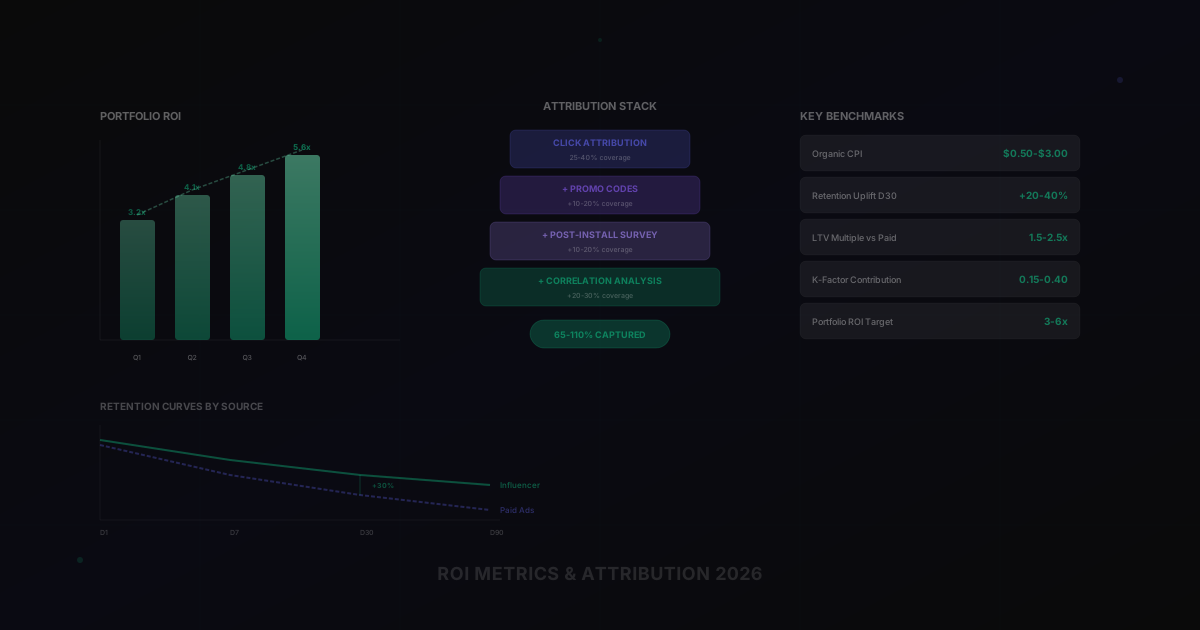
Total creator/influencer spend divided by total attributed installs from organic (non-paid) distribution. This is your base efficiency metric. Unlike paid CPI, organic CPI should decrease over time as you accumulate content that continues generating installs after the initial posting window. A strong organic CPI in 2026 for most B2C app categories is $0.50–$3.00, compared to paid CPI of $2–$8 on the same platforms.
When you amplify organic winners through Spark Ads or Partnership Ads, the blended CPI combines both the creator cost and the ad spend against total installs from both organic and paid distribution. A well-optimized blended CPI should sit 30–50% below your pure paid acquisition CPI, because the organic installs subsidize the overall cost. Track this at the creative level, not just the campaign level.
Compare D1, D7, and D30 retention of influencer-attributed users against your overall average and against paid-ad-attributed users. Influencer-sourced users typically retain 20–40% better because they arrive with higher intent and trust (they saw a real person recommend the app, not an ad). This retention premium is one of the most undervalued aspects of influencer ROI — a 30% retention uplift on Day 30 can mean 2x the lifetime value per user.
Segment your user LTV by acquisition source: organic influencer, paid-amplified influencer, paid ads (non-influencer), and organic (non-attributed). The LTV comparison tells you not just how much it costs to acquire users from each channel, but how much each user is worth. In most B2C apps, influencer-sourced users have 1.5–2.5x higher LTV than paid-ad users — which means your acceptable CPI for influencer channels should be proportionally higher.
Influencer content does not just drive direct installs — it often triggers secondary sharing and word-of-mouth that generates additional installs. Track the K-factor contribution of influencer campaigns: for every 100 directly attributed installs, how many secondary installs follow within 7 days? Influencer campaigns with strong community-challenge or shareable-output formats can generate K-factors of 0.15–0.40, meaning 15–40 additional installs per 100 direct installs — effectively free acquisition.
Total installs generated per piece of content produced. This metric tells you how efficiently your content engine converts creative effort into growth. A high content efficiency ratio means you are producing less content of higher quality; a low ratio means you are producing volume without proportional results. Benchmark: top-performing programs generate 200–500 installs per video across organic and paid distribution combined.
No single attribution method captures the full value of influencer and UGC content. The solution is a multi-layer attribution stack where each layer captures a different slice of the total impact:
Users who click a creator’s unique tracking link (UTM link, deep link, or MMP-tracked link) and install the app within a 7–14 day attribution window. This is the most precise layer but captures the smallest portion of total influenced installs — typically 25–40%. The rest of the users saw the content, remembered the app, and installed through a non-tracked path.
Users who install the app and enter a creator-specific promo code during onboarding or in-app. Promo codes capture users who did not use the tracking link but remembered (or screenshotted) the code. This layer adds 10–20% additional attributed installs beyond click attribution. Promo codes also provide a strong validation signal — users who take the effort to enter a code have higher intent and typically retain better.
A single-question in-app survey during onboarding: “How did you hear about us?” with options including “TikTok/Instagram creator,” “Friend/word of mouth,” “App Store search,” etc. Survey attribution adds another 10–20% and captures the “saw it on TikTok, searched in App Store” pathway that link and code attribution miss. Keep the survey to one mandatory question with 4–6 options — anything longer reduces completion rate.
Compare your daily organic install volume against creator posting schedules. When a creator posts, you should see a statistically significant lift in organic installs within 24–72 hours. The delta between your baseline organic installs and the elevated volume during creator posting windows represents the “unattributed halo effect.” This layer captures the remaining 20–30% of influenced installs that no direct attribution method can reach.
Total Attribution Stack Coverage:
Use the combined total as your “influenced installs” metric. De-duplicate where possible, but accept that some overlap between layers is unavoidable and preferable to undercounting.
The attribution stack above requires specific technical infrastructure. Here is what you need and how to configure it:
An MMP is the foundation of your attribution infrastructure. It handles link generation, click tracking, install attribution, and post-install event tracking across all channels. Major MMPs offer dedicated influencer measurement modules that generate unique tracking links for each creator, attribute installs across click-through and view-through windows, and provide creator-level dashboards showing installs, events, and revenue.
Configuration essentials:
Generate unique promo codes for each creator. The codes should be: memorable (creator name or shorthand, not random strings), single-use or limited-use to prevent abuse, and connected to your backend so redemptions are logged with timestamp, user ID, and creator ID. Build a simple admin dashboard where you can generate, deactivate, and report on promo codes. Most in-app purchase and subscription platforms support promo code functionality natively.
Implement the survey as a non-skippable single-screen during onboarding, between registration and the first core action. The question should be: “How did you discover [app name]?” with options: “TikTok,” “Instagram,” “YouTube,” “Friend recommendation,” “App Store browsing,” “Other.” Log the response against the user ID so you can segment all downstream metrics (retention, LTV, engagement) by discovery source.
Build a dashboard (spreadsheet or BI tool) that overlays your daily organic install curve with your creator posting schedule. Log every creator post with: timestamp, platform, creator name, content type, and any tracking link data. Overlay this against your hourly and daily install data. Use a 3–7 day rolling baseline to calculate expected organic installs, and measure the lift above baseline during creator posting windows. Automate this with API pulls from your MMP and social monitoring tools.
Benchmarks vary by app category, market, and creator tier, but the following ranges represent healthy performance for B2C mobile app influencer programs in early 2026:
Category-specific notes: Fitness and health apps tend to see the highest retention uplift (30–40%) because influencer recommendations carry strong trust signals in health decisions. Utility and productivity apps see the highest organic CPI efficiency ($0.50–$1.50) because the content is demo-driven and highly actionable. Entertainment and social apps see the highest K-factors (0.25–0.40) because sharing is built into the product experience.
Attribution tells you who drove the installs. Incrementality testing tells you whether those installs would have happened anyway without the influencer spend. This is the most sophisticated level of measurement and the one that gives you the most reliable budget allocation data.
Pause all influencer activity for 2–4 weeks in one market (or one audience segment) while maintaining it in a comparable market. Compare the install volume, quality, and LTV of the holdout market against the active market. The difference represents the true incremental contribution of your influencer program. This is the gold standard for proving ROI to stakeholders who question whether influencer spend is truly additive.
For individual high-spend creators, pause their activity for 2 weeks and measure the change in installs from their attributed segments. If a creator is driving genuine incremental installs, you will see a measurable drop during the pause period. If you see no change, the creator may be reaching users who would have installed anyway — valuable information for budget reallocation.
If your app operates in multiple markets, run influencer campaigns in half your markets while holding the other half as controls. This requires matched market pairs (similar demographics, similar organic install baselines). After 4–6 weeks, compare total installs, not just attributed installs, between test and control markets. The total install lift in test markets represents the true incremental value of your influencer program, including all the unattributed halo effects.
When to Run Incrementality Tests:
Managing an influencer program as a portfolio rather than a collection of individual relationships is the key to maximizing overall ROI. Here is how to think about allocation:
Grade every creator monthly on a composite score that combines:
Based on the composite score, place each creator into one of four tiers:
Tier 1 (Top 10%): Your best performers. Increase budget, move to retainer/ambassador agreements, give them early access to new features, and protect these relationships. These creators should receive 40–50% of your total influencer budget.
Tier 2 (Next 20%): Consistent performers with room for optimization. Maintain current spend levels, test new content formats and approaches. Allocate 25–30% of budget.
Tier 3 (Next 40%): Below-average but not failing. Reduce to minimum engagement, test one more cycle with adjusted briefs. Allocate 15–20% of budget.
Tier 4 (Bottom 30%): Underperformers. Gracefully off-board and replace with new organic-test candidates. Allocate remaining 5–10% (primarily to testing replacements).
Allocate 70–80% of your budget to “exploitation” (scaling proven creators and formats) and 20–30% to “exploration” (testing new creators, new platforms, new content approaches). Without the exploration budget, your program will eventually stagnate as top creators plateau or churn. Without the exploitation budget, you will never scale the winners that drive compounding returns.
A well-designed reporting dashboard turns raw data into allocation decisions. Here is the dashboard structure we recommend, organized by audience:
Implementation tip: Start with a spreadsheet-based dashboard using manual data pulls. Once you have validated the metrics and reporting cadence, migrate to a BI tool with automated data pipelines. Do not over-invest in tooling until you know which metrics actually drive your decisions — most teams discover that 3–5 core metrics drive 90% of their allocation decisions, and the rest is context.
Most app marketers under-invest in measurement and over-invest in execution. They produce more content, engage more creators, and spend more money — without reliable data telling them whether any of it is working. The teams that build robust measurement infrastructure gain a compounding advantage: every dollar they spend teaches them something, and every learning makes the next dollar more efficient.
Start with the four-layer attribution stack. Set up the technical infrastructure to capture each layer. Establish your baseline benchmarks. Run your first incrementality test within 90 days. Build the tiered portfolio optimization system. And design dashboards that turn data into decisions, not just reports.
The gap between teams that measure well and teams that measure poorly is not 10–20% in performance. It is 2–3x. When you know exactly which creators, formats, and platforms drive the highest LTV-adjusted ROI, every allocation decision becomes obvious — and your influencer program becomes a precision growth engine rather than a hopeful marketing experiment.
The Viral App helps B2C mobile apps set up full-stack attribution, build reporting dashboards, and optimize creator portfolios for maximum ROI. Let’s make your data work harder.
Schedule a Strategy CallLearn how to implement multi-touch attribution for mobile apps in 2026. Track every touchpoint and optimize your UA spend with proven frameworks.
Transform influencer marketing for your mobile app from one-off campaigns to an evergreen growth engine. Proven 2026 strategies inside.
Micro-influencers vs macro for app growth: which delivers better ROI in 2026? Data-driven comparison with real campaign insights.