Acquisition without retention is a leaky bucket. This guide covers every stage of the retention curve — from the first 60 seconds of onboarding through 30-day compounding loops — with tactical playbooks, category-specific benchmarks, AI-driven churn prediction, and a ready-to-execute 30-day launch plan.
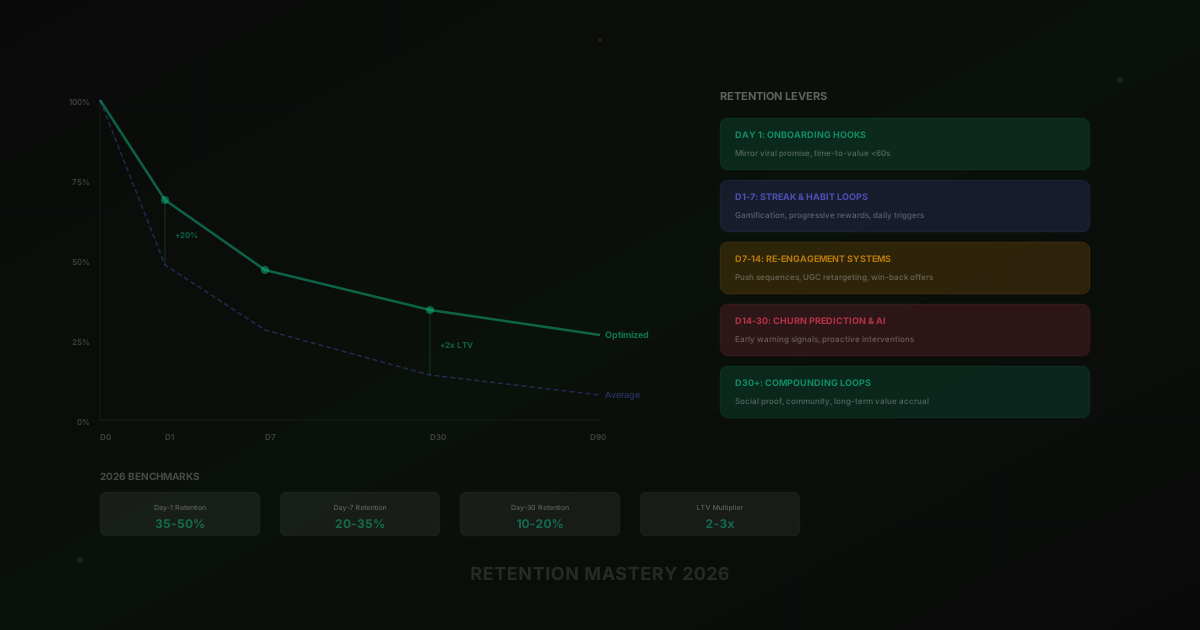
In 2026, the single most important metric for B2C mobile app growth is not CPI, not download volume, and not even viral coefficient. It is retention. Specifically, the shape of your retention curve in the first 30 days determines whether your app can sustain growth or whether every new user you acquire leaks out the bottom of a bucket you can never fill.
The math is simple and unforgiving. An app with 40% Day-1 retention and 15% Day-30 retention can afford to pay $3–$5 per install and still generate positive LTV. An app with 25% Day-1 retention and 5% Day-30 retention cannot sustain any acquisition cost above $0.50 — which effectively limits growth to organic virality alone. A 15-percentage-point improvement in Day-1 retention can double or triple the amount you can spend on acquisition, which compounds into dramatically faster growth.
This guide covers the entire retention lifecycle for B2C apps in 2026: what to build, when to build it, how to measure it, and what the benchmarks look like across categories. Every section is tactical. Every recommendation has been tested in real app growth programs.
2026 Retention Benchmarks (B2C Mobile):
Day-1 retention is the single highest-leverage retention metric because it is the steepest drop on every retention curve. Most B2C apps lose 60–75% of new users within the first 24 hours. Reducing that drop by even 10 percentage points has cascading effects on every subsequent retention metric and on LTV.
If users discovered your app through a UGC video showing a specific output or experience, the first screen they see after install must deliver exactly that experience. Not a tutorial. Not an account creation form. Not a permissions request. The thing they came for. If the viral video showed a photo being transformed by your AI, the first screen should let them transform a photo. If the video showed a calorie scan, the first screen should let them scan food. Every screen between the install and the promised experience is a retention leak.
The 60-second rule is the most important onboarding principle in 2026. A new user should experience the core value proposition of your app within 60 seconds of their first open. Not be told about it. Not watch a walkthrough of it. Experience it themselves.
This means ruthlessly eliminating onboarding friction. Move account creation to after the first value moment, not before. Defer all non-essential permissions (notifications, contacts, location) to contextual triggers later in the experience. Pre-load any data or content needed for the first interaction so there is zero loading screen. Every second of delay before the first value moment costs you 2–5% of your new user cohort.
Every successful B2C app has an “aha moment” — the specific action or experience that correlates with long-term retention. Identifying and engineering the path to this moment is the most important product decision you will make for retention.
To find your aha moment, analyze your best-retained cohorts. What actions did they complete in their first session that churned users did not? Common examples: completing a first workout (fitness apps), saving a first recipe (food apps), adding a first friend (social apps), completing a first lesson (education apps), generating a first output (AI/creative apps). Once identified, design the entire Day-1 experience around guiding every new user to that moment as fast as possible.
Day-1 Retention Checklist:
The Day-1 to Day-7 window is where habits form or fail. Users who return for 3 consecutive days after install have 4–6x higher Day-30 retention than users who return only on Day 1. The goal of this phase is to convert a single-session experience into a recurring behavior pattern.
Daily streaks. The simplest and most effective habit mechanism. Users see a counter that increments each day they open the app and complete a core action. Breaking the streak feels like losing progress, which creates a psychological commitment that is disproportionately powerful relative to the engineering effort required. Duolingo proved this at scale — their streak mechanic is directly responsible for 60%+ of their daily active usage.
Progressive rewards. Streaks work better when they unlock incrementally valuable rewards. Day 1: a badge. Day 3: access to a premium feature. Day 7: a bonus content pack. Day 14: a streak shield (one free miss). The rewards should escalate in value, making longer streaks feel increasingly worth protecting.
Streak recovery. Do not make streaks fragile. Offer a 12–24 hour grace period. Allow one free streak recovery per month. Send a push notification 2 hours before the streak expires. The goal is to make streaks sticky, not punishing — users who feel punished by a broken streak often churn entirely rather than rebuilding.
Every effective habit loop has three components: a trigger, a routine, and a reward. For mobile apps in 2026, the most effective triggers are:
Time-based triggers. A push notification at the same time every day, aligned with the user’s natural routine. Morning for productivity apps, evening for entertainment apps, post-meal for nutrition apps. Consistency of timing matters more than the message content — you are training a neurological habit loop.
Context-based triggers. Notifications tied to real-world events: “You just finished a workout — log it before you forget” (detected via health API), “Your friend just posted a new score” (social trigger), “New content matching your interests just dropped” (content trigger). Context-based triggers have 2–3x higher open rates than generic time-based triggers.
Variable reward schedules. Instead of the same reward every day, introduce variability. Some days the reward is a small bonus, some days it is a surprise drop, some days it is a social recognition. Variable reward schedules create anticipation and make the habit loop more durable than fixed schedules — this is the slot machine principle applied to retention design.
Gamification Levers & Their Impact:
By Day 7, you have separated your users into two groups: those who have established a habit (retained) and those who have drifted away (at risk). The re-engagement system’s job is to pull the at-risk group back before they become permanently churned. Users who have not opened the app in 3–7 days are in a critical window — they are still recoverable, but every additional day of inactivity makes recovery less likely.
The 3-touch sequence. For users who have not opened the app in 3+ days, deploy a three-message push sequence over 5 days. Message 1 (Day 3 of inactivity): value reminder — reference their last positive interaction (“Your 5-day streak is waiting — don’t let it expire”). Message 2 (Day 5): social proof — show what they are missing (“12 of your friends posted new scores this week”). Message 3 (Day 7): incentive — offer something concrete to come back (“Come back today and unlock a free premium week”).
Personalization matters. Generic push notifications have a 2–4% open rate. Personalized notifications (referencing the user’s specific activity, progress, or social connections) have 8–15% open rates. Use the data you have: their last completed action, their best score, their friend activity, their preferred content category. Every push notification should feel like it was written for that specific user.
Users who installed through a UGC video can be retargeted with new UGC content through paid channels. Create retargeting audiences of users who installed but have not opened in 3–7 days, and serve them fresh UGC videos that showcase the specific feature or experience they originally came for. The creative should remind them of the promise that drove the initial install and show something new that makes the app worth reopening. UGC retargeting campaigns typically achieve 3–5x better click-through rates than standard retargeting banners because they match the format and tone of the content that originally attracted the user.
For users who have not responded to push sequences, deploy win-back offers through email and in-app messaging (triggered on the next open). Effective win-back offers include: free trial extensions, premium feature unlocks, exclusive content drops, or progress boosts. The key principle is that the offer should reduce the perceived effort of re-engaging — users who have been away for a week feel like they are “behind” and need a reason to believe catching up is worth the effort.
By 2026, the most sophisticated retention systems are not reactive — they are predictive. Instead of waiting for users to stop opening the app and then trying to win them back, AI models identify users who are likely to churn before they actually do, enabling proactive intervention while the user is still active.
A churn prediction model takes user behavioral signals as inputs and outputs a probability score indicating how likely each user is to churn in the next 7–14 days. The most predictive signals for B2C app churn in 2026:
Session frequency decline. A user who was opening the app 5 times per day and drops to 2 times per day is exhibiting churn behavior, even though they are still technically active. The rate of decline matters more than the absolute number — a sudden drop is more alarming than a gradual decrease.
Feature engagement narrowing. Users who start using fewer features over time are disengaging. A fitness app user who initially logged workouts, tracked meals, and checked the leaderboard but now only logs workouts is showing early signs of declining interest in the broader product.
Session duration shortening. Average session length declining week over week is a strong churn predictor, especially for apps where engagement depth (not just frequency) drives retention.
Social graph activity. If a user’s friends or connections are churning, the user is significantly more likely to churn themselves. Social network effects work in both directions — they drive both retention and churn.
Once a user is flagged as high-risk by the churn model, trigger one or more proactive interventions:
Feature discovery nudges. Surface features the user has not tried yet that are correlated with higher retention. “Have you tried our new meal planning feature? Users who use it are 40% more likely to hit their goals.”
Social reconnection. If the user’s social graph is a retention factor, prompt them to invite friends, join a challenge, or connect with an active community. Social connections are the strongest retention anchor for most B2C apps.
Personalized content refresh. Algorithmically surface new content, challenges, or goals that align with the user’s demonstrated interests. Make the app feel fresh and relevant to their specific usage pattern.
Concierge outreach. For high-value users (top 10% by LTV potential), consider direct outreach: an in-app message from the “team,” a personalized email, or even a human customer success touchpoint. The ROI on retaining a high-LTV user justifies the cost of individual attention.
Churn Prediction Model Performance Targets:
Retention mechanics that work for a fitness app may fail for a photo editor. Category context determines which levers matter most and which benchmarks are realistic. Here are the highest-impact retention tactics for the major B2C app categories in 2026:
Primary retention driver: Progress visualization. Users who can see their improvement over time (weight charts, strength progressions, streak calendars) retain 2–3x better than users who only see individual workout results. Build comprehensive progress dashboards that make improvement visible and emotionally rewarding.
Critical tactic: Adaptive difficulty. Workouts that automatically adjust to the user’s improving fitness level prevent the two biggest churn triggers in fitness: boredom (too easy) and frustration (too hard). Apps like Hevy and Fitbod have demonstrated that adaptive programming increases D30 retention by 20–35% compared to static workout libraries.
Primary retention driver: Micro-completion. Breaking learning into 3–5 minute sessions with clear completion markers (progress bars, lesson counts, skill trees) creates a sense of daily achievement that sustains motivation. The ideal session length for retention is 5–8 minutes — long enough to feel productive, short enough to fit into any schedule.
Critical tactic: Spaced repetition and review. Users who are prompted to review previously learned material retain it better and retain the app longer. The combination of new content and structured review creates a feeling of genuine progress that is more durable than novelty alone.
Primary retention driver: Connection density. Users with 7+ connections in the app have 3–5x higher D30 retention than users with 0–2 connections. The single most important onboarding goal for social apps is getting new users to their “magic number” of connections as fast as possible.
Critical tactic: Content notifications from connections. Users return more reliably for content from people they know than for algorithmic recommendations. Prioritize “Your friend just posted” and “Your friend just achieved” notifications over “You might like this” notifications. Social triggers outperform content triggers by 2–3x for open rates.
Primary retention driver: Output quality and shareability. Users who generate an output they are proud enough to share have 4–6x higher D7 retention. Optimize the AI model and default settings to produce share-worthy results on the first attempt — even if it means limiting options in the initial experience.
Critical tactic: New capability drops. AI tool users are especially sensitive to novelty — they exhaust existing features faster than users of other app categories. Regular drops of new models, styles, or capabilities (weekly or biweekly) create recurring reasons to return. Frame each drop as an event: “New portrait style just dropped — try it before everyone else.”
Measuring retention correctly is harder than most teams realize. The wrong measurement framework leads to optimizing for metrics that do not actually predict business outcomes. Here is the measurement stack that works for B2C apps in 2026.
Classic retention (Day-N). The percentage of users from a cohort who open the app on exactly Day N after install. This is the standard metric and the one most teams track. It is useful for benchmarking against industry data but has a significant flaw: it penalizes apps where usage is naturally periodic (every 2–3 days) rather than daily.
Rolling retention (Day-N+). The percentage of users from a cohort who open the app on Day N or any day after. This is more forgiving and more accurate for apps with non-daily usage patterns. A user who opens on Day 1, Day 4, and Day 8 would show as “not retained” on Day-2 classic retention but “retained” on Day-2 rolling retention.
Bracket retention (Day N–M). The percentage of users who open the app at least once during a range (e.g., Day 7–14). This is the most practical metric for weekly or biweekly usage patterns. For apps where daily usage is not the expected behavior (meal planners, period trackers, travel apps), bracket retention is the primary metric to optimize.
Always analyze retention by cohort, not in aggregate. The cohorts that matter most:
Acquisition source cohorts. Retention varies dramatically by source. Organic users from TikTok UGC typically retain 20–40% better at Day-30 than users from paid Meta campaigns. Users from influencer campaigns with accurate product demonstrations retain better than users from aspirational ads with inflated expectations. Track retention by source to allocate acquisition budget toward the channels that drive the highest-quality users.
Activation cohorts. Segment users by which onboarding actions they completed. Users who reached the aha moment in session 1 versus session 2 versus never. This analysis reveals which onboarding steps are genuinely correlated with retention and which are just friction that delays the value moment without improving outcomes.
Behavioral cohorts. Group users by their usage patterns (power users vs. casual users vs. periodic users) and track retention for each group separately. This prevents the common mistake of designing retention interventions for the “average user” who does not actually exist — your user base is a mixture of distinct behavioral segments, each needing different retention approaches.
Measurement Stack:
After analyzing retention programs across dozens of B2C apps, these are the mistakes we see most often — and they are almost always more damaging than teams realize because the effects compound over time.
Pitfall 1: Optimizing for Day-1 at the expense of Day-7. Some onboarding optimizations increase Day-1 retention by creating artificial hooks (free coins, locked content teasers, cliffhangers) that bring users back once but do not create sustainable engagement. If your Day-1 retention is improving but Day-7 is flat or declining, your onboarding is creating false engagement, not real habit formation.
Pitfall 2: Notification spam. Sending too many push notifications is the fastest way to get users to disable notifications entirely — and once notifications are disabled, your primary re-engagement channel is gone forever. The optimal frequency for most B2C apps is 1–2 push notifications per day during the first week, decreasing to 3–5 per week after the habit is established. Every notification must deliver genuine value or useful information.
Pitfall 3: Treating all churned users the same. A user who churned after one session needs a completely different re-engagement approach than a user who was active for 3 weeks and then stopped. Segment your churned users by how long they were active, how deeply they engaged, and why they likely left (no value found vs. value found but habit not formed vs. habit formed but broken by external factor). Each segment needs a different win-back strategy.
Pitfall 4: Ignoring content-retention alignment. If your UGC and marketing content sets expectations that the app does not meet, you will have high install volume but terrible retention. The most common version: viral videos showing an app’s most premium features, but new users land on a free tier that does not include those features. Expectation mismatches are retention poison — ensure your acquisition content accurately represents the new user experience.
Pitfall 5: Building retention features without measuring them. Teams often ship streaks, badges, leaderboards, and other retention mechanics without setting up measurement to determine whether they actually improve retention. Every retention feature should be A/B tested with a clear hypothesis and success metric before being rolled out to the full user base.
If you are starting from scratch or want to systematically overhaul your retention stack, here is a week-by-week execution plan that prioritizes the highest-impact levers first.
WEEK 1: MEASUREMENT & BASELINE
WEEK 2: DAY-1 OPTIMIZATION
WEEK 3: HABIT FORMATION
WEEK 4: RE-ENGAGEMENT & PREDICTION
Users who survive to Day 30 are qualitatively different from the users you started with. They have formed a habit. They understand the product. They have invested time and data into the app. The retention strategy for these users shifts from preventing churn to deepening engagement and creating switching costs that make leaving increasingly difficult.
Encourage long-term users to create and share content that showcases their progress or achievements. This serves two purposes: it creates shareable UGC that drives new acquisition (closing the growth loop), and it deepens the user’s personal investment in the app. A fitness user who has shared 20 progress photos has a powerful emotional and social reason not to switch to a competitor — their audience expects continued updates.
Users who are part of an active in-app community (groups, forums, challenges, teams) have 3–5x higher Day-90 retention than solo users. Community creates social obligation, shared identity, and content that is only accessible within the app. Invest in community features after the core retention loop is working — community amplifies existing retention but cannot compensate for a weak core product experience.
The most powerful long-term retention mechanic is accumulated value that the user cannot take with them if they leave. Workout histories, meal logs, learning progress, saved content, social connections, reputation scores — every day of usage adds to a personal data asset that becomes more valuable over time. Design your data model to accumulate and visualize this value. Show users their “journey” in a way that makes switching to a competitor feel like starting over from zero.
Every other growth lever — UGC production, influencer partnerships, paid amplification, viral mechanics — is multiplied by retention and divided by churn. A 10% improvement in Day-30 retention does not just add 10% more users at Day 30. It increases LTV, which increases affordable CPI, which increases acquisition volume, which increases the organic viral loop, which compounds every cycle.
The teams that win in 2026 are not the ones spending the most on acquisition. They are the ones whose retention curves flatten earliest and highest. Every dollar invested in retention improvement generates returns across every acquisition channel simultaneously.
Start with the 30-day launch plan. Measure everything. Iterate weekly. The retention gains compound — and so does the competitive advantage they create.
The Viral App builds complete retention systems for B2C mobile apps — from Day-1 onboarding optimization through AI-driven churn prediction. We combine UGC-driven acquisition with retention engineering to maximize LTV across your entire user base.
Schedule a Strategy CallWin back churned app users with UGC and micro-creators. This re-engagement playbook covers proven strategies to boost retention and reactivation.
Build an unstoppable app growth flywheel combining UGC, paid acquisition, and feedback loops. Scale sustainably in 2026 with this proven system.
Design viral loops and referral systems that drive exponential app growth. Combine gamification with proven mechanics for 2026.