Reactivating a churned user costs 3–5x less than acquiring a new one — and reactivated users already know your product. This playbook covers every re-engagement channel, segmentation model, creative workflow, incentive structure, and measurement framework you need to build a systematic churn recovery engine.
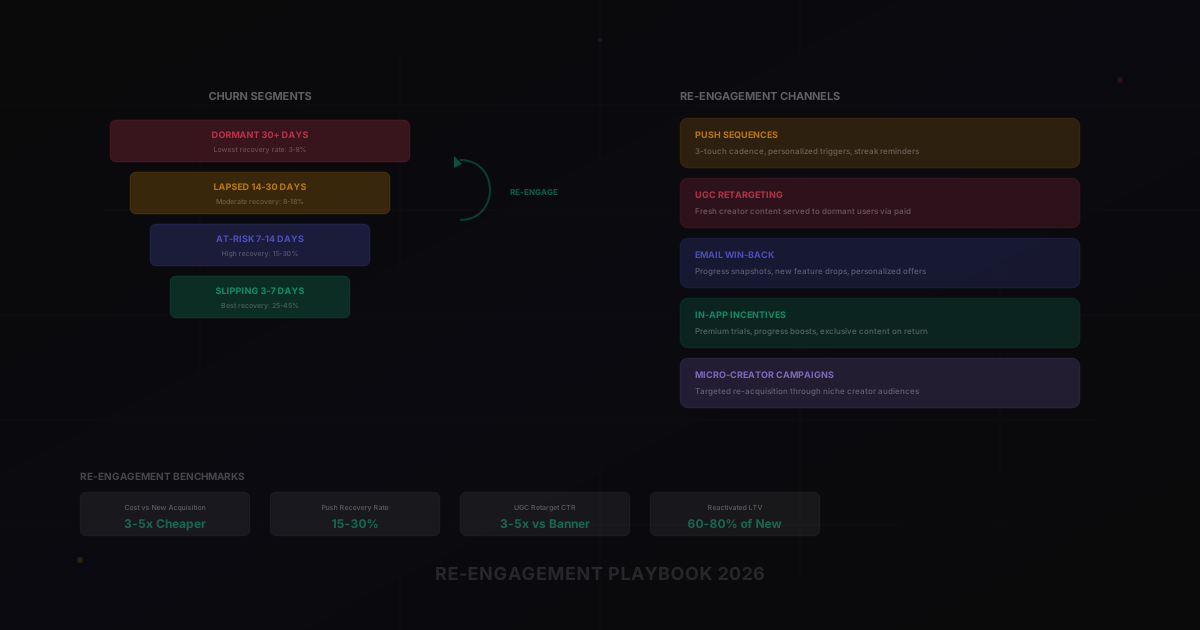
The economics of re-engagement are compelling and underutilized. Most B2C app teams spend 90%+ of their growth budget on new user acquisition and less than 5% on reactivating users who have already installed, onboarded, and demonstrated interest in the product. This allocation is backwards.
Cost advantage. Reactivating a churned user through push notifications costs essentially nothing. Reactivating through email costs pennies. Even paid UGC retargeting campaigns targeting churned users cost 60–80% less per reactivated user than acquiring a brand-new install through cold campaigns. The user has already installed — you are not paying for awareness, interest, or download friction. You are only paying to remind them why they installed in the first place.
Quality advantage. Reactivated users have a significant head start on new users. They have already passed the install barrier, completed some onboarding, and formed a baseline understanding of the product. Their time-to-value on reactivation is nearly zero compared to 30–60 seconds for a new user. This means their post-reactivation retention rates are typically 20–40% higher than first-time retention rates for new users.
Data advantage. You know why churned users left. You have their behavioral data: which features they used, how many sessions they completed, what their engagement pattern looked like before they stopped. This data enables precise segmentation and personalized re-engagement that is impossible with cold acquisition campaigns targeting strangers.
Re-Engagement vs. New Acquisition (2026 Benchmarks):
Not all churned users are the same. A user who opened the app once and never returned is fundamentally different from a user who was active for three weeks and then stopped. Treating them the same wastes resources on unrecoverable users and underinvests in highly recoverable ones.
Tier 1: Slipping (3–7 days inactive). These users have established some engagement history but have recently stopped returning. They are your highest-priority re-engagement targets because they are the most recent, most recoverable, and most likely to have been disrupted by an external factor (busy week, phone change, notification fatigue) rather than a fundamental product rejection. Recovery rate: 25–45%.
Tier 2: At-Risk (7–14 days inactive). Users who have not returned in 1–2 weeks are transitioning from passive to actively disengaged. The habit loop has broken, and they need a stronger stimulus to return. This segment responds well to fresh content, new feature announcements, and social triggers. Recovery rate: 15–30%.
Tier 3: Lapsed (14–30 days inactive). At this stage, the user has likely forgotten about the app or actively decided to stop using it. Re-engagement requires a compelling offer or a significant product update that gives them a reason to reconsider. Recovery rate: 8–18%.
Tier 4: Dormant (30+ days inactive). Long-dormant users are the hardest to reactivate and the most expensive per recovery. However, the sheer volume of dormant users in most app databases means that even a 3–8% recovery rate can generate significant reactivation numbers. Prioritize dormant users who had high engagement before churning — they had demonstrated product affinity and are more likely to return than users who bounced after one session.
Within each tier, further segment by engagement depth before churn:
Power users who churned. Users who were daily active, used multiple features, and had high session counts. Their churn likely has a specific trigger: a bug, a bad update, a competitor launch, or a life change. Re-engagement should be highly personalized and may warrant direct outreach.
Casual users who drifted. Users who opened the app 2–3 times per week and gradually decreased. They found value but not enough to sustain a habit. Re-engagement should focus on showing them features or content they never discovered.
One-session users who bounced. Users who installed, opened once, and never returned. They either did not find the value proposition quickly enough or had mismatched expectations from the acquisition content. Re-engagement should address the onboarding gap — show them the app’s value in a new way, ideally through fresh UGC that demonstrates a different angle.
UGC retargeting is the most effective paid re-engagement channel for B2C apps in 2026 because it combines the familiarity of the app (the user has already installed it) with the freshness of new creator content (showing them something they have not seen before). Standard retargeting banners generate 0.3–0.8% click-through rates. UGC retargeting videos generate 2–5% click-through rates — a 3–5x improvement.
Match the original acquisition channel. If a user installed through a TikTok UGC video, retarget them with new TikTok-style UGC content. If they installed through an Instagram Reel, use Reels-format content. Matching the original channel format creates a familiar feeling that increases the chance of re-engagement.
Show something new. Do not retarget with the same content that originally drove the install — the user has already seen it and it was not enough to retain them. Instead, show them a new feature, a new use case, or a new creator demonstrating a different aspect of the app. The message should be: “The app has something you haven’t tried yet.”
Address the churn reason. If your data suggests why users in this segment churned, tailor the creative to address that reason. Users who churned after the free trial ended should see content emphasizing the free features or a special offer. Users who churned after hitting a skill wall should see content showing easier ways to use the app. Users who churned from boredom should see the newest, most exciting features.
Include a clear return CTA. UGC retargeting videos must end with a specific, compelling reason to reopen the app: “Open the app and try the new AI portrait mode,” “Your 30-day progress report is waiting,” or “Claim your free week before it expires.” Generic CTAs like “Download now” do not work for retargeting because the user already has the app installed.
Audience creation. Build retargeting audiences in your MMP (AppsFlyer, Adjust, or Singular) based on churn tier: Slipping (3–7 day inactive), At-Risk (7–14 day), Lapsed (14–30 day), and Dormant (30+ day). Sync these audiences to TikTok Ads Manager and Meta Ads Manager for paid distribution.
Budget allocation by tier. Allocate retargeting budget inversely to churn duration: 40% to Slipping, 30% to At-Risk, 20% to Lapsed, 10% to Dormant. The highest recovery rates are in the freshest segments, so that is where your money works hardest.
Frequency capping. Cap retargeting frequency at 3–5 impressions per user per week. Above that threshold, you risk brand fatigue and negative sentiment. If a user has seen 5 retargeting ads without reopening, move them to the next tier or pause retargeting and rely on email and push sequences.
Effective re-engagement uses multiple channels in a coordinated sequence. No single channel works for all users — some respond to push notifications, others to emails, others to paid retargeting. The key is layering channels so that each user is reached through the channel they are most likely to respond to.
Push notifications are your first line of defense. They are free, instant, and reach users who have not disabled notifications. For slipping users (3–7 days inactive), deploy a 3-touch push sequence:
Touch 1 (Day 3 of inactivity): Value Reminder
“Your 5-day streak is about to expire — open the app to save it.” or “You left a workout incomplete — finish it in 2 minutes.”
Touch 2 (Day 5): Social Proof
“8 of your friends completed challenges this week — see what you missed.” or “2,400 people tried the new feature today.”
Touch 3 (Day 7): Incentive
“Come back today and get a free premium week.” or “Unlock a bonus content pack — expires in 24 hours.”
Email is ideal for longer-form re-engagement messages that push notifications cannot deliver. Use email for progress reports (“Here is what you accomplished in your first 2 weeks”), new feature announcements with visual previews, and personalized win-back offers. Email works best for at-risk and lapsed users (7–30 days inactive) who may have disabled push notifications. Optimal email cadence for re-engagement: one message per week maximum.
When a churned user does reopen the app, the in-app experience should acknowledge their absence and make re-engagement as smooth as possible. Show them what is new since their last visit. Offer to skip them past any stale state (expired streaks, outdated content). Present a quick win to deliver immediate value. Do not show the same generic home screen they saw last time — personalize the return experience to reduce the friction of catching up.
Deploy UGC retargeting for users who have not responded to push and email sequences within 7–10 days. This is your paid escalation channel for users who are still reachable through advertising platforms but have gone silent on owned channels.
For dormant users (30+ days), standard retargeting creative often fails because the user has mentally moved on. Micro-creator campaigns — new UGC from fresh creators showcasing new features or use cases — can effectively “re-acquire” these users as if they were seeing the app for the first time. The difference from true new acquisition is that the user has the app already installed, so the conversion barrier is dramatically lower (open vs. download + open).
Incentives accelerate re-engagement, but poorly designed incentives can train users to churn intentionally to receive offers. The key is to make incentives feel like a welcome-back gift rather than a reward for leaving.
Premium trial extensions. Offer 7 days of free premium access to returning users. This works especially well for freemium apps where the premium experience is significantly better than free. Users get to experience the full product again, which can reignite their engagement. Conversion to paid after a re-engagement trial: 8–15%.
Progress boosts. For apps with progression systems (fitness, learning, games), offer a boost that reduces the gap between where the user left off and where active users are. “Skip ahead 5 levels” or “Get a 2x XP boost for your first 3 sessions back.” This addresses the psychological barrier of feeling “behind” that keeps many churned users from returning.
Exclusive content drops. Offer access to content that is only available to returning users. This creates FOMO and exclusivity without discounting or devaluing the core product. “Welcome back — we saved a special workout plan just for you” or “Returning users get early access to the new portrait style.”
Streak restoration. For apps with streak mechanics, allowing returning users to restore their previous streak (or start with a 3-day head start) removes the pain of starting over. Users are significantly more likely to return if they know their previous progress is not lost.
Anti-gaming safeguards. Limit re-engagement incentives to once per user per 90-day period. Do not advertise incentives publicly — they should feel like a personal gesture, not a standing offer. Track re-engagement incentive redemption rates and churn-after-incentive rates to ensure you are not creating a cycle of intentional churning.
Re-engagement creative is structurally different from acquisition creative. It must acknowledge the user’s existing relationship with the app, show them something new, and provide a specific reason to return. Here is the production workflow:
Hook formula for re-engagement UGC: “I stopped using [app] for [time period]... then I saw [new feature/update] and had to come back.” This narrative mirrors the churned user’s experience and provides social proof that returning is worth it. It is authentic, relatable, and directly addresses the viewer’s own situation.
Creator selection. Use creators who have genuine experience with the app, including a real period of not using it. Authenticity is critical for re-engagement creative — churned users are more skeptical than new users because they have already tried the product. If the creator feels fake, the message backfires.
Production cadence. Produce 3–5 re-engagement UGC pieces per month, each targeting a different churn segment or featuring a different new feature. Rotate creative every 2–3 weeks to prevent fatigue in retargeting audiences that see the same ads repeatedly.
Apply the same AI-hybrid workflow used for acquisition content: take a winning re-engagement video and produce 3–5 variations with different hooks, CTAs, and visual treatments. Test each variation against a different churn segment. AI variation is especially valuable for re-engagement because the audience segments are smaller and fatigue faster — having more creative options extends the effective lifespan of each campaign.
Measuring the true impact of re-engagement campaigns is more complex than measuring acquisition campaigns because some churned users would have returned organically without any intervention. You need to isolate the incremental impact of your re-engagement efforts.
The gold standard for measuring re-engagement lift is a holdout group. For each churn segment, randomly assign 10–15% of users to a control group that receives no re-engagement messages. Compare the reactivation rate of the treated group (those who received re-engagement messages) against the control group. The difference is your incremental lift — the reactivations that would not have happened without your intervention. Typical incremental lift for well-designed re-engagement programs: 40–60% of total reactivations are incremental.
Most reactivated users are exposed to multiple re-engagement touchpoints before returning: a push notification, an email, and then a retargeting ad. Use a multi-touch attribution model to understand the contribution of each channel. First-touch attribution credits the push notification. Last-touch credits the retargeting ad. A time-decay model credits all touchpoints with declining weight based on recency. Time-decay is the most accurate for re-engagement because each touchpoint builds on the previous ones to eventually tip the user over the reactivation threshold.
Reactivation is only valuable if the user stays. Track post-reactivation retention at D7 and D30 after the return event. If reactivated users churn again within 7 days at rates above 60%, your re-engagement is driving temporary opens but not sustained re-engagement. In that case, focus on improving the return experience (in-app messaging, streak restoration, quick wins) rather than increasing re-engagement volume.
Re-Engagement Measurement Dashboard:
These benchmarks are based on aggregated data from B2C app re-engagement programs across fitness, education, social, creative tools, and entertainment categories in 2026.
Push Notification Re-Engagement:
Email Win-Back:
UGC Retargeting:
Overall Program:
Re-engagement programs operate in a space where aggressive tactics can backfire. Here are the critical risks to manage:
Notification fatigue. The number one risk. Over-messaging churned users accelerates their decision to uninstall entirely rather than just leave the app dormant. Once a user uninstalls, your free re-engagement channels (push, in-app) are gone permanently. Set strict frequency caps: maximum 3 push messages per re-engagement sequence, with a 30-day cooldown before repeating.
Privacy regulations. In 2026, GDPR, CCPA, and similar regulations require explicit consent for marketing communications. Ensure your push notification and email re-engagement sequences comply with opt-in requirements. Retargeting audiences must be built using consented data. Maintain a clear and accessible opt-out mechanism for all re-engagement channels.
Apple and Google policies. Both app stores have guidelines around notification usage. Notifications that are perceived as spammy can result in reduced notification delivery priority (silent notifications) or, in extreme cases, policy violations. Keep notifications genuinely useful and tied to the user’s in-app activity or preferences.
Incentive abuse. Users may learn that churning leads to free premium access or other rewards, creating a cycle of intentional churn-and-return. Mitigate this by limiting incentive offers to once per 90 days, varying the offer type so it is not predictable, and monitoring for patterns of repeated churn-reactivation cycles.
Brand perception. Aggressive retargeting can make your brand feel desperate. Cap retargeting frequency, use high-quality creative that adds value (not just “come back please”), and include a graceful exit — after 3 unsuccessful retargeting cycles, stop targeting the user and accept the churn.
Here is a week-by-week execution plan for launching a complete re-engagement program from scratch:
WEEK 1: SEGMENTATION & INFRASTRUCTURE
WEEK 2: OWNED CHANNELS (PUSH & EMAIL)
WEEK 3: PAID CHANNELS (UGC RETARGETING)
WEEK 4: MEASUREMENT & OPTIMIZATION
Every B2C app has a database of churned users that represents untapped growth potential. These users already know your product, already have it installed, and already demonstrated enough interest to download it in the first place. The re-engagement playbook turns this dormant asset into an active growth channel at a fraction of the cost of new acquisition.
The math works in your favor: reactivating users at 3–5x lower cost than new acquisition, with LTV at 60–80% of new user levels, generates a blended cost-per-active-user that no pure-acquisition strategy can match. And because re-engagement operates on owned data (your user database), it is resilient to the platform changes and privacy restrictions that make acquisition harder every year.
Start with the 4-week rollout. Measure incrementality from day one. Iterate weekly. The churned users in your database are waiting for a reason to come back — give them one.
The Viral App builds complete re-engagement systems for B2C mobile apps — from UGC retargeting creative and push sequences to churn segmentation and incremental lift measurement. Turn your dormant user base into an active growth channel.
Schedule a Strategy CallMaster B2C app retention in 2026 with data-driven strategies. Reduce churn, increase LTV, and build habits that keep users coming back.
A proven UGC framework to scale mobile apps in 2026. From creator sourcing to content operations, build your growth engine.
Design viral loops and referral systems that drive exponential app growth. Combine gamification with proven mechanics for 2026.