ATT killed deterministic tracking for 65–75% of iOS users. SKAdNetwork data is coarse and delayed. Third-party cookies are dead. Yet you still need to know which channels drive real growth. This guide builds a 6-layer attribution stack that recovers 85–110% of signal — privacy-compliant, platform-resilient, and calibrated by incrementality testing.
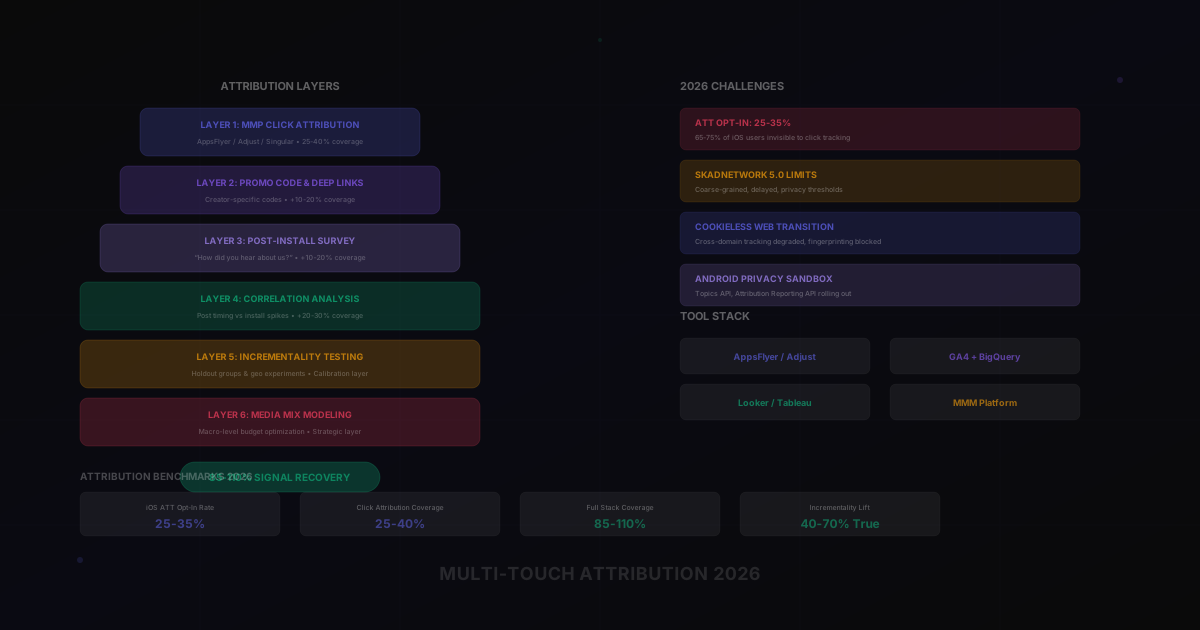
Mobile app attribution in 2026 operates in a fundamentally different environment than it did even two years ago. The combination of Apple’s App Tracking Transparency (ATT), Google’s Privacy Sandbox for Android, the death of third-party cookies, and increasingly strict privacy regulations has made the old model of deterministic, user-level click attribution obsolete for the majority of your user base.
ATT opt-in rates in 2026 have settled at 25–35% across B2C app categories. This means 65–75% of your iOS users cannot be tracked at the individual level through traditional click attribution. Your MMP (AppsFlyer, Adjust, Singular) can only deterministically attribute about a quarter to a third of iOS installs. The rest appear as “organic” in your MMP dashboard — but they are not actually organic. They are paid, influencer-driven, or referral-driven installs that simply cannot be tracked through the old deterministic model.
Apple’s SKAdNetwork (SKAN) provides aggregate conversion data without exposing individual user identities. SKAN 5.0 introduced improvements — redownload attribution, multiple conversions, and web-to-app support — but fundamental limitations remain:
Coarse-grained conversion values. SKAN provides only 6 bits (64 possible values) for conversion data, and that is under best conditions. Many campaigns fall below the privacy threshold and receive only 2-bit (4 values) or even null conversion data. This means you cannot track granular post-install events — only broad categories like “registered” or “made a purchase.”
Delayed reporting. SKAN postbacks are delayed by 24–48 hours minimum, with a random additional delay of up to 24 hours. Real-time optimization is impossible. You are always optimizing against yesterday’s data at best.
Privacy thresholds. Campaigns that do not meet Apple’s crowd anonymity thresholds receive null or coarse data. This disproportionately affects smaller campaigns, niche audiences, and new channels — exactly the areas where you need attribution data most.
Google’s Privacy Sandbox for Android is rolling out the Topics API (for interest-based targeting without individual tracking) and the Attribution Reporting API (aggregate conversion measurement similar to SKAN). While Android tracking has historically been more permissive than iOS, the direction is clear: individual-level, deterministic tracking is being systematically replaced by aggregate, privacy-preserving measurement across both platforms.
Third-party cookies are effectively dead in 2026. Chrome, Safari, and Firefox all block cross-site tracking by default. This matters for mobile app attribution because many attribution paths include a web touchpoint: a user sees a TikTok video, visits the app’s website, then downloads from the App Store. Without cross-domain cookie tracking, this path is invisible to traditional analytics. You need server-side tracking, first-party data strategies, and probabilistic models to fill the gap.
Signal Loss Summary (2026):
The solution to signal loss is not to find a single replacement for deterministic tracking. It is to build a multi-layer model where each layer captures a different slice of signal, and the combination recovers 85–110% of total attribution coverage. Here are the six layers, from most precise to most strategic.
Your MMP (AppsFlyer, Adjust, or Singular) remains the foundation. It provides deterministic, user-level attribution for the 25–35% of iOS users who opted in to ATT and the 60–75% of Android users still trackable. This data is the most precise and trustworthy — it tells you exactly which click led to which install, which post-install events occurred, and which channel/campaign/creative drove each conversion. Treat this as your ground truth for the subset of users it can see.
Promo codes are a privacy-proof attribution mechanism because the signal travels through the user’s own action, not through a tracking pixel. Assign unique promo codes to each creator, campaign, and channel. When a user enters a code during onboarding or at checkout, you get a deterministic attribution signal that is completely independent of ATT, SKAN, or cookie status. For UGC and influencer campaigns, promo codes typically capture 10–20% of total installs from each campaign — not all users remember or bother to enter the code, but those who do provide a clean signal. Deep links (Branch, AppsFlyer OneLink) serve a similar function by carrying attribution parameters through the install process, though their reliability has declined on iOS due to ATT-related restrictions.
A simple “How did you hear about us?” screen during onboarding captures self-reported attribution data that no tracking technology can provide. Users will tell you “I saw a TikTok video,” “A friend recommended it,” or “I searched the App Store.” This data is noisy (users misremember, simplify, or skip the question) but directionally valuable at scale. When aggregated across thousands of users, post-install survey data reveals channel contribution patterns that complement the MMP data. Best practice: make the survey a single tap (not a text field), limit options to 5–8 channels, and include “Other” as a catch-all. Response rates of 40–60% are achievable with good UX design.
Correlation analysis matches the timing of content publishing or campaign activation with install spikes. When a creator posts a video at 2 PM and you see an install spike at 2:30 PM, the correlation is a strong attribution signal — even without any click tracking. Build an automated system that ingests content posting timestamps from all platforms and overlays them with hourly install data. Use statistical methods (Granger causality, cross-correlation functions) to identify which posts caused which install spikes. This layer is especially powerful for TikTok organic content where click attribution is weakest (most users search the App Store after seeing a video rather than clicking a link).
Incrementality testing does not directly attribute individual installs to channels. Instead, it measures the causal impact of each channel by running controlled experiments. There are two primary methods:
Holdout group testing. For each channel, randomly withhold ad exposure from 10–15% of the target audience. Compare install rates between the exposed and holdout groups. The difference is the incremental lift — the installs that would not have happened without the channel. This tells you whether a channel is genuinely driving new installs or just taking credit for installs that would have happened organically.
Geo experiments. Pause a channel in specific geographic regions while maintaining it in others. Compare install rates between the paused and active regions. Geo experiments are especially useful for channels where holdout testing is difficult (like organic TikTok or influencer campaigns where you cannot control who sees the content).
Media Mix Modeling (MMM) uses statistical regression to determine the relationship between channel spending and business outcomes (installs, revenue, LTV) over time. Unlike the other layers, MMM does not attempt to attribute individual users — it works at the aggregate level, analyzing how changes in spend across channels correlate with changes in total outcomes. MMM is privacy-proof by design (it uses no user-level data) and provides a strategic view of channel efficiency that is impossible to get from bottom-up attribution alone. In 2026, tools like Google’s Meridian, Meta’s Robyn, and platforms like Measured and Recast make MMM accessible to teams without dedicated data science resources.
Total Signal Recovery:
Coverage can exceed 100% when multiple layers attribute the same install, which is expected and useful for cross-validation.
Building a 6-layer attribution stack requires a coordinated set of tools. Here is the recommended stack for B2C mobile apps in 2026, organized by function.
MMP: AppsFlyer, Adjust, or Singular. Choose one. All three provide comparable functionality for click attribution, SKAN postback management, deep link routing, and audience segmentation. AppsFlyer has the largest market share and most integrations. Adjust is popular in European markets with strong GDPR compliance tooling. Singular combines attribution with cost aggregation and creative analytics. The MMP handles Layers 1 and 2 (click attribution and deep link attribution).
Deep Link Provider: Branch or MMP-native. Branch provides robust deep linking and deferred deep linking for carrying attribution parameters through the App Store install process. Most MMPs also offer native deep linking (AppsFlyer OneLink, Adjust Universal Links). If you are already using an MMP, start with their native solution before adding a separate deep link provider.
BigQuery (recommended) or Snowflake. Layers 3 (survey data) and 4 (correlation analysis) require a central data warehouse where you can join attribution data from the MMP with survey responses, content publishing timestamps, and install time series. BigQuery is the most cost-effective option for most B2C app teams and integrates natively with GA4, Looker, and most MMPs. Export raw MMP data to BigQuery daily, ingest survey responses from your app backend, and pull content posting data from TikTok/Meta/YouTube APIs.
GA4 + Looker or Tableau. GA4 provides event-level analytics and integrates with BigQuery for raw data access. Looker (or Tableau) connects to BigQuery to build the dashboards that combine data from all six attribution layers into unified views. The visualization layer is critical — attribution data from six layers is too complex to interpret in spreadsheets. You need purpose-built dashboards that reconcile, deduplicate, and present a single view of channel performance.
Incrementality: Most MMPs offer built-in incrementality testing (AppsFlyer Incrementality, Adjust’s Pulse). For more advanced geo experiments, tools like GeoLift (Meta open source) or Measured.com provide dedicated incrementality measurement. MMM: Google Meridian (open source, runs on BigQuery) is the most accessible MMM solution for mobile app teams. Meta’s Robyn is another open-source option. Both require 12+ months of historical spend and conversion data to produce reliable models. For teams without data science capacity, managed MMM platforms like Recast, Paramark, or Lifesight handle the modeling and provide actionable budget recommendations.
The hardest attribution problem in 2026 is reconciling data across channels that each have their own reporting system, their own attribution windows, and their own incentive to over-claim credit. TikTok Ads Manager, Meta Ads Manager, Apple Search Ads, Google Ads, and your MMP all report different numbers for the same campaign. Here is how to build a single source of truth.
Step 1: Establish the MMP as the primary attribution source. Use your MMP’s reported installs as the baseline for all attribution. The MMP sees across all channels and deduplicates — if both TikTok and Meta claim credit for the same install, the MMP resolves the conflict based on its attribution model (typically last-touch with configurable lookback windows).
Step 2: Layer in self-reported data. Add post-install survey responses and promo code data to supplement the MMP’s blind spots (the 65–75% of iOS users who opted out of ATT). Where the MMP says “organic” but the survey says “TikTok,” credit TikTok. This triangulation approach recovers a significant portion of the “dark” attribution that the MMP cannot see.
Step 3: Apply correlation analysis for remaining gaps. For installs that are neither MMP-attributed, survey-attributed, nor promo-code-attributed, use temporal correlation analysis to probabilistically assign attribution. A spike of 200 installs that occurs 30 minutes after a creator posts a video and has no other attribution signal can be confidently attributed to that post.
Step 4: Calibrate with incrementality data. Use incrementality test results to adjust the attribution weights from Steps 1–3. If your multi-layer model says TikTok drove 40% of installs but incrementality testing shows TikTok’s true incremental contribution is 30%, apply a 0.75 calibration factor to TikTok’s attribution. This prevents over-counting and ensures budget allocation decisions are based on causal impact, not just correlation.
A privacy-first attribution stack is not just a regulatory requirement — it is a competitive advantage. Teams that build their measurement systems on privacy-compliant foundations do not have to rebuild every time a new regulation takes effect or a platform tightens its tracking policies. Here are the principles:
Aggregated reporting by default. Design all dashboards and reports to display aggregate data (cohort-level, campaign-level, channel-level) rather than individual user journeys. This is not just a privacy safeguard — aggregate data is actually more useful for decision-making because it smooths out individual noise and reveals true patterns.
First-party data as the foundation. Promo codes, post-install surveys, and in-app behavior data are all first-party data collected with user consent. Build your attribution stack on these signals rather than on third-party tracking that may be restricted or blocked at any time. First-party data is more durable, more accurate, and more defensible than any third-party tracking mechanism.
Consent management. Implement a consent management platform (CMP) that presents clear opt-in choices for tracking, stores consent records, and dynamically enables or disables data collection based on user preferences. This ensures compliance with GDPR, CCPA, and emerging regulations while maximizing the data you can collect from users who do consent.
Data minimization. Only collect and store the data you actually need for attribution decisions. Do not hoard user-level data “just in case.” Define clear retention policies: raw MMP data retained for 90 days, aggregated attribution data retained for 24 months, survey responses anonymized after 30 days. Data minimization reduces legal risk, storage costs, and the blast radius of any potential data breach.
Different stakeholders need different views of attribution data. A single dashboard that tries to serve everyone serves no one. Build three purpose-built views:
Shows high-level channel performance and budget efficiency. Metrics: blended CPI by channel, ROAS by channel, total installs by source (all six layers combined), month-over-month trends, budget allocation vs. performance. Updated weekly. This dashboard answers the question: “Are we spending our growth budget on the right channels?”
Shows daily campaign performance for the growth team. Metrics: daily installs by campaign, creative-level performance (CTR, CPI, conversion rate), SKAN postback data, promo code redemption rates, correlation analysis alerts (install spikes after content posts). Updated daily. This dashboard answers the question: “What is working right now and what needs attention?”
Shows long-term channel efficiency and incrementality data. Metrics: incremental CPI by channel (adjusted for organic cannibalization), LTV by acquisition source (12-month view), MMM-derived marginal ROI curves, channel saturation indicators. Updated monthly. This dashboard answers the question: “Where should we invest the next dollar for maximum growth?”
Dashboard Metrics by View:
Executive (Weekly):
Blended CPI, ROAS, total installs by channel, budget allocation efficiency, MoM trends
Operations (Daily):
Campaign-level CPI, creative performance, SKAN data, promo code rates, correlation alerts
Strategy (Monthly):
Incremental CPI, LTV by source, MMM marginal ROI, channel saturation, holdout results
Incrementality testing is the calibration layer that keeps all other attribution layers honest. Without incrementality, your multi-layer model is susceptible to over-counting (multiple layers claiming the same install) and channel over-attribution (channels taking credit for installs that would have happened organically).
Major channels: quarterly. Run holdout tests on TikTok, Meta, and your largest influencer programs every quarter. These channels are your biggest spend categories, and even a 10% over-attribution correction can save significant budget or reveal opportunities for increased investment.
Secondary channels: semi-annually. Test channels like YouTube Shorts, Apple Search Ads, and Google Ads every 6 months. These channels are typically smaller in spend and more stable in incrementality, so less frequent testing is sufficient.
New channels: immediately. When you launch a new acquisition channel, run an incrementality test within the first 4–6 weeks. New channels often have inflated self-reported metrics because their attribution models are optimistic by design. Incrementality testing in the first month prevents you from scaling a channel based on false performance signals.
When an incrementality test shows that a channel’s true incremental contribution is lower than its attributed contribution, apply a correction factor to all future attribution from that channel. For example, if TikTok Ads claims 1,000 installs per week but incrementality testing shows only 650 of those are truly incremental (the other 350 would have installed organically), apply a 0.65 incrementality factor to TikTok. Your “true CPI” for TikTok is then: (spend / 650), not (spend / 1,000). This correction is essential for accurate budget allocation — without it, you systematically over-invest in channels that cannibalize organic installs and under-invest in channels with high true incrementality.
Signal Coverage:
Incrementality Findings:
Attribution Windows (2026 Standard):
Error 1: Trusting platform self-reporting. Every ad platform over-reports its own performance. TikTok, Meta, and Google all use generous attribution windows and count view-through conversions that may not be truly incremental. Fix: Always use your MMP as the primary source, calibrate with incrementality testing, and never make budget decisions based on platform-reported data alone.
Error 2: Labeling unattributed installs as “organic.” In a post-ATT world, the majority of installs that your MMP labels as “organic” are actually influenced by paid or influencer channels. Making budget decisions based on inflated organic numbers leads to under-investment in the channels that are actually driving growth. Fix: Build Layers 2–4 to recover attribution for the “dark” installs that the MMP cannot see.
Error 3: Optimizing on last-touch attribution only. Last-touch attribution gives full credit to the final touchpoint before conversion, ignoring all earlier touchpoints that influenced the user’s decision. This systematically over-credits bottom-of-funnel channels (search, retargeting) and under-credits top-of-funnel channels (UGC, influencer, brand). Fix: Use multi-touch attribution models (time-decay or data-driven) that distribute credit across the full user journey. At minimum, compare last-touch and first-touch attribution to understand how credit shifts.
Error 4: Ignoring post-install quality. Attribution that only tracks installs without tracking post-install behavior (retention, activation, revenue) optimizes for volume instead of value. A channel that drives 1,000 installs with 5% D30 retention is less valuable than a channel that drives 500 installs with 20% D30 retention. Fix: Pass post-install events (registration, subscription, purchase, D7 retention) through your MMP and include them in all attribution analysis. Optimize for LTV-adjusted CPI, not raw CPI.
Error 5: Running incrementality tests too infrequently. Channel incrementality changes over time as audiences shift, creative refreshes, and competitive dynamics evolve. An incrementality factor measured 6 months ago may be stale. Fix: Run incrementality tests on major channels quarterly and update correction factors after each test.
Error 6: Not accounting for cross-channel effects. Users often see your content on multiple channels before converting. Pausing TikTok may not just reduce TikTok installs — it may also reduce “organic” App Store installs from users who discovered you on TikTok and then searched the App Store. Fix: Use geo experiments to measure the full cross-channel impact of each channel, including downstream effects on organic and search channels.
The teams that win in 2026 are not the ones with the best MMP or the most sophisticated SKAN implementation. They are the ones that build a complete attribution system — multiple layers of signal, calibrated by incrementality, unified in a single data warehouse, and visualized through purpose-built dashboards. No single layer provides the full picture. Together, they provide the clarity needed to allocate budget with confidence in a privacy-first world.
Start with what you have (your MMP), add the low-cost layers (promo codes, surveys), build the analytical layers (correlation, incrementality), and graduate to the strategic layer (MMM) when you have 12+ months of data. Each layer you add recovers signal that was previously invisible. By the time all six layers are operational, you will have better attribution coverage than most teams had in the pre-ATT era — and it will be built on a privacy-compliant foundation that does not break when the next privacy change arrives.
Build the system. Calibrate it quarterly. Trust the data. The signal is there — you just need the right layers to capture it.
The Viral App builds multi-layer attribution systems for B2C mobile apps — from MMP setup and promo code infrastructure to correlation analysis, incrementality testing, and unified dashboards. See the full picture of your growth performance.
Schedule a Strategy CallMeasure the real ROI of your UGC and influencer campaigns. Discover the metrics and attribution models that matter most for app growth in 2026.
Win back churned app users with UGC and micro-creators. This re-engagement playbook covers proven strategies to boost retention and reactivation.
Master B2C app retention in 2026 with data-driven strategies. Reduce churn, increase LTV, and build habits that keep users coming back.