The complete playbook for scaling B2C mobile apps using TikTok organic growth, UGC creators, and influencer marketing. Real benchmarks, real campaign structures, and real results from scaling apps like Cal AI, Hevy, Knowt, and more.
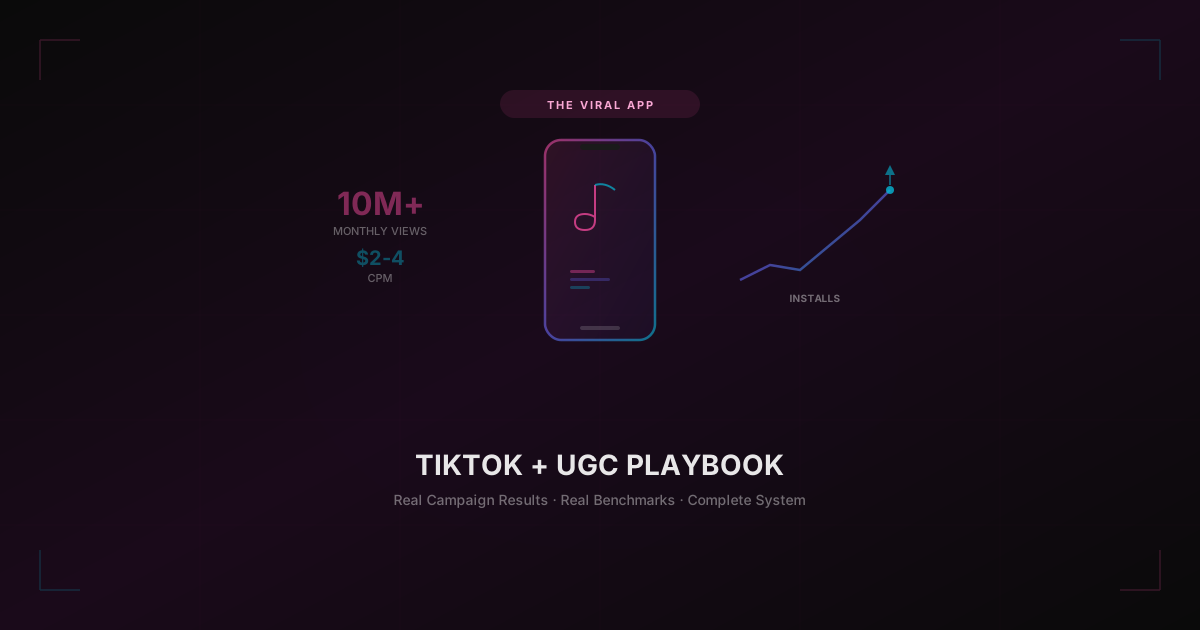
Most app marketers are still running the same 2023 playbook: launch Meta ads, hire a UGC freelancer on Fiverr, and pray for a 2x ROAS. Meanwhile, the apps actually winning in 2026 are doing something completely different.
At The Viral App, we have scaled apps like Cal AI, Hevy, Knowt, Spoil.me, and more using a repeatable system that combines TikTok organic growth, creator-led UGC, and influencer seeding. This is the playbook we use internally, with real numbers, real benchmarks, and real campaign structures.
No fluff. Just what works.
Before posting anything, you need to prime the algorithm. TikTok is not Instagram. The discovery engine rewards accounts that behave like real creators, not brands.
For the first 5-7 days, do not post. Instead, train the algorithm by engaging with content in your niche:
This "primes" TikTok to show your future content to the right audience. Skip this step and your first 10 videos will land on dead FYPs.
The biggest mistake apps make is hiring "UGC creators" who have never used the product. The content feels fake because it is fake. Here is how we source and structure deals.
Pro tip: Negotiate bundles. A 3-video package with a nano creator at $100/video is almost always better ROI than one video from a macro creator at $5,000. Volume beats vanity metrics every time.
We use a tiered approach:
We have tested thousands of videos across dozens of app campaigns. Here are the content formats that consistently outperform everything else.
1. "POV" Hook + Demo: "POV: you finally found an app that [solves specific pain point]." Show the app in use within the first 2 seconds. This format alone accounts for 40% of our best-performing videos.
2. Before/After Transformation: Show the "before" state (messy, disorganized, struggling) and the "after" state (clean, organized, thriving) with the app as the bridge. Works incredibly well for productivity, fitness, and finance apps.
3. "I Tried" Review Style: "I tried [app name] for 30 days and here is what happened." Authentic, narrative-driven, builds trust. Best for subscription apps where LTV matters.
4. Trending Sound + App Demo: Layer your app demo over a trending TikTok sound. The algorithm boosts content using trending audio. Check TikTok Creative Center for trending sounds weekly.
5. "Things I Wish I Knew" Listicle: "5 things I wish I knew before trying to [goal]." Position your app as the solution to one of the items. Educational content gets saved and shared at 3x the rate of pure promotional content.
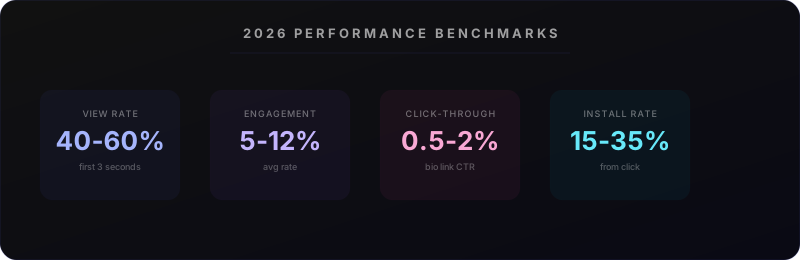
Here are the benchmarks we track and optimize toward across all campaigns:
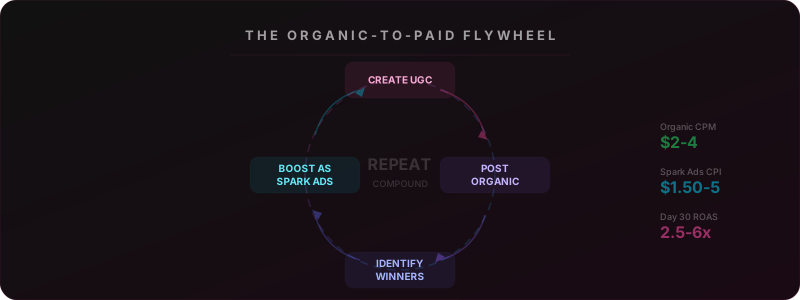
Key insight: The magic of TikTok is that organic content that performs well can be immediately boosted as Spark Ads. This means your best-performing organic videos become your best-performing ads with zero additional creative cost. We call this the "organic-to-paid flywheel" and it is the single most efficient growth loop in mobile marketing right now.
TikTok is the primary engine, but the best results come from a multi-channel approach. Here is what else we layer on top:
Repurpose TikTok content to Instagram Reels with minor edits (remove TikTok watermark, adjust aspect ratio if needed). Instagram Reels get 30-50% of the views of TikTok but often convert at a higher rate due to an older, higher-spending audience.
Same repurposing strategy. YouTube Shorts has the longest content shelf life. A Short can continue driving installs for 6-12 months after posting. Lower initial views but incredible long-tail value.
For apps with strong community fit (fitness, productivity, finance), Reddit threads and niche communities drive highly engaged installs. Not scalable in the same way, but the users acquired from Reddit have 2-3x higher retention than social media installs.
For apps with higher LTV, mid-roll podcast ads in niche shows (10K-50K listeners) deliver outstanding CPI at $3-8 per install with premium user quality.
Scaling a mobile app in 2026 is not about spending more on Meta ads. It is about building a content engine that compounds. TikTok organic + UGC creators + Spark Ads creates a flywheel that gets cheaper and more effective over time.
At The Viral App, we build this entire system for B2C apps in 90 days. We handle creator sourcing, content production, campaign management, and performance optimization. Then we hand over the playbook so your team can keep scaling independently.
Ready to build your growth engine? Schedule a free consultation and we will walk you through exactly how this system would work for your app.
Ready to scale your app? Schedule a free consultation
The first 1.5 seconds of your TikTok decide everything. TikTok's algorithm measures early retention — if viewers swipe past in the first 2 seconds, the video is dead on arrival. Your hook pattern is your most important creative variable.
The 5 hook formulas that consistently work for app marketing:
Posting cadence for app marketing accounts: For fresh accounts (first 30 days), post 3-5 times per day to feed the algorithm enough data to find your audience. After establishing baseline performance, reduce to 1-2 high-quality posts per day. Weekdays between 7-9 AM and 6-9 PM local time consistently outperform other windows for app-install content — these are the moments when users are on their phones with time to download.
Content pillars framework: Structure your content calendar around a 60/30/10 split. 60% educational content (how-to's, tips, tutorials showing your app's value). 30% entertaining content (trends, skits, relatable moments that happen to feature your app). 10% promotional content (direct CTAs, feature announcements, limited offers). The 60% educational content builds trust and following. The 30% entertainment drives viral reach. The 10% promotional converts that attention into installs.
Most apps fail at UGC not because they can't find creators, but because they don't have a repeatable system for sourcing, vetting, and managing them. A creator pipeline turns UGC from a one-off experiment into a predictable growth engine.
Step 1: Source candidates. Three channels, in order of effectiveness:
Step 2: Outreach. DM is the primary channel for TikTok creators. Keep it short and specific. Template that converts at 15-20%:
"Hey [name]! Love your [specific video reference]. We're [App Name] — [one-sentence description]. Looking for creators to make [content type] at [$rate range]. Interested? Happy to share more details."
Do NOT send a paragraph. Do NOT ask them to fill out a form as a first touchpoint. Do NOT lead with "we have an exciting opportunity." Get to the point: what you want, what you'll pay.
Step 3: Briefing documents. Once a creator says yes, send a brief within 24 hours (delay kills momentum). Your brief should include: product overview (2 sentences max), content objective (awareness vs. installs), key talking points (3-5 bullets), creative direction (reference 2-3 example videos), technical requirements (video length, orientation, where to show the app), and FTC disclosure requirements.
Step 4: Managing 20+ creators simultaneously. Create an iMessage or WhatsApp group per content batch (not one giant group — that's chaos). Set deadlines with 48-hour buffers built in for the 30% of creators who deliver late. Use a shared calendar showing who's posting what and when. Check your creator database every morning for: content due today, payments due this week, and creators who've gone silent for 5+ days.
Dealing with flaky creators: Budget for 20-30% no-show rate. If you need 15 videos, brief 20 creators. Send reminder DMs at the 72-hour and 24-hour marks before deadlines. After 2 missed deadlines without communication, move the creator to "inactive" — don't burn the bridge, but stop allocating briefs until they re-engage.
Organic UGC is powerful, but the real magic happens when you pour paid budget behind your proven winners. TikTok Spark Ads let you boost organic creator posts as ads — keeping the social proof (likes, comments, shares) while scaling reach to targeted audiences.
The 80/20 rule for UGC paid amplification: Spend 80% of your paid UGC budget on content that's already proven organically. A video that hit 100K+ views organically has a validated hook, validated audience response, and lower risk of wasted spend. The other 20% goes to testing promising new content that hasn't had time to prove itself organically yet.
How Spark Ads work:
Whitelisting process: Negotiate Spark Ads rights upfront in your creator contracts — don't try to add this after content is delivered. Include a clause granting 30-60 day Spark Ads usage rights. For top performers, negotiate 90-day or unlimited usage rights for a 20-30% fee premium. Always get this in writing. Verbal agreements with creators don't hold up when a video does 10M views as a Spark Ad.
Budget allocation for app install campaigns: Start with $50-100/day per creative on a CPA (cost per action) objective targeting app installs. Let each creative run for 72 hours before making optimization decisions — TikTok's algorithm needs learning time. Kill creatives with CPI above 2x your target after the learning phase. Scale winners by 20-30% per day (not more — sudden budget jumps trigger TikTok's algorithm to re-enter learning phase).
Measuring true incrementality: The hardest question in UGC paid amplification — would these users have installed anyway? Run holdout tests: for 2 weeks, pause Spark Ads entirely and measure organic install volume. Compare against your Spark Ads-on periods. Typically, we see 60-70% incrementality — meaning 60-70% of Spark Ad installs are truly incremental, while 30-40% would have happened organically. Factor this into your true CPI calculations.
Every piece of UGC you produce for TikTok can work across 4-5 other channels with minimal adaptation. Repurposing multiplies your content ROI by 3-5x without requiring additional creator spend.
TikTok → Instagram Reels: Remove TikTok watermarks (use SnapTik or request unwatermarked originals from creators). Adjust captions — Instagram's audience responds better to longer, more descriptive captions (2-3 sentences vs. TikTok's punchy one-liners). Add relevant Instagram hashtags (different algorithm, different hashtag strategy). Instagram Reels has a longer shelf life — content can surface in Explore for 30-90 days vs. TikTok's 48-72 hour peak window.
TikTok → YouTube Shorts: YouTube Shorts has the longest content shelf life of any short-form platform — videos can generate views for 6-12 months. Upload with YouTube-optimized titles (more keyword-rich, less clickbaity than TikTok). Add an end screen card linking to your app's download page. YouTube Shorts audiences skew slightly older and more intent-driven, which often means higher install-to-retention rates.
TikTok → Paid Ad Creative (Meta & Google): Your best-performing organic UGC is your best-performing paid creative. Period. Export winning TikToks and run them as Meta Ads (Instagram Stories/Reels placements) and Google UAC video ads. UGC-style ads consistently outperform polished brand creative on cost-per-install — we see 40-60% lower CPI with UGC creative vs. studio-produced ads across our portfolio.
UGC in non-social channels:
Rights management: Ensure your creator contracts include multi-platform usage rights from day one. A standard clause: "Brand may repurpose content across Instagram, YouTube, paid advertising, email, and owned web properties for [X] months from delivery." Paying 10-20% extra for full cross-platform rights is one of the highest-ROI investments in your creator budget.
Here's a real-world breakdown of how we scaled a B2C fitness app from zero TikTok presence to over 100,000 installs in 4 months using the exact playbook described in this guide. Numbers are from a real program — creator names anonymized.
Month 1: Foundation & Testing ($5,000 budget)
Month 2: Scale Winners ($12,000 budget)
Month 3: Cross-Platform Expansion ($18,000 budget)
Month 4: Optimize for Quality ($15,000 budget)
4-Month Totals:
The takeaway: TikTok UGC isn't just a cheap acquisition channel — it's a better acquisition channel. Users who discover your app through authentic creator content arrive with pre-built trust and higher intent. They retain better, convert to paid at higher rates, and generate word-of-mouth that compounds your growth. The playbook isn't complicated. Find creators, brief them well, amplify winners, cut losers, and repeat. The apps that win in 2026 are the ones that systematize this process and run it like a machine.
Decode the 2026 TikTok algorithm for mobile app marketing. Learn what drives reach, engagement, and installs on the platform.
Stay ahead of short-form video trends in 2026. Learn what works on TikTok, Reels, and YouTube Shorts for mobile app marketing.
A proven UGC framework to scale mobile apps in 2026. From creator sourcing to content operations, build your growth engine.