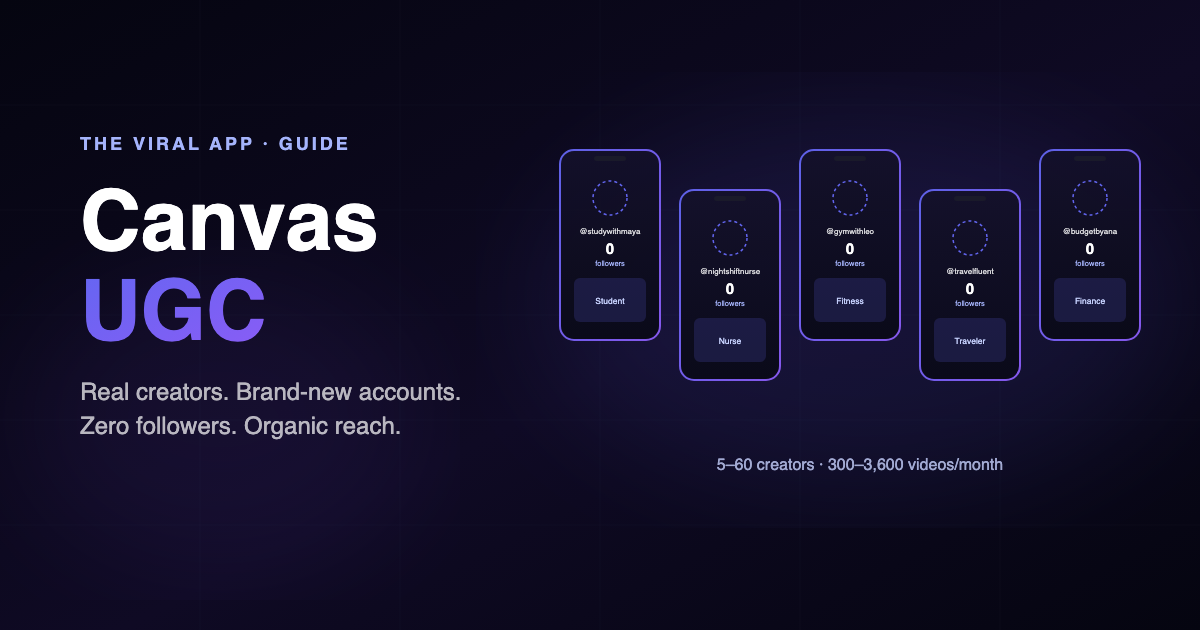
Canvas UGC is a short-form video model where real creators post about your app on brand-new TikTok and Instagram accounts that start with zero followers. Every account is a blank canvas: no audience, no history, no bias. Reach comes from the For You and Reels recommendation feeds, not from anyone’s existing following.
It sounds counterintuitive. Why would you pay creators to post on accounts nobody follows? Because on TikTok and Reels, followers barely matter anymore. The algorithm shows each new video to a small test audience and decides from watch time, rewatches, shares and comments whether to push it further. A great video on a zero-follower account can reach a million people. A weak video on a creator with 500K followers can stall at a few thousand views.
We have run this model for 60+ consumer apps at The Viral App, with a network of 10,000+ creators and 3B+ organic views generated. This guide explains how Canvas UGC actually works, how much volume you need, how to measure it honestly, and when it is the wrong choice for your app.
Canvas UGC in one sentence
Creators film native short-form videos about your app and publish them every day on dedicated, purpose-built accounts that start from zero followers, so you can test many content angles cheaply on organic reach and scale the ones that work.
What Is Canvas UGC?
The name comes from the “blank canvas” account. Instead of borrowing a creator’s audience (influencer marketing) or buying videos to run as ads (traditional UGC), you build a portfolio of new accounts around your app and let creators fill them with content.
A program counts as Canvas UGC when it has these five traits:
- Purpose-built accounts. Each creator runs a new account dedicated to one niche or persona tied to your app, not their personal page and not your official brand handle.
- Creator-native content. Real people on camera, filmed on a phone, in the language of the platform. It should look like something a user would post, not an ad.
- Organic distribution. Reach comes from the recommendation feed. No paid boost is needed for a video to find its audience.
- Daily publishing. Accounts post consistently, usually one to several videos per day, for weeks or months.
- A testing loop. Performance data decides which hooks, formats and angles get repeated and which get cut. Without this, you only have a lot of videos.
Here is what that looks like in practice. A language-learning app might run four accounts in parallel: a student documenting a 30-day challenge, a traveler using the app before a trip, a skit account dramatizing “ordering coffee abroad,” and a teacher sharing quick grammar tips. Same app, four audiences, four sets of hooks, all tested at once.
Canvas UGC vs. Traditional UGC vs. Influencer Marketing
These three get mixed up constantly, and they solve different problems. The difference is what you are paying for and where the content lives.
| Canvas UGC | Traditional UGC | Influencer marketing | |
|---|---|---|---|
| What you buy | Ongoing organic content plus testing | Video files for your ads | Access to an existing audience |
| Where it is posted | New dedicated accounts | Not posted organically (runs as ads) | The creator’s own account |
| Creator needs followers | No | No | Yes |
| Volume | Hundreds to thousands of videos a month | A handful to dozens | One to a few posts per creator |
| Built-in testing | Yes, every video is a free test | Only through paid spend | Limited |
| Best for | Finding what content works, then scaling it | Feeding a paid ads account | Credibility and launches with a known face |
Two other terms often get confused with Canvas UGC:
- Faceless slideshow accounts also use new accounts, but post text-on-image carousels with no creator on camera. They are cheap to produce, but they rarely build the trust that a real person talking about your app does. Many apps run both.
- AI UGC uses AI-generated avatars. It is useful for fast creative testing in paid ads (we cover it in our AI UGC service), but organic feeds increasingly label and limit synthetic content. Canvas UGC relies on real humans.
Why Fresh Accounts Work Better Than You Would Expect
The most common objection is “but nobody follows these accounts.” That is exactly the point. There are four reasons zero-follower accounts are a feature, not a bug.
1. The feed is interest-based, not follower-based
TikTok’s For You feed and Instagram Reels recommend videos to people based on what they watch and engage with, not on who they follow. Every new video gets an initial test audience. If it holds attention, it gets shown to more people. A creator’s follower count has little to do with that first test.
2. Every video is a clean experiment
On an influencer’s account, a video’s performance is mixed up with that creator’s audience and reputation. On a fresh account, the content has to stand on its own. If a hook works there, it is because the hook works, which makes the result far more useful when you later turn it into a paid ad.
3. You can niche down hard
A dedicated account can be about one persona and one problem: “nurse working night shifts tracking her sleep,” “college student who stopped failing exams.” Narrow accounts teach the algorithm exactly who to show them to. A personal account that mixes your app with vacations and brunch never gets that clarity.
4. A portfolio spreads the risk
One influencer post is one bet. Ten or thirty accounts posting daily are hundreds of bets a month. Some accounts will stall, and that is fine. The program does not depend on any single creator or video.
How a Canvas UGC Campaign Works, Step by Step
This is the process we run in our UGC campaigns for mobile apps. Every provider does it a bit differently, but a serious program covers all six steps.
Step 1: Strategy and content angles
Before anyone films, map who the app is for and why they would care. That means competitor research on what is already working in your category, two to five audience personas, and a first batch of angles to test: the problem, the transformation, the “I didn’t know this existed” reveal, the skit, the day-in-the-life. Each angle gets hooks, talking points and a call to action.
Step 2: Recruit creators who match the audience
Creators are chosen for on-camera ability and fit with the persona, not follower count. A fitness app needs people who look like they actually train. A study app needs creators the target student would relate to. A program usually starts with 5 to 15 creators and can grow to 60 once the winning angles are clear.
Step 3: Set up and warm up the accounts
Each creator opens a new account with a clear niche in the name, bio and profile picture. A short warm-up period, using the platform normally and engaging with the niche before posting heavily, helps the algorithm understand what the account is about. Our guide on building brand accounts on TikTok covers the warm-up in detail.
Step 4: Publish every day
Consistency matters more than polish. Creators post daily, using native editing, trending sounds where they fit, and captions written for search. TikTok and Instagram are increasingly used as search engines, so captions and on-screen text should include the words your users actually type.
Step 5: Test, cut and double down weekly
This is where most programs fail. We introduce four to five new angles every week. Angles that do not gain traction within 5 to 10 days get cut. Angles that do get repeated with variations: new hooks, new creators, new settings. The goal is not one viral video. It is a growing library of formats that reliably perform.
Step 6: Scale winners, organically and in paid
Once a format proves itself, you scale it two ways: more creators and accounts producing that format, and the best videos turned into paid ads on TikTok and Meta. Because those videos already proved they hold attention with a cold audience, they usually make much stronger ads than concepts invented in a meeting.
How Much Volume Does Canvas UGC Need?
Volume is not a vanity number in this model. It is how you buy information. Most videos will be average. A small share will break out, and you cannot predict which ones in advance. The more quality attempts you make, the faster you find the outliers and learn why they worked.
Our campaigns run between 300 and 3,600 videos per month. Two rules matter more than the exact number:
- Variation beats repetition. 300 near-identical videos teach you one thing. 300 videos across 10 angles and 5 personas teach you which angle, which persona and which hook style work.
- Give it time before judging. Plan for at least four weeks of daily posting before you decide whether the program works. New accounts take time to find their audience, and the first angles are rarely the best ones.
How to Measure Canvas UGC
Views are the easiest number to report and the least useful one on their own. Measure the program in layers, from “is the content working?” to “is the business growing?”
| Layer | What to look at | What it tells you |
|---|---|---|
| Execution | Videos posted vs. planned, accounts active | Is the machine running? |
| Attention | Hook hold rate, average watch time, completion | Do people stop scrolling and keep watching? |
| Resonance | Shares, saves, comments asking about the app | Is the message landing with the right people? |
| Intent | Profile visits, link clicks, branded searches | Are viewers going looking for the app? |
| Business | Installs, trials, subscriptions, paid ad performance of winners | Is it moving revenue? |
What about attribution?
Be honest about it: organic short-form is hard to attribute click by click. Most people who discover an app on TikTok do not tap a link. They search for it in the App Store later. So look for the footprints instead:
- Lifts in organic installs and branded App Store search that line up with viral videos.
- A “How did you hear about us?” question in onboarding, with TikTok and Instagram as options.
- Comments and DMs asking for the app name.
- Cost per install when the winning videos run as paid ads, compared with your previous creatives.
For a deeper framework, see our guide to ROI metrics and attribution for UGC campaigns.
What Does Canvas UGC Cost?
Cost depends far more on scope than on the label. The main drivers are:
- Number of creators and videos per month. This is the biggest lever.
- How creators are paid. Common structures are a flat fee per video, a base fee plus view-based bonuses, or performance-based deals for large campaigns. Bonuses keep creators focused on making content that actually performs.
- How much is managed. Strategy, briefs, recruitment, quality control, daily posting oversight and reporting all take work, whether you do it in-house or a partner does.
- Your learning budget. The first weeks are for finding what works. Budget for that phase instead of expecting the first batch to be profitable.
For a broader breakdown of UGC pricing models, read how much UGC costs in 2026, or book a call and we will scope a program for your app.
Is Canvas UGC Legit? Disclosure and Platform Rules
Yes, when it is done transparently. Creators are real people talking about a real product, and paid partnerships must be disclosed. In the US, the FTC requires a clear disclosure when a creator is paid to promote a product. In the UK, the CMA and ASA apply similar rules. On TikTok, creators should turn on the commercial content disclosure setting. On Instagram, they should use the paid partnership label or a clear #ad.
Good programs also stay within each platform’s community guidelines: one real person behind each account, no fake engagement, no misleading claims about what the app does. Shortcuts here get accounts restricted and put the whole program at risk.
Is Canvas UGC Right for Your App?
It is a strong fit when
- Your app is a consumer (B2C) product that is easy to show on a phone screen in a few seconds.
- Your audience spends time on TikTok, Reels or Shorts.
- You want to find winning creatives before spending heavily on paid ads.
- You can commit to at least two to three months. Our standard system runs over three months.
- Your onboarding and paywall are solid enough to convert the traffic you get.
Consider something else when
- You sell to businesses through long sales cycles. Content can help, but daily consumer-style videos are rarely the main driver.
- Your product cannot be shown visually or explained in under 30 seconds.
- You need guaranteed results within two weeks. Canvas UGC is a discovery engine, not a switch you flip.
- Your product is in a restricted category (some health, finance or gambling products) where creator content faces heavy limits.
Common mistakes
- Briefing like an ad agency. Scripts that sound like ads perform like ads, which on organic feeds means poorly.
- Judging after one week. New accounts need time, and the first angles are hypotheses.
- Only counting views. A video with 2 million views and no app interest is worth less than one with 200K views and hundreds of “what app is this?” comments.
- Never moving winners into paid. Organic winners are the best ad creative you will get. Not testing them in paid leaves most of the value on the table.
Want to see the model working? Browse our case studies, including how we helped Cal AI scale with creator content.
Frequently Asked Questions
What is Canvas UGC?
Canvas UGC is a short-form video model where creators publish recurring videos about an app or brand on new, dedicated TikTok and Instagram accounts that start with zero followers. Reach comes from the platforms' recommendation feeds instead of an existing audience, and performance data decides which content angles get scaled.
Do Canvas UGC creators need followers?
No. Creators are chosen for on-camera ability and fit with the target audience, not follower count. The accounts start from zero, and TikTok and Reels distribute each video based on how viewers engage with it, not on how many followers the account has.
How is Canvas UGC different from influencer marketing?
Influencer marketing pays for access to a creator's existing audience on their own account, usually for a few posts. Canvas UGC pays for ongoing content on new dedicated accounts, at much higher volume, with each video acting as a test of a hook or angle.
How many videos does a Canvas UGC campaign need?
Enough to test many angles at once. A pilot with 5 creators posting twice a day produces about 300 videos a month; larger programs reach thousands. Variation across angles, personas and hooks matters more than raw volume.
How long does it take to see results from Canvas UGC?
Plan for at least four weeks of daily posting before judging a program. Early signals like watch time and comments can appear in the first weeks, but finding repeatable winning formats usually takes one to three months.
Can Canvas UGC videos be used as paid ads?
Yes, and they should be. Videos that perform organically with a cold audience are strong candidates for TikTok and Meta ads, provided the creator agreement includes the right usage rights.
Does Canvas UGC need to be disclosed?
Yes. Paid creator content must be disclosed under rules such as the FTC guidelines in the US and CMA guidance in the UK. Creators should use TikTok's commercial content setting or Instagram's paid partnership label, or a clear #ad.
Who owns the Canvas UGC accounts?
It depends on the agreement. Ownership of the accounts, access and content usage rights should be defined in the contract before the program starts, including what happens to the accounts when the campaign ends.
Want to See What Canvas UGC Could Do for Your App?
We recruit 5 to 60 creators who post your app on fresh TikTok and Instagram accounts, test new angles every week, and turn the winners into your best ads. Tell us about your app and we will map out a program.
Schedule a Strategy Call