The ultimate synthesis of everything we know about scaling B2C mobile apps in 2026. Not a collection of tactics — a self-reinforcing system where organic UGC testing feeds micro-scaling, micro-scaling feeds paid amplification, paid amplification feeds data-driven iteration, and every cycle compounds the one before it.
Most app growth strategies are linear. You run a campaign, measure results, and decide whether to do more of the same or try something different. Each effort exists in isolation. Good months happen because of lucky creative hits. Bad months happen because the creative well runs dry. There is no compounding. No system.
The flywheel model is different. It is a self-reinforcing growth system where every stage generates the inputs for the next stage, and every cycle makes the entire system more efficient. Teams running a properly configured flywheel do not experience random month-to-month swings — they experience compounding improvement, where CPI decreases, win rates increase, and install velocity accelerates over time.
This guide describes the complete flywheel as we have seen it operate in the highest-performing B2C app growth programs in 2026. Every stage is covered in depth: what happens, how it feeds the next stage, and what metrics tell you the flywheel is spinning faster.
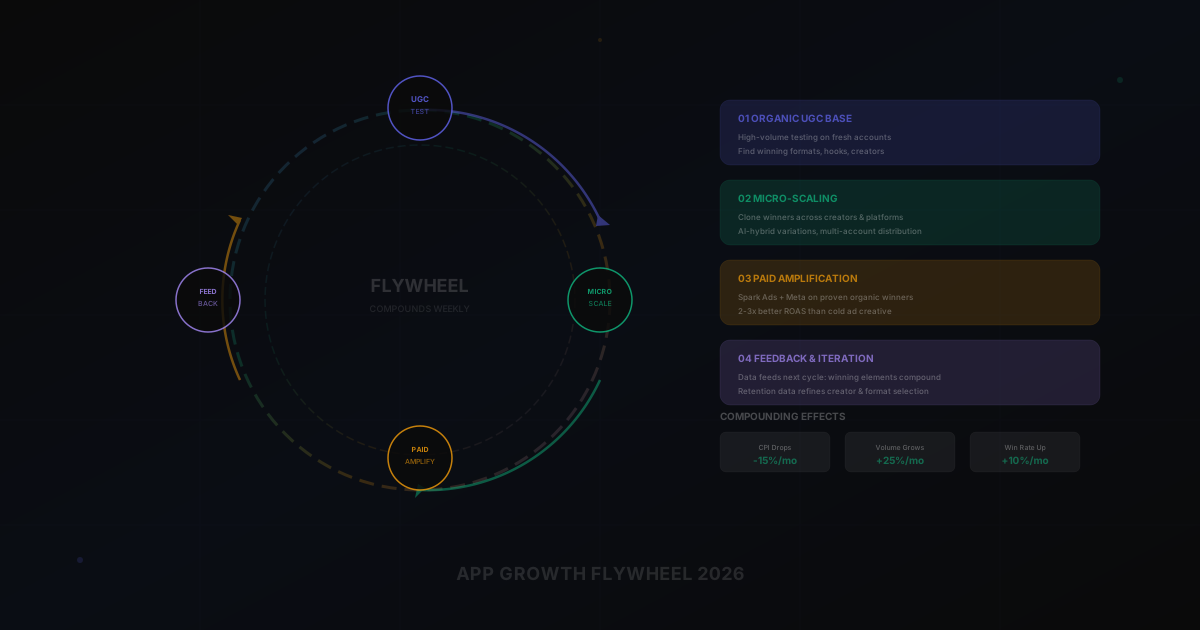
Before diving into each stage, picture the complete system. The flywheel has four interconnected phases that run in a continuous loop:
PHASE 1: ORGANIC UGC BASE →
High-volume content testing on fresh accounts across TikTok, Reels, and Shorts. Multiple creators, multiple formats, multiple hooks. The goal is signal: find what works, discard what doesn’t. Output: a library of proven winners with performance data.
PHASE 2: MICRO-SCALING →
Take proven winners and multiply them. AI-hybrid variations, cross-creator cloning, multi-account distribution. Scale the winning elements (hooks, formats, angles) across new executions. Output: 3–5x more content at predictable quality levels.
PHASE 3: PAID AMPLIFICATION →
Push the top 5–10% of organic performers into paid distribution via Spark Ads, Partnership Ads, and Meta campaigns. Proven content with existing social proof converts 2–3x better than cold ad creative. Output: scalable, profitable user acquisition at volume.
PHASE 4: FEEDBACK & ITERATION → (back to Phase 1)
Performance data from all three phases feeds back into the next cycle. Winning hooks become templates. High-LTV creators get more budget. Underperforming formats get retired. Every cycle starts smarter than the last. Output: compounding efficiency.
The arrow from Phase 4 connects back to Phase 1. The loop never stops — it accelerates.
The foundation of the entire flywheel is organic content testing. Without this phase, everything else is guesswork — you are paying to amplify content you hope works rather than content you know works.
Creator network. Build and maintain a roster of 15–40 UGC creators producing content on a regular cadence. These are not one-off partnerships — they are a standing content army that produces 50–100+ videos per month across all platforms. Recruit through organic outreach, creator marketplaces, and your existing user base.
Testing accounts. Distribute content across multiple accounts (branded, creator-owned, and fresh testing accounts) to isolate content performance from account authority. A winning piece of content should perform well regardless of which account publishes it — that is how you know the content is the variable, not the account.
Format diversity. Test across the full spectrum of proven formats: genuine discovery reactions, output showcases, day-in-my-life integrations, before/after transformations, comparisons, mini tutorials, and community challenges. Each format appeals to a different audience motivation, and you need data on which ones convert best for your specific app.
Hook variation. For every base video, test 3–5 hook variations. The hook determines 80% of a video’s distribution potential, so testing hooks at volume is the single highest-leverage activity in the organic testing phase. Use AI script generation to produce hook variants quickly, then film or edit each one.
A video qualifies as a winner in the organic testing phase when it meets two criteria: (1) engagement rate above your category baseline (>5% for most B2C app categories on TikTok, >3% on Reels), and (2) measurable install signal — either direct tracked installs via link or promo code, or a visible correlation between the post timing and an install spike. Videos that get high engagement but zero install signal are entertainment, not growth content — they stay in the library but do not advance to the next phase.
Phase 1 Key Metrics:
The organic testing phase produces winners. The micro-scaling phase multiplies them. This is where the AI-hybrid workflow, multi-creator distribution, and cross-platform adaptation turn 5–15 winning videos into 50–100+ publishable variations.
Axis 1: Creator multiplication. Take a winning format and brief it to 5–10 additional creators, each bringing their own audience and style. The format stays the same (same hook structure, same narrative arc, same CTA approach), but the human execution varies. This tests whether the format works broadly or was a one-time hit with a specific creator’s audience.
Axis 2: AI variation. Use AI tools to generate 5–10 variations of each winner: alternative hooks, voice-over variants, visual recuts, caption styles, and thumbnail options. The human core of the content stays intact — AI handles the packaging variations. Every variation goes through a human quality gate before publishing.
Axis 3: Platform adaptation. Adapt each winning piece of content for all three major short-form platforms. Optimize for TikTok’s rewatch-rate priority, Reels’ save-and-share priority, and Shorts’ CTR-and-intent priority. Same core content, different packaging for each platform’s algorithm and audience behavior.
When you combine all three scaling axes, the multiplication is dramatic. One organic winner becomes: 5–10 creator executions × 3–5 AI variations each × 3 platform adaptations = 45–150 individual pieces of publishable content. Not all of these will perform equally — but you only need 10–20% of them to hit the same performance bar as the original winner to generate enormous volume at the same quality level.
Phase 2 Key Metrics:
This is where the flywheel generates direct, scalable revenue. You take the top 5–10% of content from the micro-scaling phase — the videos that have already proven they drive engagement and installs organically — and push them into paid distribution.
TikTok Spark Ads. Promote existing organic posts from creator accounts. The post retains all its existing social proof (likes, comments, shares) and appears in the For You feed looking identical to organic content — because it is organic content with paid distribution behind it. Spark Ads from proven organic winners consistently deliver 2–3x better ROAS than cold ad creative because they have already survived the harshest quality filter: the organic algorithm.
Meta Partnership Ads (Instagram). The Instagram equivalent of Spark Ads — promote Reels from creator accounts with paid reach while maintaining the organic appearance and social proof. Meta’s targeting capabilities add a layer of audience precision that TikTok’s interest-based system cannot match, making this especially powerful for apps with specific demographic targets.
YouTube Shorts Ads. The newest entrant in the paid amplification stack. YouTube’s Shorts ad inventory is less competitive and cheaper than TikTok or Meta in early 2026, creating an arbitrage opportunity for teams that can produce Shorts-optimized content. Combined with YouTube’s intent-driven audience, Shorts ads drive higher-LTV installs at lower CPIs for apps in education, productivity, and self-improvement categories.
Rule 1: Only amplify proven winners. No content enters paid distribution without first proving itself organically. This single rule eliminates the biggest source of wasted ad spend in app marketing — paying to distribute content that nobody wants to watch.
Rule 2: Start with small budgets, scale based on data. Begin each creative with $50–$100/day. If CPI is within target after 48 hours, increase to $200–$500/day. If CPI holds after a week, scale to $1,000+/day. This graduated scaling prevents budget waste on creative fatigue and ensures you never overspend on a single piece of content.
Rule 3: Rotate creative before it fatigues. Even the best content has a limited paid lifespan — typically 2–4 weeks before engagement declines and CPI rises. The flywheel solves this naturally: by the time a piece of paid creative is fatiguing, the organic testing and micro-scaling phases have already produced the next batch of winners ready for amplification.
Rule 4: Track blended CPI, not just paid CPI. When you amplify a creator’s post via Spark Ads, it also boosts the organic distribution of that post. The true CPI should account for both the paid and the organic installs generated. Blended CPI is typically 30–50% lower than pure paid CPI, which significantly improves the ROI picture.
Phase 3 Key Metrics:
This is the stage that turns a good growth strategy into a great one. The feedback loop takes data from all three preceding phases and uses it to make the next cycle better. Without this stage, you have a linear process. With it, you have a flywheel.
Channel 1: Content performance data. Which hooks earned the highest rewatch rates? Which formats drove the most installs per view? Which visual styles, voice tones, and CTA approaches outperformed? This data feeds directly into the briefs for the next cycle of organic UGC testing — every brief is informed by what worked in the previous cycle, not by intuition or trend-chasing.
Channel 2: User quality data. Track D1, D7, and D30 retention, activation rate, and LTV for users acquired from each piece of content. Some content drives high install volume but low retention (users arrived with mismatched expectations). Other content drives fewer installs but much higher retention (users arrived with accurate expectations and genuine intent). This data tells you which content to amplify more and which to deprioritize — even if the surface-level engagement metrics look similar.
Channel 3: Creator performance data. Not all creators are equal, and their relative performance changes over time. Monthly creator grading (install volume, user quality, content efficiency, reliability) tells you where to increase investment, where to maintain, and where to replace. The creator roster should evolve every cycle — bottom performers are replaced by new organic-test candidates, and top performers are elevated to ambassador roles with deeper creative involvement.
At the end of each cycle (typically monthly), the growth team conducts a structured review that produces three outputs: (1) updated content briefs incorporating the winning elements from the past cycle, (2) updated creator tier assignments with budget reallocations, and (3) updated format and platform prioritization based on cross-platform performance data. These three outputs become the inputs for the next Phase 1, and the flywheel starts again — but smarter, faster, and more efficient than the previous cycle.
The flywheel does not just repeat — it accelerates. Here are the specific compounding effects that make each cycle more powerful than the last:
Win rate improvement. In cycle 1, your organic testing win rate might be 8–10% (8–10 winners out of every 100 videos). By cycle 6, informed by five cycles of data, your win rate should be 15–25%. You are testing fewer wild experiments and more refined variations of proven elements. This means more winners per dollar spent on content production.
CPI compression. As your content quality and targeting improve cycle over cycle, your organic CPI decreases (more installs per video) and your paid CPI decreases (better-performing creative needs less ad spend per install). Teams running the flywheel for 6+ months typically see 10–15% CPI improvement per month, compounding.
Creator network strengthening. With each cycle, your best creators get better at producing content for your app (they understand the product more deeply, they know what hooks work, they have a relationship with the community). And your worst creators get replaced with better candidates. The average quality of your creator roster increases monotonically over time.
Content library compounding. Old winners do not stop generating installs. A video that went viral three months ago continues earning organic views and installs through platform recommendation systems. Your content library becomes an ever-growing asset that generates baseline installs independent of current production — a moat that is extremely difficult for competitors to replicate.
Algorithm familiarity. As your accounts accumulate consistent posting history and engagement signals, platform algorithms become more confident in distributing your content. Account authority compounds — new posts from established, high-engagement accounts receive larger initial test cohorts and faster distribution than identical content from new accounts.
Once the flywheel is spinning effectively in your primary market, the system can be replicated in new markets with a significant head start — you already know which formats, hooks, and structures work.
Step 1: Localize the format, not the content. Take your winning format structures (hook type, narrative arc, CTA approach) and brief them to creators in the target market. Do not translate existing content — re-create it with local creators who understand the cultural context. The format is universal; the execution must be local.
Step 2: Run a compressed organic test. Because you already know which formats work, the organic testing phase in a new market can be compressed from 4–6 weeks to 2–3 weeks. You are testing local execution of proven formats, not discovering formats from scratch. The win rate in new markets is typically 1.5–2x higher than your first market because of accumulated format knowledge.
Step 3: Fast-track to paid amplification. With proven format knowledge and a compressed testing phase, new markets can reach the paid amplification stage in 4–6 weeks versus 3–4 months for the first market. This dramatically reduces the time and investment needed to achieve positive ROI in each new territory.
Step 4: Cross-market learning loops. Winning content from one market often inspires winning content in another. A format that breaks out in Brazil might work equally well in Indonesia once localized. Build cross-market reporting that surfaces wins from all territories, and create a process for rapidly testing cross-market format transfers.
A flywheel can slow down or stall if you are not actively monitoring its health. Here are the warning signals and the corrective actions for each:
Signal: Organic win rate declining for 2+ cycles
Your content is becoming stale or your formats are over-saturated in the market.
Pivot: Increase exploration budget to 30–40% (up from 20–30%). Test genuinely new formats, not just variations of existing winners. Refresh your creator roster with 5–10 new faces. Study what competitors and adjacent apps are doing differently.
Signal: Paid CPI rising while organic CPI is stable
Your paid creative is fatiguing faster than your organic pipeline can replace it.
Pivot: Increase Phase 2 output volume. Add more AI variation axes (new hook styles, new visual treatments). Expand your paid channel mix — if TikTok is fatiguing, shift budget to Reels or Shorts where your creative may have more headroom.
Signal: Install volume stable but retention declining
You are acquiring more users but lower-quality users. Content may be setting inaccurate expectations or reaching the wrong audience segments.
Pivot: Audit your content for expectation accuracy. Ensure UGC demonstrates real app value, not exaggerated outcomes. Shift targeting toward audiences that match your highest-LTV user profiles. Prioritize creators whose attributed users have the best retention, even if their volume is lower.
Signal: Creator churn exceeding 20% per quarter
You are losing creators faster than you can replace them, which disrupts the flywheel’s consistency.
Pivot: Audit your creator compensation and relationship management. Are you paying competitively? Are you providing growth support? Are you communicating reliably? Invest in creator retention for your top two tiers before investing in new recruitment.
Signal: Platform algorithm change disrupting organic distribution
A major platform update changes the rules of organic distribution, and your content performance drops across the board.
Pivot: Pause micro-scaling (Phase 2) and return to pure organic testing (Phase 1) with a wide format exploration. Re-establish your winner baseline under the new algorithm rules, then rebuild the micro-scaling and paid amplification phases on the updated foundation. The flywheel structure means you can rebuild faster than teams without a system.
For teams that want to build this visual into their internal documentation, here is the complete flywheel diagram described in full structural detail:
Center: A circular flywheel icon with the label “GROWTH FLYWHEEL” and the subtitle “Compounds Every Cycle.”
12 o’clock position (Phase 1): “ORGANIC UGC BASE” node. Inputs: creator network (15–40 creators), format library, hook templates, platform accounts. Activities: high-volume content production (50–100/month), multi-platform publishing, 72-hour performance grading. Outputs: 5–15 proven organic winners per month. An arrow flows clockwise to the 3 o’clock position.
3 o’clock position (Phase 2): “MICRO-SCALING” node. Inputs: proven winners from Phase 1, AI variation tools, expanded creator roster. Activities: creator multiplication (5–10 new executions per winner), AI-hybrid variation (5–10 per execution), platform adaptation (3 versions per video), human quality gate. Outputs: 50–100+ scaled variations per month. Arrow flows clockwise to 6 o’clock.
6 o’clock position (Phase 3): “PAID AMPLIFICATION” node. Inputs: top 5–10% of Phase 2 output, paid media budget. Activities: Spark Ads (TikTok), Partnership Ads (Instagram), Shorts Ads (YouTube), graduated budget scaling ($50/day → $1,000+/day per creative), creative rotation every 2–4 weeks. Outputs: scalable install volume, blended CPI data, deep performance analytics. Arrow flows clockwise to 9 o’clock.
9 o’clock position (Phase 4): “FEEDBACK & ITERATION” node. Inputs: content performance data (all phases), user quality data (retention, LTV, activation), creator performance data (tier scores). Activities: monthly review, brief updates, creator tier reassignment, format/platform reprioritization, exploration budget allocation. Outputs: updated briefs, updated creator roster, updated priorities. Arrow flows clockwise back to 12 o’clock — completing the loop.
Outer ring annotations: Between each node, label the data that flows between phases: “Winners + Data” (Phase 1 → 2), “Scaled Creatives” (Phase 2 → 3), “Performance Data” (Phase 3 → 4), “Insights + Briefs” (Phase 4 → 1).
Compounding indicators: Around the outside of the flywheel, annotate the compounding metrics: “Win Rate: +2–3% per cycle,” “CPI: −10–15% per cycle,” “Content Library: grows 50–100 assets per cycle,” “Creator Quality: improves with every tier review.”
The most important insight in this entire guide is that the flywheel is not a part of your growth strategy — it is your growth strategy. Individual tactics (UGC production, influencer partnerships, paid ads, AI tools) are components. The flywheel is the system that connects them into something greater than the sum of its parts.
Teams that execute individual components well but do not connect them into a system will see good-not-great results. Teams that build the flywheel and commit to running it for 6–12 months will see compounding results that accelerate over time — decreasing CPIs, increasing win rates, expanding content libraries, deepening creator relationships, and growing install velocity.
The flywheel takes effort to get spinning. The first two cycles are the hardest: you are building infrastructure, establishing processes, and collecting baseline data. By cycle 3–4, the momentum becomes self-reinforcing. By cycle 6, the system is generating results that linear strategies cannot match. Start building the flywheel today. Every week you delay is a week of compounding you will never get back.
The Viral App builds and operates complete growth flywheels for B2C mobile apps — from organic UGC testing and creator networks to AI-hybrid scaling, paid amplification, and data-driven iteration. Let’s get your flywheel spinning.
Schedule a Strategy CallDesign viral loops and referral systems that drive exponential app growth. Combine gamification with proven mechanics for 2026.
Make your B2C mobile app go viral in 2026. Step-by-step guide covering content strategy, referral mechanics, and launch tactics.
A proven UGC framework to scale mobile apps in 2026. From creator sourcing to content operations, build your growth engine.