The complete workflow for combining AI generation tools with human UGC creators to produce 3–5x more content at a fraction of the cost — without triggering the “uncanny valley” that kills engagement. From format identification to AI cloning, human polish, scale testing, and conversion optimization.
There is a new reality in B2C mobile app marketing: the teams producing the most content are winning. Not necessarily the teams producing the best content — the teams producing the most volume of good-enough content, testing it fast, and then doubling down on the winners.
But pure-human UGC production has a ceiling. You can only recruit, brief, and manage so many creators before costs spiral and turnaround times stretch into weeks. And pure-AI content — fully synthetic videos generated from scratch — still trips the uncanny valley detector that platforms and audiences have become surprisingly good at spotting in 2026.
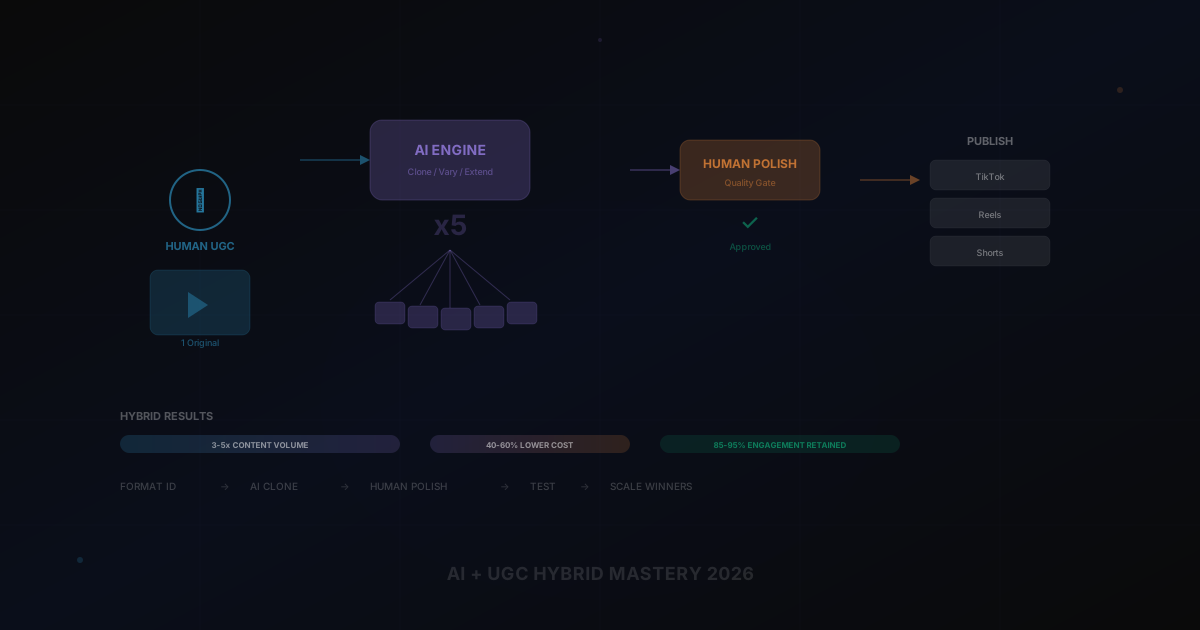
The answer is neither one nor the other. It is the hybrid: using AI tools to multiply the output of your human creators, turning every winning piece of UGC into 5–10 testable variations without requiring the original creator to shoot a single extra take. The teams that have mastered this workflow in early 2026 are reporting 3–5x more publishable content per month, 40–60% lower cost-per-creative, and — critically — engagement rates that hold steady because the human core remains intact.
This guide walks through the entire process, step by step. No vague theory — this is the exact workflow you can implement this week.
Before diving into the workflow, it is worth understanding why the hybrid approach has become the default for high-performing app growth teams in 2026. The economics are straightforward:
A typical UGC creator delivers 3–5 finished videos per brief cycle. A brief cycle takes 5–10 days from script approval to final delivery. If you are managing 10 creators, you are looking at 30–50 videos per cycle — maybe 6–8 cycles per quarter if you are efficient. That gives you roughly 200–400 videos per quarter.
That sounds like a lot until you factor in TikTok, Reels, and Shorts all requiring different aspect ratios, hooks, and pacing. You need to test at least 20–30 new creative concepts per week across platforms to find the 2–3 that merit scaling. At 200–400 per quarter, you are barely keeping up — and every video costs $100–$500 depending on the creator.
Fully AI-generated content — synthetic avatars, AI voice-overs, AI-scripted everything — can be produced at essentially infinite volume. But the engagement data tells a clear story: fully synthetic UGC-style content averages 40–60% lower engagement rates compared to human-created equivalents, and the gap widens as audiences become more AI-literate.
Platform algorithms are also adapting. TikTok and Instagram have both introduced detection layers that can down-rank content identified as predominantly AI-generated. The risk is not just lower engagement — it is reduced distribution from the start.
The hybrid model solves both problems simultaneously. You start with authentic human-created content — real faces, real voices, real reactions — and then use AI to clone, vary, and extend that content into dozens of testable variations. The human core provides the authenticity signal that algorithms and audiences reward. The AI layer provides the volume that testing demands.
The numbers we are seeing from teams running this workflow in early 2026:
The workflow has five distinct phases. Each phase has a clear input, a clear output, and a clear owner. The entire cycle from “original UGC delivered” to “10 variations live and being tested” takes 24–48 hours.
Before any AI touches your content, you need to know which formats are worth cloning. This phase is purely analytical:
Review your top performers. Pull every video from the last 30–60 days that exceeded your engagement baseline (we typically use >5% engagement rate or >30% average watch time as the threshold). Categorize each winner by its structural format: is it a problem-solution demo? A reaction video? A storytelling arc? A comparison? A “watch me try this” narrative?
Identify the replicable elements. For each winning video, break it down into components: the hook (first 1–2 seconds), the narrative structure, the visual style, the audio treatment (voice-over vs. on-camera, music choice, pacing), and the CTA. Which of these elements are format-dependent (they define the format and should be preserved) versus instance-dependent (they are specific to this particular video and can be varied)?
Build your clone-worthy shortlist. You want 3–5 proven formats that are structurally distinct from each other. These become your “master templates” for the AI variation phase. Typically: one talking-head format, one screen-demo format, one reaction/duet format, one lifestyle-context format.
This is where the AI tools earn their keep. For each master-template video, you generate multiple variations across several axes:
Hook variations. Using AI script generation, create 5–8 alternative opening hooks for the same video structure. Keep the body and CTA identical — only the first 1.5 seconds change. This is the highest-leverage variation because hooks determine 80% of a video’s distribution potential.
Voice-over cloning. If the original uses voice-over (not on-camera speech), AI voice cloning tools can generate the same script in different vocal tones, pacing, and emphasis patterns. A single script becomes 3–4 voice-over variants in minutes. Important: always use your creator’s voice with their explicit consent, or use licensed AI voices — never clone without permission.
Visual recuts. AI editing tools can automatically re-sequence B-roll, change transition timing, adjust color grading, and swap background music from a single source video. The core footage (the human creator) stays untouched — the surrounding visual context changes.
Caption and text overlay variations. AI generates alternative on-screen text, different caption styles, and varied text placement. This is especially powerful for TikTok where text overlays dramatically affect watch time.
Thumbnail/cover frame variations. For platforms that use cover images (Reels, YouTube Shorts), AI generates multiple thumbnail options from the same video content with different text, framing, and visual treatments.
Typical output from one master video:
This is the phase that separates teams producing genuinely high-performing hybrid content from teams producing AI slop. Every single variation must pass through a human editor before it goes live. The human polish phase is not optional — it is what preserves the authenticity that makes hybrid content work.
Audio-visual sync check. AI voice cloning and re-editing can introduce subtle timing mismatches. A human editor watches every variation at full speed, checking that voice-over matches visual pacing, that transitions feel natural, and that nothing looks “off” in a way that triggers the uncanny valley.
Authenticity gut-check. The editor asks one question: “Would I believe a real person made this and posted it organically?” If the answer is anything other than an immediate yes, the variation gets flagged for revision or discarded. This subjective check is surprisingly reliable and catches problems that automated quality metrics miss.
Platform-specific adjustments. Each platform has subtle norms. TikTok content should feel raw and spontaneous. Reels audiences accept slightly more polished production. Shorts viewers expect fast pacing. The human editor adjusts each variation to match the platform where it will be posted.
Compliance and brand safety. AI-generated scripts can occasionally produce claims or language that is off-brand or non-compliant. The human review catches these before they go live.
Polished variations get published for testing. The goal is not to find the “best” video in isolation — it is to identify which elements (hooks, voice styles, visual treatments) consistently outperform so you can compound those insights into future content.
Publish 3–5 variations per platform per day across your testing accounts. Stagger posting times to control for time-of-day effects. Track at the variation level, not just the video level — you want to know whether “Hook A + Voice Style 2” beats “Hook C + Voice Style 1” regardless of the base video.
Let variations run for 48–72 hours before making any decisions. Early TikTok performance (first 2 hours) is notoriously unreliable for predicting final reach. Wait for the algorithm to finish its test cohorts before pulling data.
After the testing window closes, grade every variation against your KPIs (engagement rate, average watch time, click-through rate to app store, install conversion). The top 10–20% of variations move into your “scale” queue for paid amplification or cross-platform redistribution. The bottom 50% get archived. The middle 30% get analyzed for extractable insights — maybe the hook was strong but the CTA was weak, or the voice style was engaging but the visual pacing was too slow.
The AI tooling landscape for content creation is evolving rapidly, so rather than recommending specific products (which may be outdated by the time you read this), here are the categories of AI capability you need in your hybrid stack and what to look for in each:
You need a tool that can take a 30–60 second voice sample from your creator and generate new voice-over in their voice with controllable parameters: speed, pitch, emphasis, emotional tone. The best tools in 2026 can produce voice-over that is indistinguishable from the original speaker in short-form contexts (under 60 seconds). Look for tools that offer fine-grained control over pacing and that handle natural speech patterns (pauses, filler sounds, breath marks) rather than producing unnaturally smooth output.
Large language models are excellent at generating hook variations, alternative CTAs, and script rewrites that preserve the core message while changing the surface-level language. Feed the model your winning script plus a description of the target format and audience, and it can generate 10–20 variations in seconds. The key is prompting with your actual performance data: “This hook achieved 8% engagement on TikTok with 18–25 female users. Generate 10 alternative hooks targeting the same audience with the same emotional trigger.”
AI-powered editing tools can automatically identify scene boundaries, key moments, and transition points in your source footage. They can then recut the same footage into multiple variations with different pacing, B-roll ordering, transition styles, and music beds. The best tools preserve the narrative arc while changing enough surface-level elements that each variation feels distinct to viewers and algorithms.
Tools that can adjust color grading, apply visual filters, change background elements, or add/modify text overlays across multiple videos in batch. The goal is not to transform the visual identity of the content but to create enough visual variation that platforms do not flag near-duplicate content while maintaining the authentic UGC aesthetic.
AI image generation tools that can extract key frames from your video and compose them into optimized cover images with text overlays, facial expression emphasis, and layout variants. Particularly important for Instagram Reels and YouTube Shorts where the cover image significantly impacts tap-through rates.
The uncanny valley in AI-assisted content is real, and it kills performance. Here are the specific triggers that make audiences feel something is “off” — and how to avoid each one:
Voice pacing that is too perfect. Real people hesitate, speed up when excited, slow down for emphasis, and occasionally stumble. AI voice-overs that are perfectly smooth and evenly paced are the single biggest uncanny valley trigger. Fix: always add micro-imperfections in your voice cloning output — slight speed variations, occasional breath sounds, natural pauses.
Lip-sync mismatches. If you are using AI to modify voice-over on content with visible lip movement, even a 100-millisecond desync is detectable by viewers. Fix: only use voice cloning on content where the speaker’s mouth is not visible (narration over B-roll, off-camera voice, or content where the speaker is looking away).
Over-polished captions. AI-generated text overlays tend toward perfect grammar and polished phrasing. UGC text is casual, uses abbreviations, and sometimes has intentional imperfections. Fix: prompt your AI text generator to match the informal register of the platform — include “tbh,” casual punctuation, and the kind of shorthand your target audience actually uses.
Repetitive visual patterns. If all your AI variations use the same transition style, the same text animation, or the same color filter, audiences start recognizing the template — even if they cannot articulate why. Fix: randomize secondary visual elements across variations. Use at least 4–5 different transition styles, 3–4 text animation styles, and varied color treatments.
The golden rule: AI should change the packaging of the content, not the substance. The human face, the human voice (cloned or original), the human reaction, the genuine product interaction — these must remain untouched. AI handles hooks, cuts, overlays, captions, and distribution packaging.
With 3–5x more content variations available, you need a structured testing framework to extract maximum signal from the data. Random publishing will give you random results.
Test one variable at a time against a control. In week one, hold everything constant except the hook — publish 5 hook variations of the same base video on the same account at the same time of day. In week two, take the winning hook and test 4 voice-over variants. In week three, take the winning hook + voice combo and test visual treatment variations. This sequential isolation gives you clean signal on which elements actually drive performance.
Run the same variation set across TikTok, Reels, and Shorts simultaneously. A hook that wins on TikTok may underperform on Reels because the audience demographics and consumption patterns differ. Build platform-specific performance profiles for each content element so you can optimize per-platform rather than using a one-size-fits-all approach.
Do not call a winner until you have enough data. For organic testing on TikTok, we use a minimum threshold of 5,000 impressions per variation before comparing performance. For Reels and Shorts, the threshold is 3,000 impressions (lower distribution makes higher thresholds impractical). If a variation has not hit the threshold after 72 hours, extend the testing window or deprioritize it — low-distribution content often has confounded metrics.
Finding a high-engagement variation is step one. Converting that engagement into app installs is step two — and it requires a different optimization lens.
CTA placement testing. Once you have a winning creative, test different CTA placements: end-card CTA, mid-video CTA (at the peak engagement moment), text-overlay CTA throughout, or pinned-comment CTA. Our data shows mid-video CTAs placed at the 60–70% mark of the video consistently outperform end-card CTAs by 25–40% on click-through rate.
Landing page alignment. The App Store or Play Store page should visually and tonally match the UGC creative that drove the click. If the video uses casual, excited language about a fitness feature, the store listing screenshots and description should reflect that same energy — not corporate marketing speak. Misalignment between creative and landing page is one of the biggest install conversion killers.
Paid amplification of organic winners. Take your top 5% of organic performers and push them into paid distribution via Spark Ads (TikTok), Partnership Ads (Instagram), or promoted content. Paid amplification of proven organic content consistently delivers 2–3x better ROAS than purpose-built ad creative because the social proof (existing likes, comments, shares) compounds the conversion effect.
Deep-funnel tracking. Connect your content performance data to in-app events — not just installs but activation, retention D1/D7/D30, and monetization. A video that drives 10,000 installs of users who churn in 48 hours is less valuable than a video that drives 2,000 installs of users who retain through Day 30. Optimize for downstream value, not top-of-funnel vanity metrics.
AI-powered content curation by platforms. TikTok, Instagram, and YouTube are all deploying AI curation models that personalize not just which content users see, but which version of that content is served. Some platforms are testing creator tools that automatically generate variant thumbnails and hooks for different audience segments. Teams that are already producing multi-variant content are pre-adapted for this shift.
Short-form video dominance continues to accelerate. By mid-2026, short-form video is projected to account for over 70% of all social media time spent for users under 30. The apps that are investing in video-first organic content strategies now are building moats that will compound for years. The hybrid workflow is the only way to produce at the volume this format demands.
Creator economy standardization. AI tools are making it possible for smaller creator teams (5–10 people) to produce output volumes previously only achievable by 30–50 person agencies. This is democratizing high-volume content testing and compressing the gap between well-funded teams and scrappy startups.
Real-time content personalization. Emerging tools can dynamically modify content elements (text overlays, CTAs, even audio emphasis) based on viewer signals in real-time. This is early-stage but signals a future where every viewer sees a slightly different version of the same core content, fully automated.
Regulatory clarity on AI disclosure. Multiple jurisdictions are moving toward requiring disclosure when AI is substantially used in content creation. The hybrid model — human core with AI-assisted variation — is better positioned for compliance than fully synthetic content, but teams should establish clear disclosure protocols now.
Risk: Platform duplicate-content penalties
If your variations are too similar, platforms may suppress them as near-duplicate content or flag your account for spammy behavior.
Mitigation: Ensure each variation differs on at least two axes (hook + visual treatment, or voice + caption style). Never publish more than 3 variations from the same base video on the same account within a 24-hour period.
Risk: Creator consent and IP disputes
Using AI to clone a creator’s voice or modify their content without explicit permission creates legal and reputational risk.
Mitigation: Include AI variation rights explicitly in your creator contracts. Specify that voice cloning, visual recuts, and script variations are permitted uses. Get written consent before any AI processing of creator content.
Risk: Quality degradation from skipping human polish
When teams feel pressure to increase volume, the human polish phase is the first to get compressed or skipped. This immediately shows up in engagement drops.
Mitigation: Make the human quality gate a mandatory step in your production workflow. Track the ratio of “AI-generated” to “human-approved” content — it should never exceed 70% (meaning at least 30% of AI output gets rejected or revised).
Risk: Audience fatigue from format repetition
Even with AI variations, if you are always cloning the same 3–4 base formats, your audience will start feeling repetitive exposure.
Mitigation: Continuously feed new human-original content into the pipeline. Aim for at least 20–30% of your published content being genuinely new (not AI-varied) to keep formats fresh.
Risk: Over-reliance on AI reducing creative innovation
If all your content is variations of existing winners, you stop discovering genuinely new formats that could outperform everything in your library.
Mitigation: Allocate 15–20% of your content budget to “exploration” — fully human-created content testing genuinely new formats, angles, and styles that have no AI variation phase.
You do not need to overhaul your entire content operation to start benefiting from the hybrid approach. Here are three experiments you can run in the next 7 days with minimal investment:
Take your single best-performing video from the last 30 days. Use an AI script tool to generate 8 alternative hooks for the same video. Re-edit the video 8 times, changing only the first 1.5 seconds each time (you can do this manually in any basic editor — no fancy AI editing tool needed). Publish all 8 variations across 2–3 days on the same platform. Compare engagement rates. This single experiment will teach you more about hook optimization than months of theory.
Take a video that uses voice-over narration (not on-camera speaking). Use an AI voice cloning tool to generate 3 voice-over variants: one faster, one slower with more pauses, one with different emphasis patterns. Swap the voice-over in each version while keeping everything else identical. Publish and measure. This isolates the impact of vocal delivery on engagement — and the results are usually surprising.
Combine the learnings from Experiments 1 and 2. Take a new piece of creator UGC and run it through the full five-phase workflow: identify the format structure, generate 6–8 AI variations (hooks + voice + visual treatments), run each through a human quality check, publish the approved variations, and track performance over 72 hours. This is your proof-of-concept for the full pipeline.
Quick-Start Checklist:
The content volume race in B2C app marketing is not slowing down. If anything, the proliferation of short-form platforms and the increasing sophistication of content recommendation algorithms means that more content, tested faster, with better data feedback loops, will continue to be the winning formula.
But volume without authenticity is wasted effort. Fully synthetic AI content is cheap to produce and cheap in impact. The hybrid approach — human authenticity amplified by AI efficiency — gives you the volume you need and the quality that audiences and algorithms reward.
Start with the three experiments above. Measure the results. Build confidence in the workflow. Then systematize it across your entire content operation. The teams that do this in early 2026 will have a compounding advantage that is very difficult for competitors to close.
The future of UGC is not human or AI. It is human and AI, working in a tightly integrated workflow where each does what it does best. Humans create the authentic core. AI scales the variations. Humans quality-gate the output. Data guides the next cycle. That is the flywheel — and it spins faster every week you run it.
The Viral App helps B2C mobile apps implement high-volume hybrid content workflows — from creator recruitment and AI tooling setup to testing frameworks and conversion optimization. Let’s build your content flywheel.
Schedule a Strategy CallA proven UGC framework to scale mobile apps in 2026. From creator sourcing to content operations, build your growth engine.
Stay ahead of short-form video trends in 2026. Learn what works on TikTok, Reels, and YouTube Shorts for mobile app marketing.
Scale your mobile app with TikTok and UGC in 2026. This playbook covers creator strategy, content systems, and growth tactics.